Home / Pest Library / House Ants
House Ants in North Texas
They nest outside and forage in, which is why we treat from the outside in.
The ants trailing across your kitchen counter almost always nest outdoors, in the soil, mulch or under the slab, and come in to forage. That is why spraying the trail feels effective for a day and changes nothing: the colony is untouched and simply sends more.
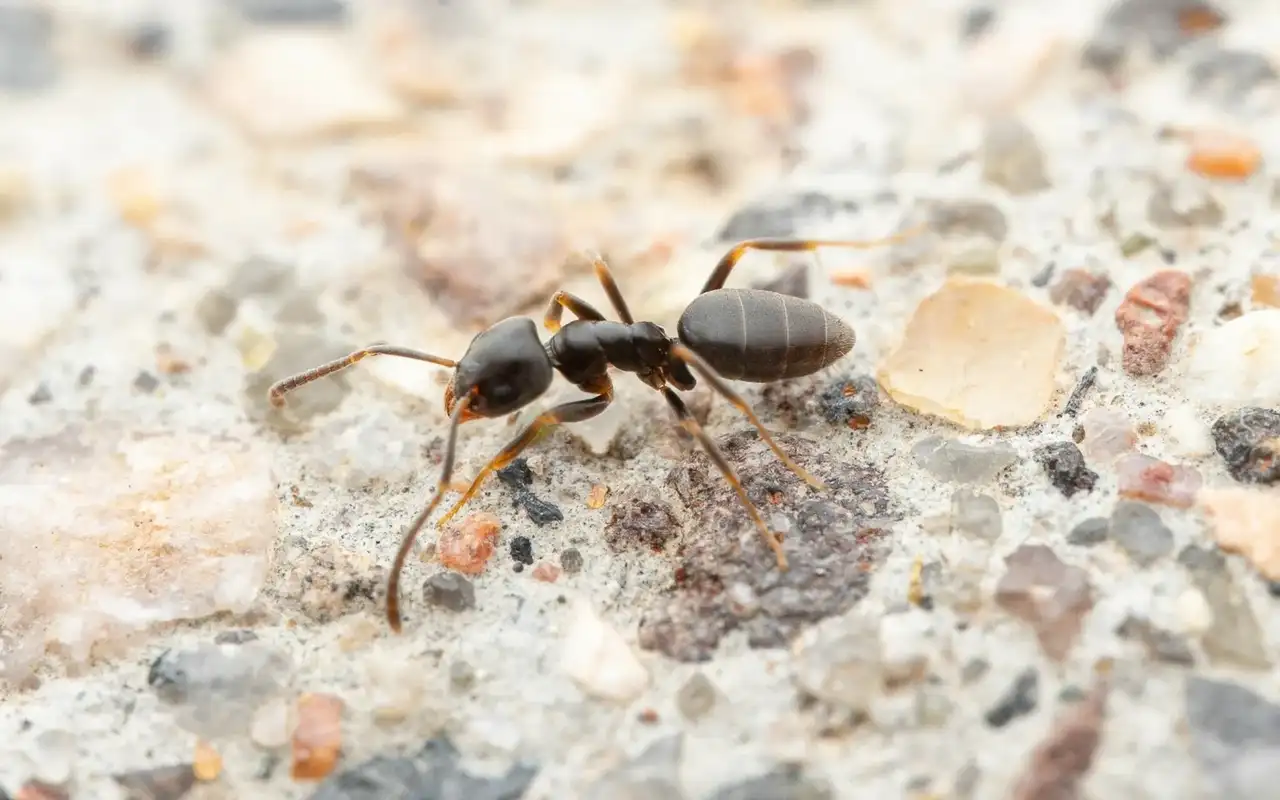
Tapinoma sessile · odorous house ant, one uniform worker size
What Do House Ants Look Like?
The common indoor invaders here are odorous house ants, which smell faintly of coconut when crushed, pavement ants, which trail from expansion joints, and acrobat ants, which raise the abdomen over the body when disturbed. All are small and uniformly sized, unlike fire ants.
HOW TO SPOT IT
SAFETY
Are House Ants Dangerous?
No real health risk. They contaminate food and they are relentlessly annoying, but they do not sting like fire ants and they do not damage structures like carpenter ants can.

Unsealed weep holes are one of the direct routes in.
Why Is My Yard Full of House Ants?
Water, food and a way in. Rain floods outdoor nests and pushes colonies toward the dry, warm slab. Mulch piled against the foundation, tree limbs touching the roof and unsealed weep holes all give direct routes inside.
Eric laying the foundation band, the barrier house ants have to cross to get inside.
How Do You Get Rid of House Ants?
Treat from the outside in. A foundation barrier plus a granular ring in the beds hits the colony where it lives, and sealing the entry points closes the route. Interior spray on the trail is the least useful thing you can do, because the ants you can see are a tiny fraction of the colony.
THE SERVICE THAT TREATS THIS
Home Defender Plan
Foundation barrier, granular bed ring and weep-hole dusting, from $30 a month.