
CANOPY TOWN
Why mature suburbs bite worse than new ones
Because a mosquito's problem in Texas is surviving the day, not finding you at night. Watauga filled in through the 1970s and 80s, and the trees that came with those yards now hold enough shade to keep soil damp and air still underneath them, which is the one thing a new subdivision with young trees and open Bermuda cannot offer. Give adults that shelter and they last until dusk; take it away and most of them do not.
That is why the fogger goes up into the foliage rather than across the lawn. On a typical Watauga lot the targets are the hedge line, the beds against the brick, the deck skirting and the north side of the house, and they get worked every 21 days from April through September. The same stop treats turf and bed edges for fleas and ticks, which is a different pest in a different place.
COST PER VISIT
What Watauga homeowners are quoted
Most of the city lands between $49.95 and $69.95 a visit. Lot square footage is the whole calculation, so the price does not move for a big tree count, an existing infestation or how close the greenbelt behind you sits, and a smaller house on a generous lot can sit a band above a larger house on a tight one.
You are billed per treatment, never for a summer up front, and no contract, startup fee or cancellation fee exists on the program. Should a fog not carry the full three weeks, the return visit is included. Run a Watauga address through /instant-quote and the number comes back on the spot.
Lots of 7,000 sq ft or less
$49.95 a visit
The tighter 1970s blocks
Lots from 7,001 to 12,000 sq ft
$59.95 a visit
Where most of Watauga sits
Lots from 12,001 to 17,000 sq ft
$69.95 a visit
Larger lots and deeper back yards
Every number on this page comes from our published price list. Watauga homes get the same table as everyone else; the instant quote reads your square footage and lot size and hands you your own line.
BEFORE YOU BUY
The three complaints we hear most
The first is that they came back. They do, after about 21 days at peak and sooner behind a storm, which is why the interval is what it is and why a treatment that fails early is redone at no cost. Nothing on the market holds a Texas yard for a month in July, and a longer promised interval is a scheduling decision rather than a stronger product.
The second is the neighbors. Adults cross a fence without noticing it, so a treated Watauga yard between two untreated ones still gets visitors. The barrier is about ending the residency, not building a wall, and the difference shows up most in how the patio feels at dusk rather than in a count of zero.
The third is water nobody claimed. A clogged gutter over a shaded corner, a bird bath topped up and never scrubbed, a saucer under a pot, a kid's wading pool left half full: each of those makes more mosquitoes in a week than the fence line does. We flag them on every visit, and larvicide goes into what cannot be drained.
SCREEN IT OR TREAT IT
A screened porch against a season of visits
A screened porch is a fair alternative and we will say so. It works every evening without anybody scheduling anything, it never washes off in a storm, and once it is built the running cost is nothing. What it costs is a construction project, and what it protects is the porch: step into the yard to throw a ball or run the grill and you are back in the mosquitoes.
The seasonal program is the other trade. It costs less to start, it covers the whole yard rather than one room, and it stops in September when the season does, but it needs re-applying every three weeks and it never gets a Watauga yard to zero. Households that mostly sit in one spot often do better with the screen; households with dogs and children using the whole lawn do better with the fog.
THE FIRST VISIT
What the technician looks at before treating
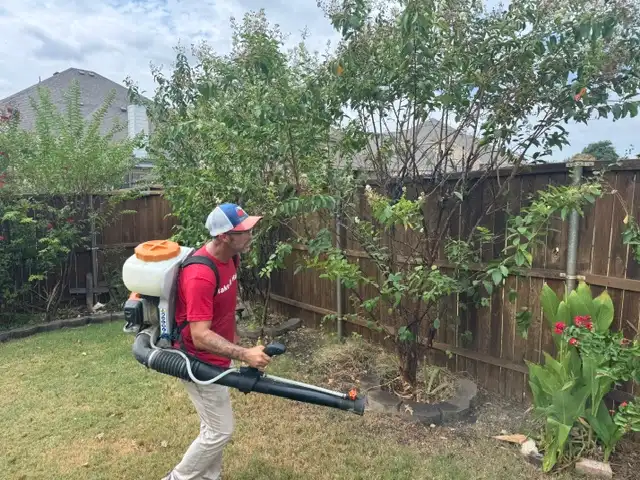
Reading the daytime cover
The first pass is an inspection: which side of the house holds shade all afternoon, how deep the foundation beds run, whether the fence line is overgrown, where the canopy is thickest. Adults occupy a small fraction of any yard, and the point is to find that fraction.
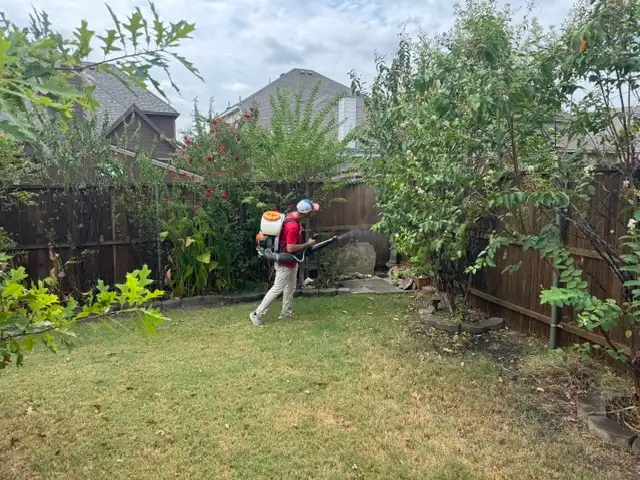
Fogging foliage and edges
Then the backpack fogger goes through ornamentals, hedges, bed interiors and shaded structures, with a separate treatment along turf and bed edges for fleas and ticks. Sunny open lawn takes very little, deliberately, because it is empty in daylight.

The standing water list
Last comes a walk-through of everything on the property holding rain, and you get told plainly which ones matter. Water that cannot be drained, such as a low spot or a French drain that holds, gets larvicide. Gate access is enough; you do not need to be home.