
GREENBELT AND MULCH
Where chiggers come from on a Bedford lot
Bedford was built out between the 1960s and the 90s, so the trees are tall, the beds are deep and irrigated, and Bear Creek and its greenbelts run right through town. Lots that back onto the creek corridor get the heaviest chigger pressure, because the unmowed grass and leaf litter on the greenbelt side of the fence is a breeding ground all summer.
Interior lots are not exempt. Thirty years of landscaping tight against the house means shrub beds with deep mulch that never dries, and chiggers live at the soil surface under that mulch just as happily as under leaves. A Bedford homeowner who gets a ring of bites at the sock line after weeding the front bed is finding out where they were hiding.
BEDFORD, BY THE NUMBERS
How much chigger control costs on a Bedford home
Chiggers are handled by the yard treatment on Complete Home & Lawn Defense, which for the 1,500-to-3,000-square-foot homes that make up most of Bedford costs $40 to $51.50 a month. The larger two-stories from the 80s and 90s fall in the $51.50-to-$62 band. That covers the whole lawn on every visit, all year, with the plan running month to month and nothing charged to leave it.
Home Defender is $30 to $54 a month for a 25-foot ring around the foundation. On a Bedford lot where the chigger habitat is the mulch bed against the house, that ring actually covers it; on a lot where the habitat is a greenbelt fence 50 feet back, it does not. Which side of Airport Freeway you live on, 76021 or 76022, has no bearing on either price.
1,500 to 3,000 sq ft
$40 to $51.50 a month
Most of Bedford's 1960s-to-80s housing
3,000 to 4,500 sq ft
$51.50 to $62 a month
Larger 90s two-stories
Home Defender, 1,500 to 3,000 sq ft
$33 to $38 a month
Ring reaches the beds, not the greenbelt fence
Every number on this page comes from our published price list. Bedford homes get the same table as everyone else; the instant quote reads your square footage and lot size and hands you your own line.
THE UNCOMFORTABLE PART
What chigger treatment in Bedford will not accomplish
Nothing we apply reaches under four inches of mulch or a bed of last fall's leaves, and Bedford yards have plenty of both. Pulling mulch back from the slab and raking litter out from under the shrubs before the visit is the homeowner's half of the job, and skipping it means treating the top of the problem while the larvae carry on underneath.
The greenbelt stays as it is. Bear Creek and the city land along it are not ours to treat, so a lot on the corridor will keep receiving larvae from that side no matter how well your own yard is handled. What the treatment does is cut the population living in your grass, which is the population doing most of the biting.
Chigger coverage is also a summer benefit inside a year-round plan. From May into August the yard treatment is working on chiggers; the rest of the year the same visits are dealing with ants, spiders, scorpions in the layered landscaping and the weep holes on 1970s brick. If you only want a chigger spray in July, that is not something we sell.
BED OR FENCE
Does a Bedford homeowner need the whole yard treated, or just the ring?
It depends on where your chiggers are. If the bites happen when you are working in the beds by the house or sitting on the patio, the habitat is within 25 feet of the foundation and Home Defender's ring covers it for $30 to $54 a month, with fire ants and the weep-hole dusting thrown in.
If the bites come from the back of the lot where the fence meets the Bear Creek greenbelt, the ring stops far short and only the whole-yard plan treats that line. For the roughly $10 to $16 a month between the two plans on a typical Bedford house, that boundary is the reason to upgrade. In both cases, pulling the mulch back and mowing the fence line short first is free and does real work.
WHAT THE FIRST VISIT COVERS
A first chigger visit on a Bedford property, step by step

Beds, mulch depth and what touches the wall
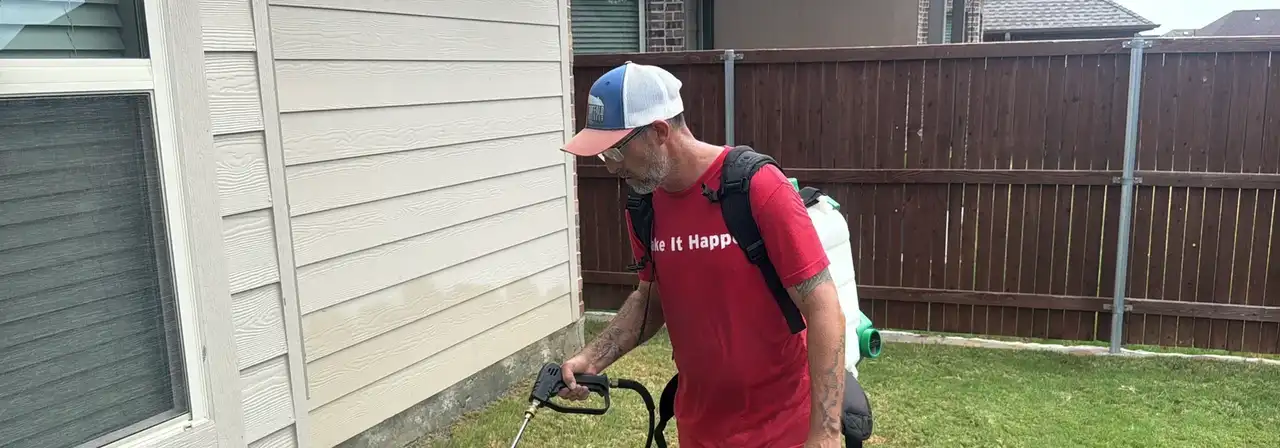
The technician starts at the landscaping, checking how deep the mulch is, which shrubs sit against the brick and where the sprinklers keep the soil wet. Those are the chigger spots on an interior lot.
The greenbelt boundary
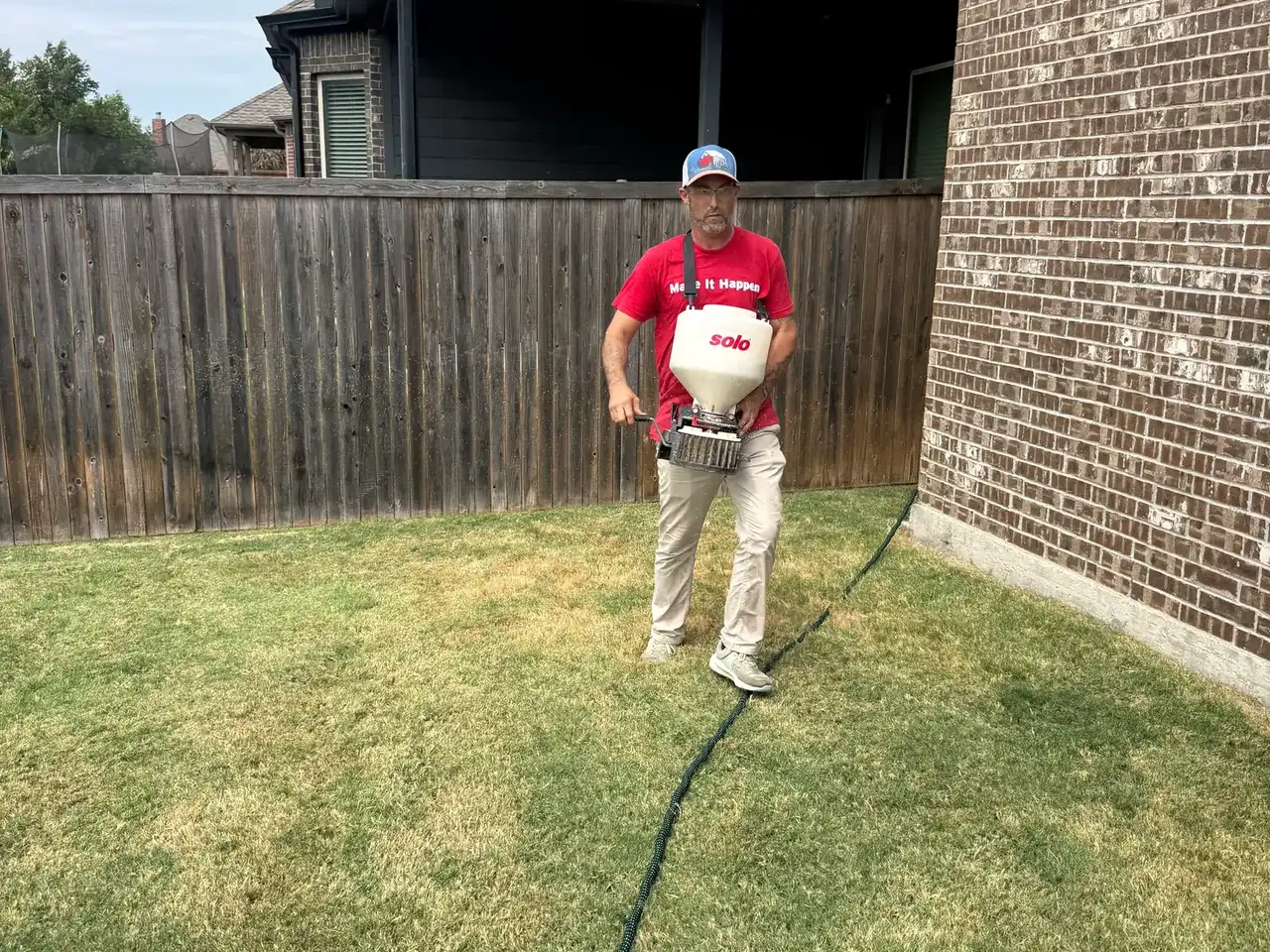
If the lot backs onto Bear Creek or a greenbelt, the back fence gets walked and treated as the main line, with the rest of the lawn covered after. That edge is where larvae cross, so it gets the heaviest application.
A three-foot band at every door
Front door, garage, patio slider and any side gate all get a treated band so chiggers picked up in the yard are not walked onto the carpet. Both Bedford ZIPs, north and south of Airport Freeway, get the identical visit.