MATURE LANDSCAPING
Why a tidy Bedford yard still produces spiders and scorpions
Because tidy and dry are not the same thing. Bedford went up largely between the 1960s and the 90s, and decades of layered landscaping have left irrigated beds, deep mulch and shrubs pressed against the brick on a great many houses. That is a shaded, damp, covered route from the yard to the foundation, and crickets, pillbugs, millipedes and roaches use it. Spiders and scorpions come for them.
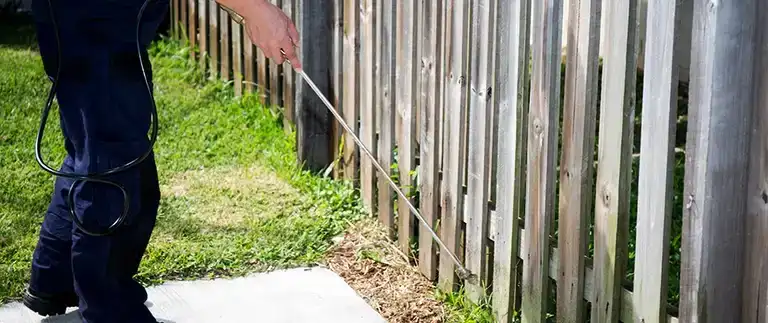
A perimeter plan interrupts that traffic rather than chasing what has already arrived in the kitchen. Home Defender puts a liquid band around the full foundation and three feet up the wall, sweeps eaves, soffits and door frames with a web pole, dusts every weep hole with Delta Dust and broadcasts granular product about 25 feet into turf and beds, four times a year, fire ant bait included.
BEDFORD BY SQUARE FOOT
The monthly number, north or south of the freeway
It is the same table on both sides of Airport Freeway, and it is read off the house. Housing in 76021 and 76022 is mostly mid-size, so most of this town lands in the two middle bands: $33 to $38 a month between 1,500 and 3,000 square feet, $38 to $46 between 3,000 and 4,500. Smaller homes are $30, and larger ones run $46 to $54.
The upgrade to Complete Home & Lawn Defense treats the whole lot rather than the ring, at $40 to $51.50 for a mid-size Bedford house and $51.50 to $62 for a larger one. There is no contract on either plan and no fee to start or to stop, retreatment between the four visits is free, and one interior treatment is in the price if you need it.
1,500 to 3,000 sq ft
$33 to $38 a month
The most common size in 76021 and 76022
3,000 to 4,500 sq ft
$38 to $46 a month
Larger two-stories through both ZIPs
Whole yard, 1,500 to 3,000
$40 to $51.50 a month
Complete Home & Lawn Defense on a mid-size house
Copper-mesh sealing
Quoted add-on
Closes the weep holes; the dusting is what is included
Every number on this page comes from our published price list. Bedford homes get the same table as everyone else; the instant quote reads your square footage and lot size and hands you your own line.
READ THIS BEFORE BUYING
The parts of your Bedford problem this will not solve
Mosquitoes are not in it. Between the Bear Creek corridor, the greenbelts and thirty years of irrigation, this is a town with steady summer mosquito pressure, and a barrier at the wall is irrelevant to an insect that flies. That is the separate 21-day program from April through September, priced per visit on the size of your lot.
It will also not overrule your sprinklers. If irrigation keeps the slab wet and mulch is banked six inches above the brick line, you have built ideal harborage and the band is working uphill. We will tell you what to pull back on the first visit, and that advice is genuinely half the result.
Older Bedford brick keeps its gaps unless someone closes them. Delta Dust in the weep holes comes with every visit and handles a lot, but the openings stay open, and copper mesh is quoted as an add-on. Scratching inside a wall is not this plan either; rodent control is $25 a month alongside a year-round plan and starts with exclusion.
GARDENING OR TREATMENT
Could you fix this with a shovel instead of a plan?
Partly, and we would rather say so. Pulling mulch back off the slab, cutting shrubs away from the brick, fixing a door sweep and adjusting the sprinkler heads that soak the foundation will noticeably reduce what reaches the wall of a Bedford house, and none of it costs a monthly fee. If your problem is mild and your landscaping is the cause, start there.
What it will not do is remove the population. Cultural fixes make the house less attractive; the treatment lowers the number of insects available to be attracted in the first place, and the eave sweep, the labeled foundation band and the broadcast fire ant bait have no homeowner equivalent that lasts. The two together are why this works, which is why the first visit includes the advice as well as the application.
DAY ONE IN BEDFORD
What the technician inspects before treating
Mulch depth and what touches the brick
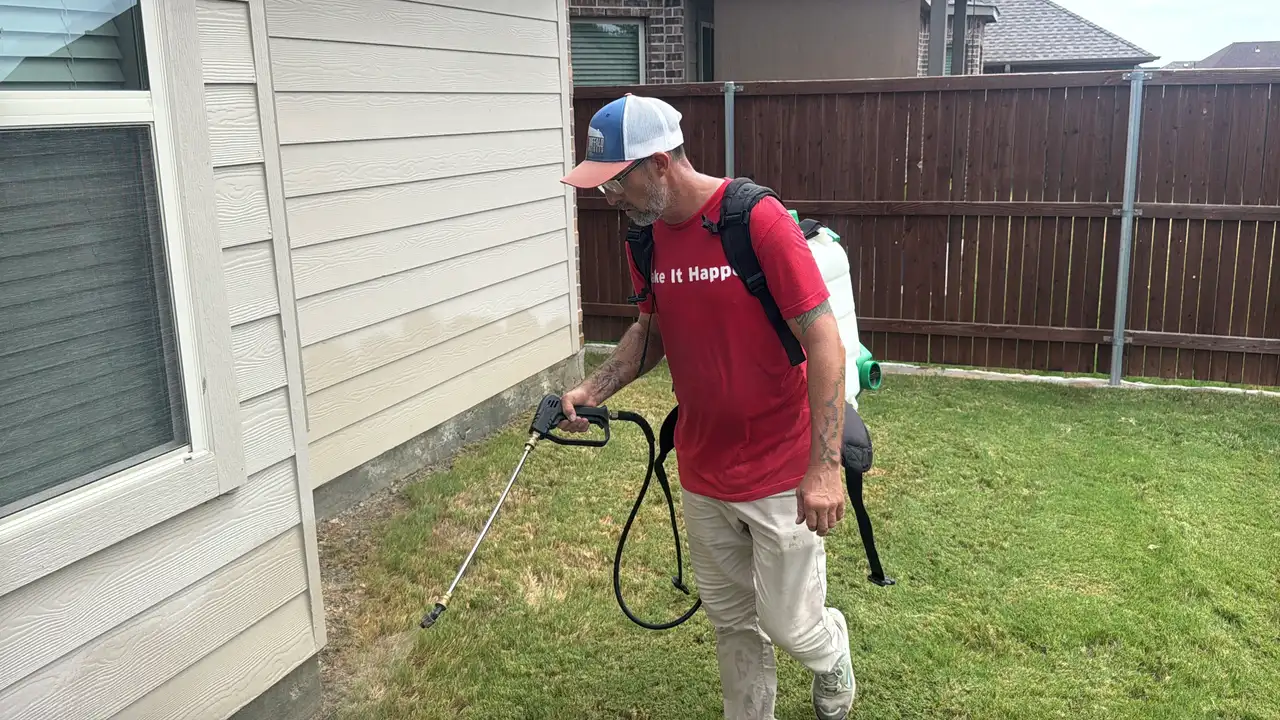
The walk starts at the slab line, looking at how high the mulch sits, which shrubs are resting on the wall and where sprinkler spray keeps the brick damp. That is the survey that usually explains a years-long ant or scorpion habit in a house of this age.

The bottom course and the eaves
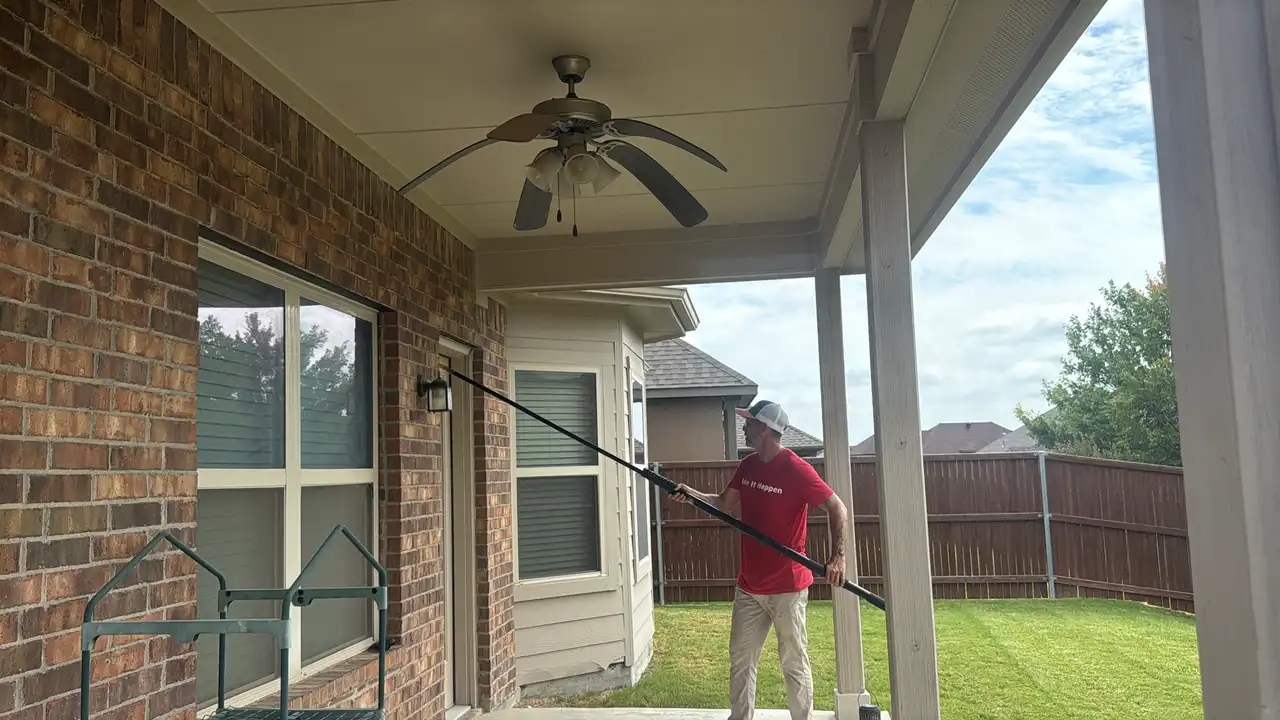
Every weep hole takes Delta Dust and the liquid band goes on around the whole foundation and three feet up. The web pole then clears eaves, soffits, porch ceilings and door frames, which under Bedford's mature trees is what stops spiders and wasps rebuilding in the same spots.
The back boundary
On lots that run to a greenbelt or the Bear Creek corridor, the rear line gets the granular barrier laid heavily, because that is where the pressure enters. The ring reaches about 25 feet from the house, so we will tell you if the whole-yard plan fits your lot better.