NEW SOIL, NEW COLONIES
Why a brand-new yard has more mounds than a fifty-year-old one
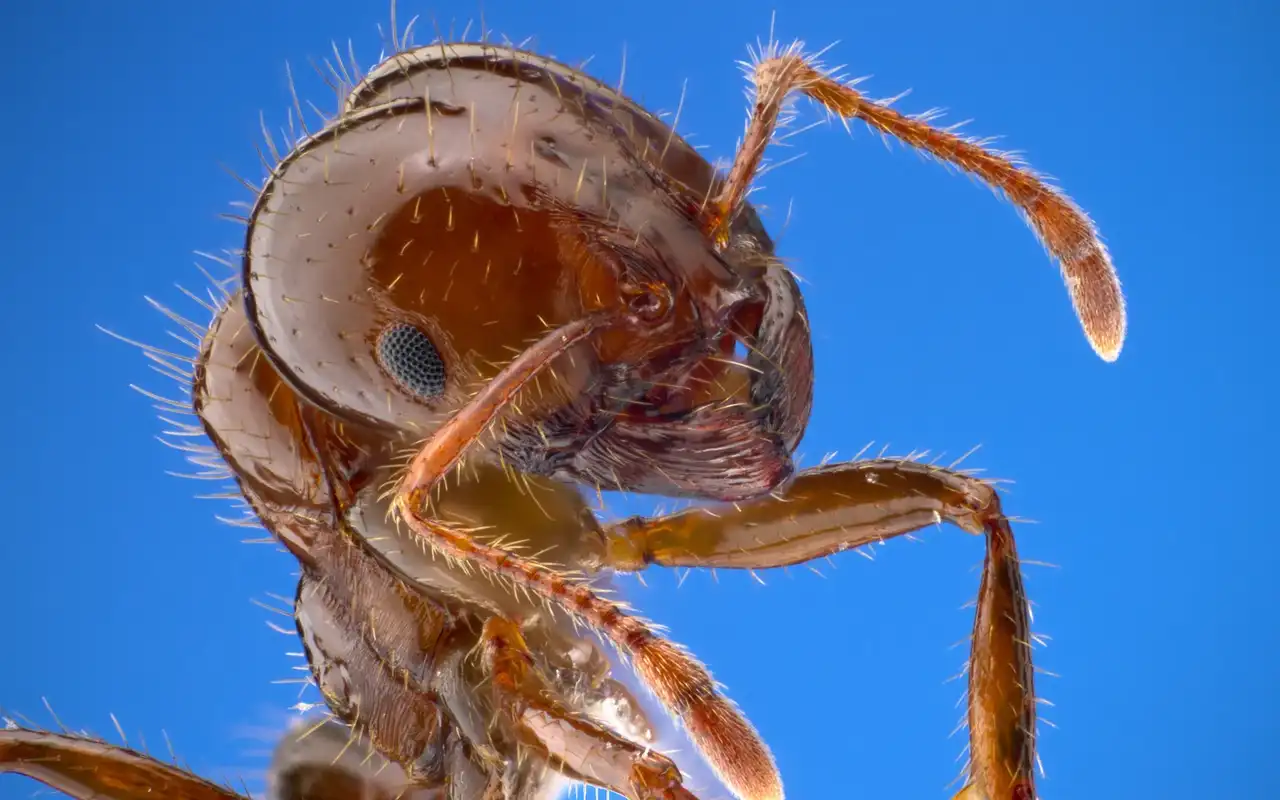
Because the competition was bulldozed. A mature yard holds a whole community of ant species occupying the ground and fighting over the same food, and fire ants have to break into that. Grade a subdivision and all of it goes, and the first species onto bare soil takes the entire site. In Northlake, where Pecan Square, the Harvest side and the streets along TX-114 and I-35W were open ground recently, that species is almost always the fire ant.
It is a stage rather than a permanent condition. Over a decade or so the soil community rebuilds and mound counts fall toward what an older town sees. The trouble is that the decade overlaps with the years your children are small, which is why we treat a new Northlake yard on the assumption that fire ants are coming instead of waiting for proof.
WHAT NORTHLAKE PAYS
Fire ants ride along with the plan
There is no fire ant invoice. Broadcast bait is part of Home Defender and part of Complete Home & Lawn Defense, and both are priced on the square footage of the house. New builds here are typically 3,000 to 4,500 square feet, which is $38 to $46 a month on Home Defender, and the larger ones at 4,500 to 6,000 come to $46 to $54.
The whole-yard plan over those two sizes is $51.50 to $62 and $62 to $73.50, adding turf treatment for the grubs and chinch bugs that young builder lawns are prone to. Both plans run month to month with nothing to sign, no fee to start and nothing charged for stopping.
3,000 to 4,500 sq ft
$38–$46/mo
The standard new build here
4,500 to 6,000 sq ft
$46–$54/mo
The larger Pecan Square homes
Same sizes, whole yard
$51.50–$73.50/mo
Complete Home & Lawn Defense
Every number on this page comes from our published price list. Northlake homes get the same table as everyone else; the instant quote reads your square footage and lot size and hands you your own line.
HONEST DRAWBACKS
Three things a Northlake homeowner should hear first
The first year will not be clean. On graded ground there are more colonies than the visible mounds suggest, and clearing them takes a full cycle of treatments rather than one spring application. Expect improvement you can measure rather than a yard that is finished.
Bait is weather-dependent in a way sprays are not. It has to sit dry for roughly a day while foragers collect it, so a wet spring pushes dates around, and we will move an appointment rather than waste the application on soaked ground.
And the lot next door is not our customer. Streets still under construction have raw ground on every side, so queens keep arriving from active build sites. Anything that appears between your scheduled visits is re-treated at no charge, which on a street like that is not a small promise.
BAIT BEFORE OR AFTER
Treat now, or wait until you actually see mounds?
On a new build, now. Early spring bait costs the same as July bait and does considerably more, because it takes out queens before the colonies have spent a season growing. Waiting until the yard is unusable buys you the same product, the same two to three week wait, and a far bigger population to work through.
The case for waiting only holds on settled ground, where a yard might genuinely produce nothing at all for a year. That is not what this ground is. If your street was pasture five years ago, treating on a schedule rather than on a sighting is the cheaper of the two choices by some distance.
NEW BUILD FIRST VISIT
What we check on a Northlake lot
The age of the build
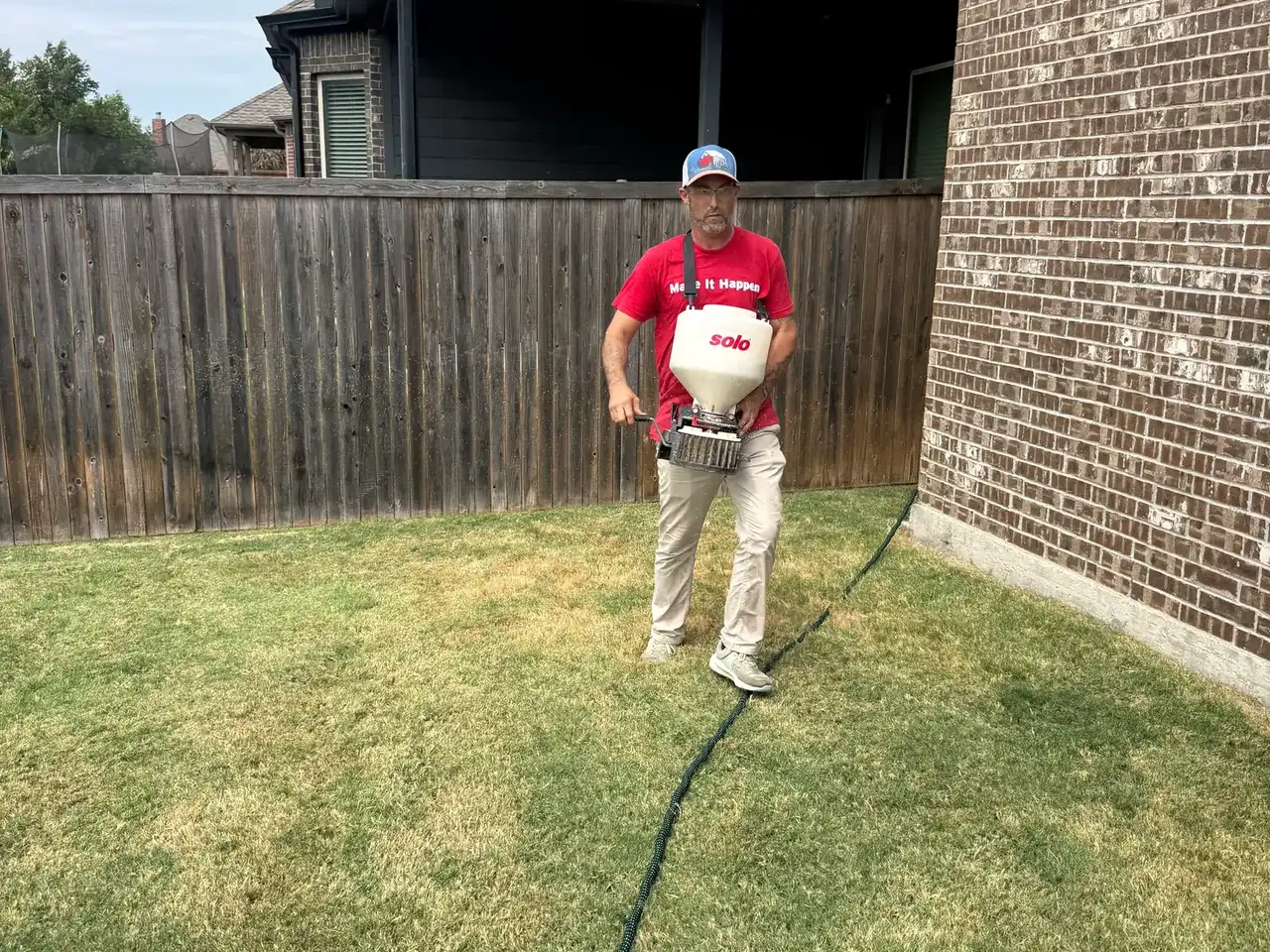
We ask when the house was finished and when the yard was sodded, because under about five years means fire ants and chinch bugs are the likely story and the visit gets weighted that way. Older than that and the emphasis shifts toward ordinary perimeter pests.
What sits behind the fence
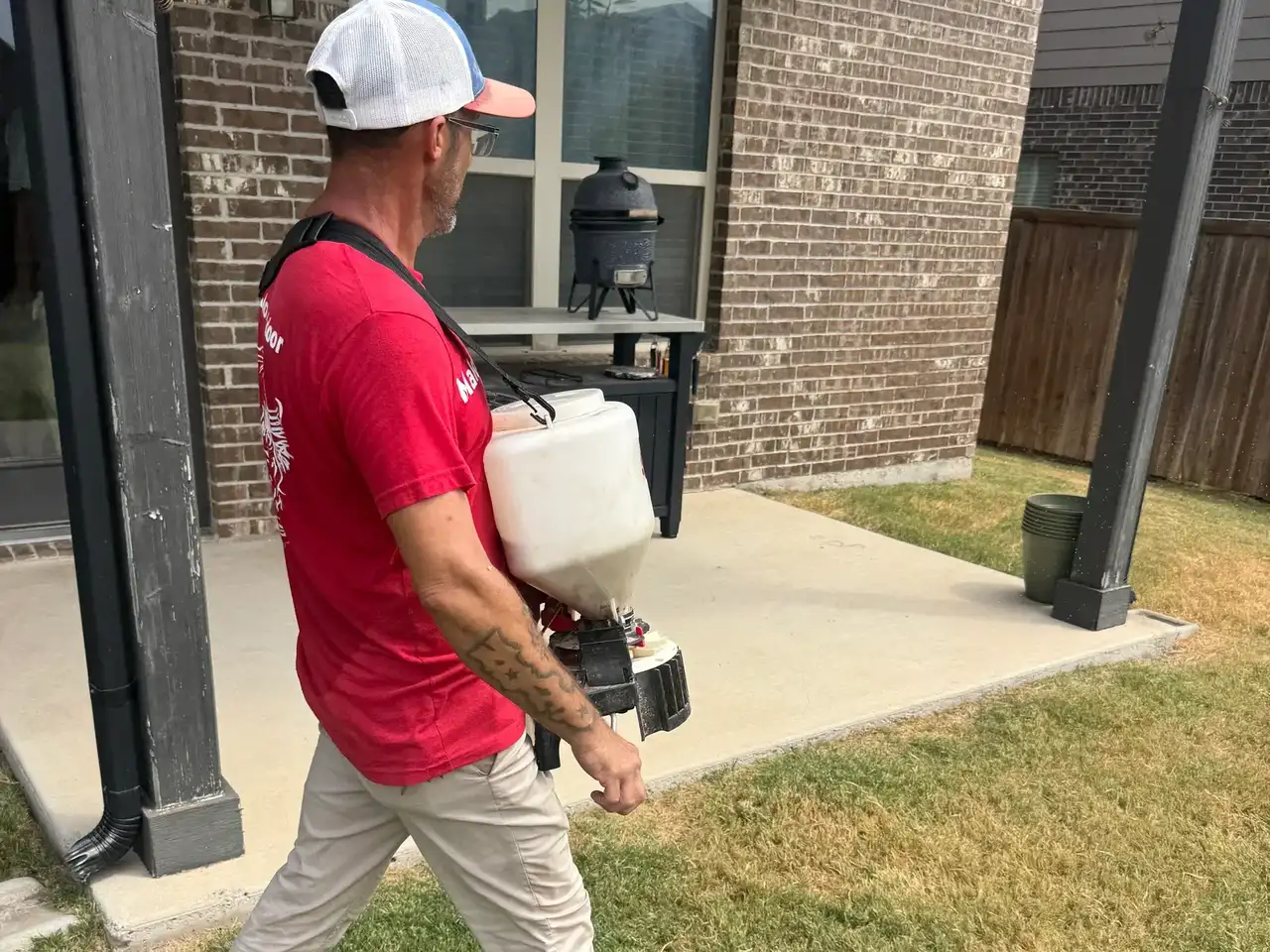
A lot backing another finished street is a different job from one backing a field or an active construction site. Open ground behind you means a boundary that needs treating rather than just a band around the foundation.
Bait everywhere, dust the new brick
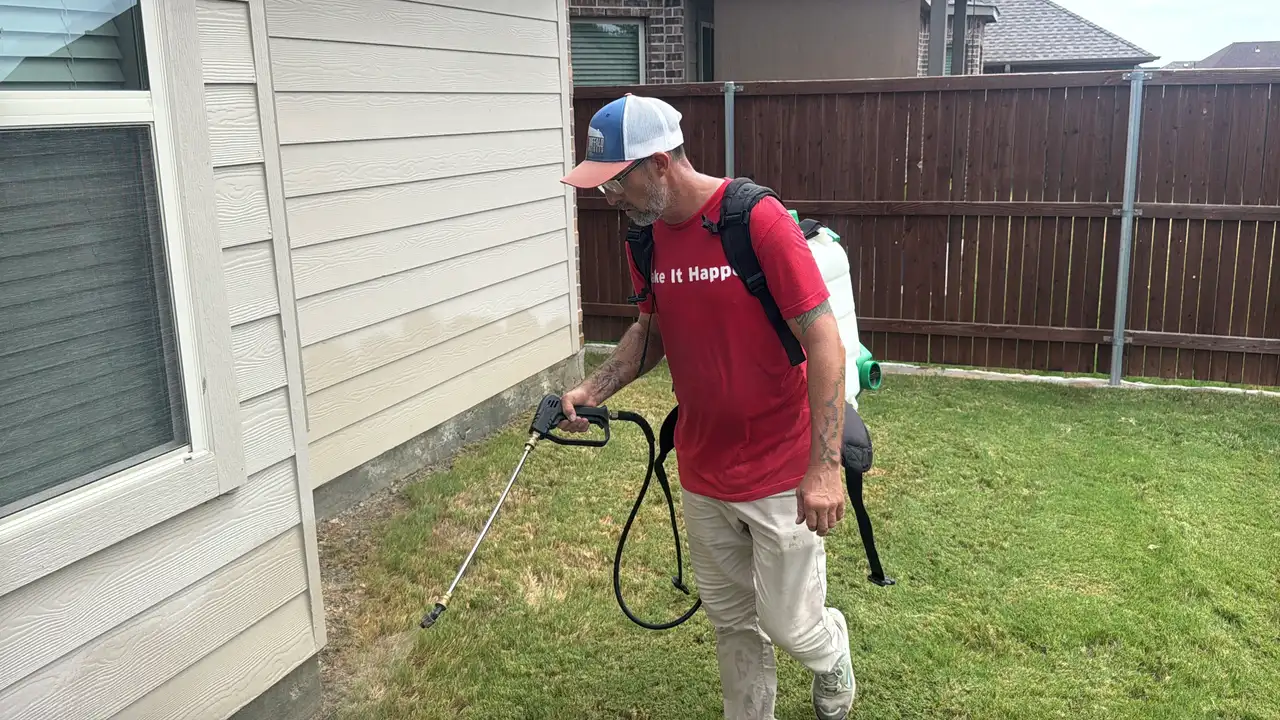
The spreader covers the whole lawn, and then Delta Dust goes into weep holes that on a new house sit wide open along the bottom course. They get copper mesh packed into them as well, sealed for good and covered by the plan, which is unusual enough in this market to be worth saying.