ACRE OF EDGE
What a Colleyville lot gives mosquitoes that a subdivision does not
Space, shade and water, which is the complete list of what they need. The large lots that define Colleyville come with long boundaries, and a boundary is where the untended growth is; the tree cover holds humidity over the ground all summer; and Big Bear Creek and Little Bear Creek run through town supplying the water that keeps production going after the rain stops.
So the pressure here is not evenly spread. A house on an interior street with open turf is a different job from one whose back fence meets a creek corridor, and the second will be biting in March when the first is still quiet. Visits land every 21 days from April through September, and on a property this size the far corners matter as much as the pool deck.
BIG LOT, BIG BAND
Why the quote here sits high on our table
Because it is priced on the lot, and Colleyville lots are large. Half an acre is $89.95 a visit, three quarters lands at $99.95, and once a property passes roughly 47,000 square feet the bands stop and we quote the address on what is actually there. The square footage of the house does not enter into it at any point.
It is a per-visit charge, so nothing is collected up front for a summer you have not had yet, and no contract keeps you signed up past the month you stop enjoying it. Retreatment between scheduled visits carries no charge. For a Colleyville address, /instant-quote will give the number before you talk to anybody.
Lots from 22,001 to 27,000 sq ft
$89.95 a visit
About half an acre
Lots from 27,001 to 32,000 sq ft
$99.95 a visit
Common on the creek side
Lots from 42,001 to 47,000 sq ft
$129.95 a visit
Just under an acre
Over 47,000 sq ft
Quoted for the property
Where the published bands end
Every number on this page comes from our published price list. Colleyville homes get the same table as everyone else; the instant quote reads your square footage and lot size and hands you your own line.
SETTING THE CEILING
What we will not claim about a creek-side yard
That we can empty it. A creek corridor is a permanent breeding source on public ground, adults fly well beyond a property line, and a Colleyville yard backing Big Bear Creek will always receive some traffic no matter who treats it or how often. The barrier takes your own acre out of the supply, and on a lot this size that is a substantial share of what is biting you.
The second thing we will not claim is that one fog covers the property forever. Peak-season product runs down in about three weeks, faster if a storm arrives the same night, and the 21-day interval exists because that is the honest number. Anything that comes back before the next visit gets treated again at no cost, which is easier than pretending it will not happen.
The third is irrigation. Heavily watered beds on a big landscape keep soil damp enough to support mosquitoes all summer, and no application changes that. Cutting the run time on the zones that stay soggy will do more for the back half of your yard than an extra visit would.
DRAIN IT OR FOG IT
Drainage work versus another season of treatment
On a large irrigated property, standing water is often the cheaper thing to fix. French drains that hold, a low spot in the turf that never dries, a water feature that has stopped circulating and gutters choked by heavy canopy all breed continuously, and correcting them removes the source rather than the adults. We larvicide what we cannot drain, but larvicide is a patch over a drainage problem, not a cure for it.
What drainage work cannot do is touch the creek, the neighbors, or the adults already resting in your ornamentals today. Treat the standing water as the permanent job and the 21-day fog as the seasonal one; a Colleyville homeowner who does both usually needs less of us than one who only buys visits and keeps the sprinklers running long.
THE FIRST COLLEYVILLE CALL
How a big-lot first appointment actually runs
Mapping what stays untreated
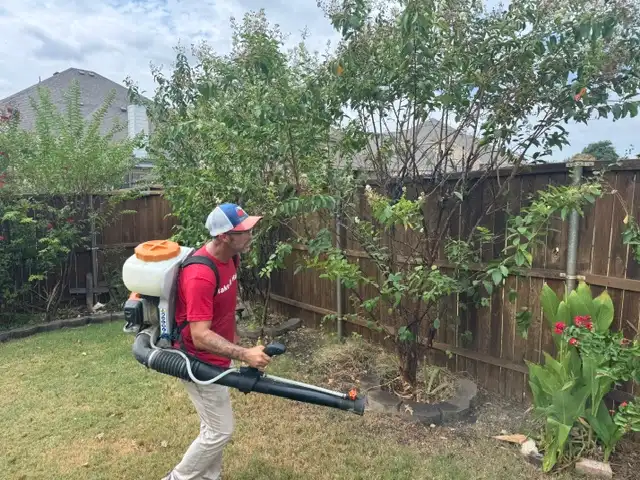
Before anything is applied we ask about pollinator beds, hives, koi ponds, vegetable plots and anything blooming that you care about, and those go on the map as no-spray. On a big landscaped lot that conversation saves a lot of grief later.
Fogging the depth of the beds
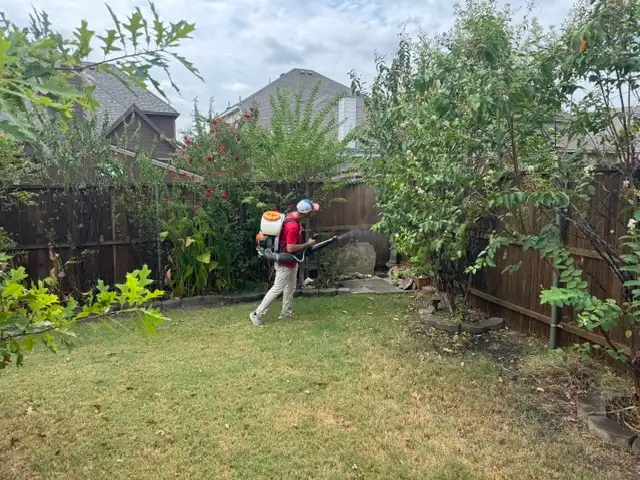
A backpack fogger works into the ornamental trees, hedge runs, deep shrub beds and the shaded structures, not across the lawn, because the lawn is empty in daylight. Turf and bed edges take a separate pass aimed at fleas and ticks for the dogs.

Walking the back boundary
The far fence gets time on the first visit, especially where the property meets a creek corridor or a greenbelt. That strip is the source, and how thoroughly it is treated decides how the rest of the summer feels on the patio.