
OLD CORE, NEW EDGES
Where chiggers turn up in Justin, and where they do not
In two places, and the newer subdivisions are neither of them. The older core off FM 156 has trees old enough to shade the ground all day and drop a bed of leaves each autumn, which is the layer chigger larvae spend the winter in. Out at the town edge, where mown grass meets pasture, the taller stuff on the far side supplies a fresh crop every summer.
The middle of a Timberbrook-style street is the quiet zone. Graded soil, young turf and no litter give larvae nothing to work with, so bites out there usually turn out to be fire ants. Welts arriving as a ring at the sock cuff and waistband several hours after you were in the grass make chiggers the right suspect.
TWO SIDES, TWO ROWS
What the two halves of Justin pay
Older core homes generally sit lower on the table than the new builds, since both year-round plans are priced on the square footage of the house. A 1,500 to 3,000 square foot home pays $40 to $51.50 a month for Complete Home & Lawn Defense, the plan that treats the whole lawn, and anything under 1,500 square feet pays a flat $40. The larger houses out toward FM 407 move up to $51.50 to $62.
Home Defender handles the foundation and 25 feet beyond it for $30 to $54 a month across the same square footage. On a compact lot in the old core that ring takes in a decent slice of the yard; on a property running back to a pasture fence it never gets near the source. Fire ant treatment comes with both, and neither asks for a contract or a startup fee.
Under 1,500 sq ft
$40 a month
Smaller homes in the older core
1,500 to 3,000 sq ft
$40 to $51.50 a month
The most common Justin band
3,000 to 4,500 sq ft
$51.50 to $62 a month
Newer builds toward FM 407
Home Defender, any size
$30 to $54 a month
Ring only, no fence-line coverage
Every number on this page comes from our published price list. Justin homes get the same table as everyone else; the instant quote reads your square footage and lot size and hands you your own line.
EXPECTATIONS, SET STRAIGHT
What to expect from this and what not to
Do not expect a treated yard to survive a bed of unraked leaves. Under the mature trees in the old core that litter is the nursery, and product applied across the top of it never reaches what lives underneath. Clearing it is the homeowner's half of this, and skipping it is the usual reason somebody decides treatment failed.
Do not expect the pasture over the fence to change, either. That ground goes on producing larvae from May into August and we have no standing to treat it, so the buffer intercepts the ones crossing into the grass you actually use. Most of the biting comes from your own side, which is what makes the buffer worth paying for.
And do not settle on chiggers as the diagnosis just because something itches. In an older Justin house with gaps at the weep holes and thresholds, ants and scorpions are the more common complaint, while bites scattered on bare arms in the evening are mosquitoes off the canopy. The pattern of the welts sorts it faster than anything else.
LEAF LITTER OR PRODUCT
A rake and a mower against a treated lawn
Habitat work is the free half and it genuinely works. Rake the litter out from under the old trees, cut the strip along the back boundary short and hold it there, and the shade and damp larvae cannot do without are gone. On a tidy interior lot in Justin that may well be the entire job.
Product handles what is already present and out of reach of a rake, which on a treed lot is most of the back half. The application crosses the lawn with its weight under the canopy and along the boundary, plus a band at each threshold so nothing is walked indoors. Do the clearing first and the treatment lasts, do neither and July will find you scratching again.
READING THE LOT FIRST
How the first appointment sizes up your property

Which Justin you live in
The age of the house and what grows around it decide the visit, because an old-core lot under heavy canopy and a two-year-old lot out on FM 407 are different jobs. That gets worked out on the walk-around before any product is mixed.
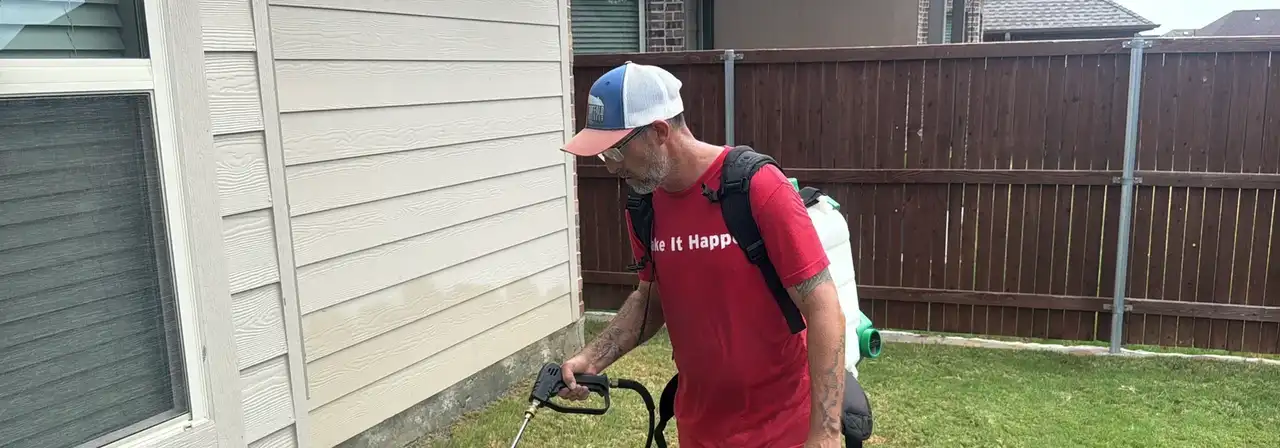
Canopy, litter and the boundary
Shaded ground, leaf beds under shrubs and the line where mowing stops all get inspected and, where they need it, flagged for clearing. Those three spots take the heaviest application once they are ready to receive it.
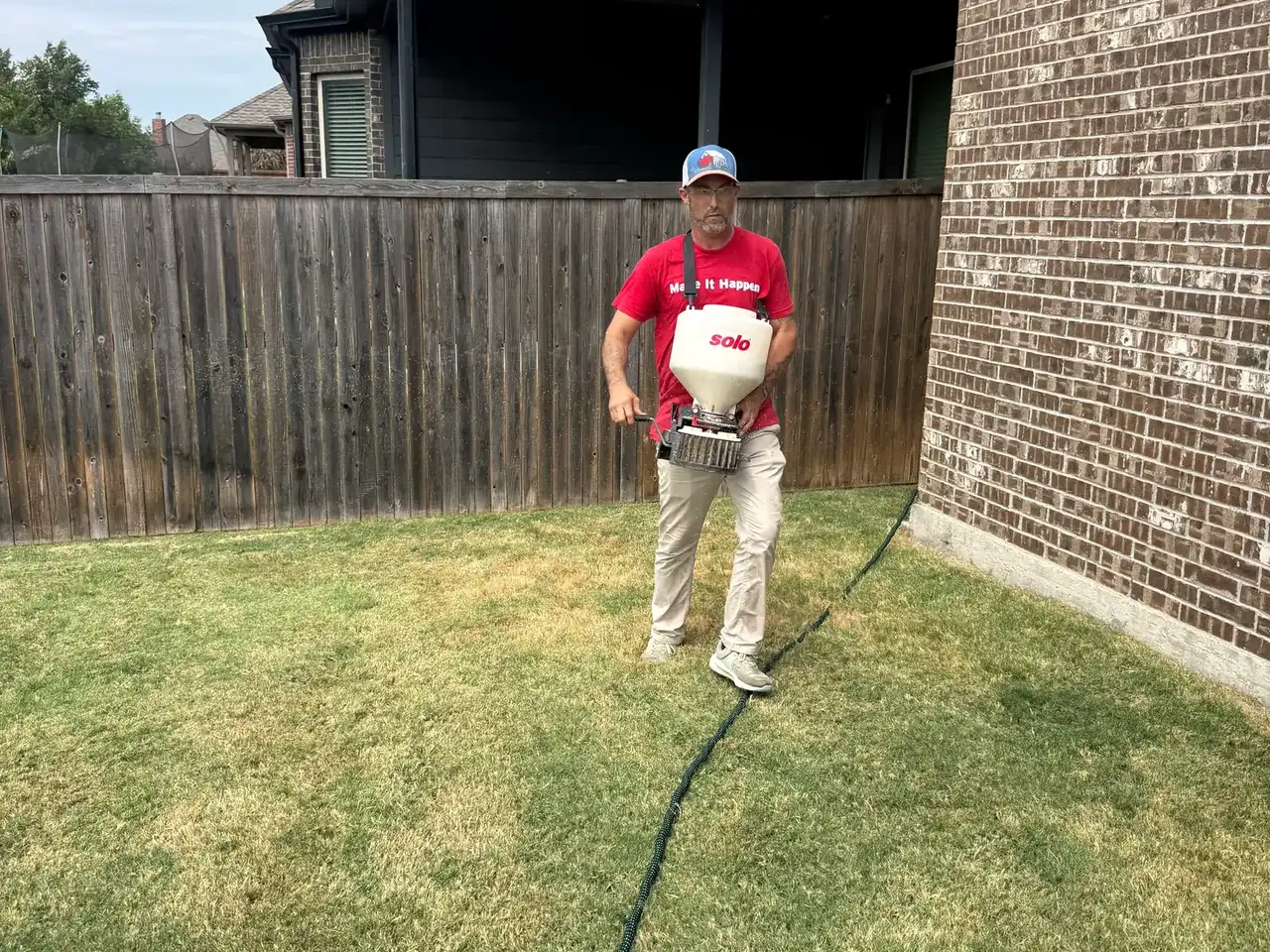
Thresholds and the brick
Every door gets a treated band so larvae are not carried across the floor, and the weep holes get Delta Dust with copper mesh sealing them for good. That sealing belongs to the plan rather than a quote, which counts for more on an older house that has had decades to open up.