A TOWN WITH TWO HALVES
Where rodents get into a Justin house
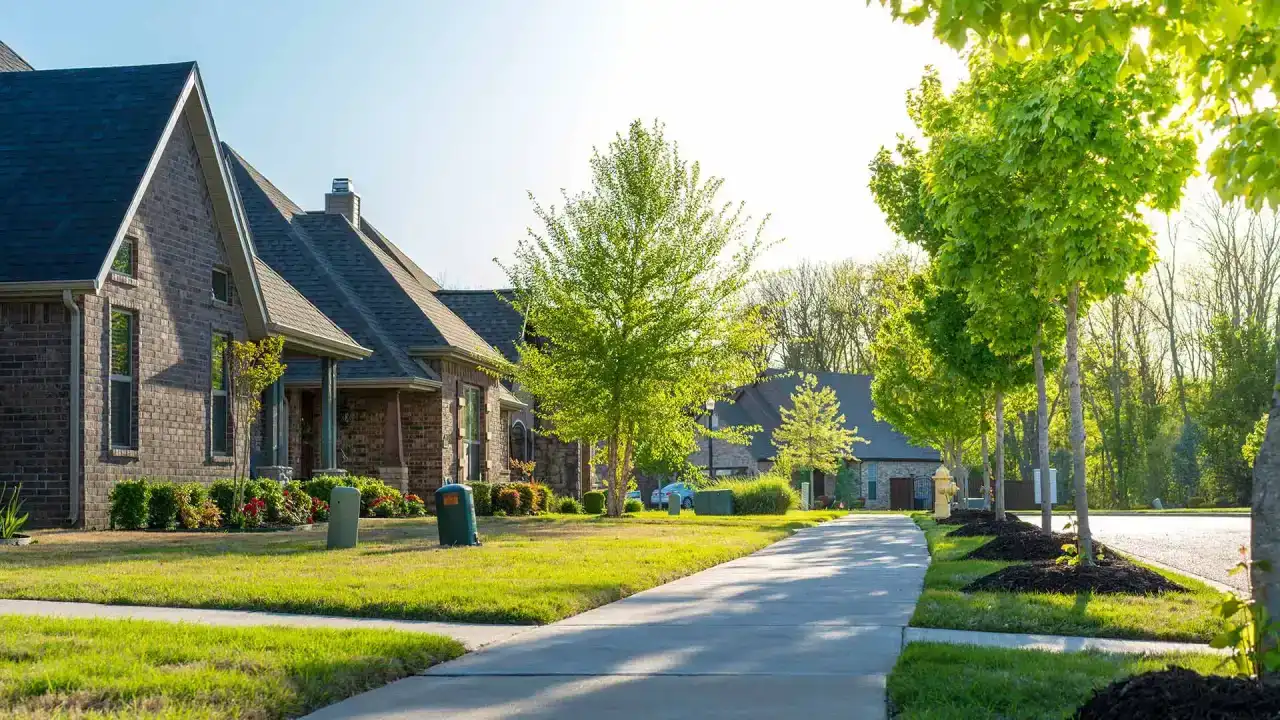
It depends entirely which Justin you live in. In the older core the housing has had decades to loosen: mortar that has cracked, a threshold worn thin, a utility penetration patched once and never revisited. Those are the classic mouse entries, low down and easy to miss from standing height.
Out toward the newer subdivisions the envelope is tight and the failures are few but predictable — the bottom corners of the garage door, the hole cut for the air conditioning line set, foam that has shrunk back from a pipe. Fewer openings, but a rodent only needs one of them.
What both halves share is the edge of town. Justin is small enough that a great many properties still back onto open ground, and that ground is where the animals testing your walls are coming from.
THE JUSTIN NUMBER
What you pay each month, and for what
The rodent side is $25 a month and it goes on top of a year-round plan, Home Defender or Complete Home & Lawn Defense. It is not sold by itself anywhere, including here, because seals that are never re-checked quietly stop working and nobody finds out until something is in the attic again.
The plan under it follows the size of the house, not the age of it. An older core house under 1,500 square feet is $30 a month for Home Defender, so $55 all in; the 1,500 to 3,000 band is $33 to $38, making $58 to $63; newer builds at 3,000 to 4,500 square feet run $38 to $46, so $63 to $71. No contract, no startup fee, and you have the number before you commit to anything.
Rodent inspection, exclusion and follow-up
$25 a month
Goes on top of either plan, never solo
Home Defender, under 1,500 sq ft
$30 a month
Smaller houses in the older core
Home Defender, 1,500 to 3,000 sq ft
$33–$38 a month
Across both sides of town
Home Defender, 3,000 to 4,500 sq ft
$38–$46 a month
The newer subdivision floor plans
Every number on this page comes from our published price list. Justin homes get the same table as everyone else; the instant quote reads your square footage and lot size and hands you your own line.
THE UNGLAMOROUS TRUTH
What the add-on leaves for you to deal with
Door hardware is yours. A worn sweep on an older Justin back door, or a garage door that no longer meets the slab, is the commonest way in and the one thing on the list we do not repair. We measure the gap, show it to you and seal everything around it.
Open ground at the town edge stays open ground. Where a property backs onto pasture or an unfinished lot, mice will be in that cover permanently, and no product changes it. The buildings are what get closed, and the yard stays a place they walk through.
Speed is the other honest limit. Sealing happens on the first visit, but trapping out what is already inside takes a couple of weeks, and anyone promising a same-day end to scratching noises is telling you what you want to hear.
OLD CORE OR NEW BUILD
Which Justin house actually needs this, and which does not
If your house dates to the older part of town and you have heard anything at all, the add-on earns its money on the inspection alone. Decades of small movements mean several likely openings rather than one, and the value is in finding the live ones rather than in the traps.
If your house is three years old with no sign of activity, be honest with yourself: you probably want the year-round plan and a garage door seal, not a rodent programme. We would rather tell you that and keep you as a customer than sell a $25 line that has nothing to do. Add it the day something shows up, and it goes on without restarting anything.
FIRST VISIT, STEP BY STEP
How we work a house in Justin
Reading the age of the wall
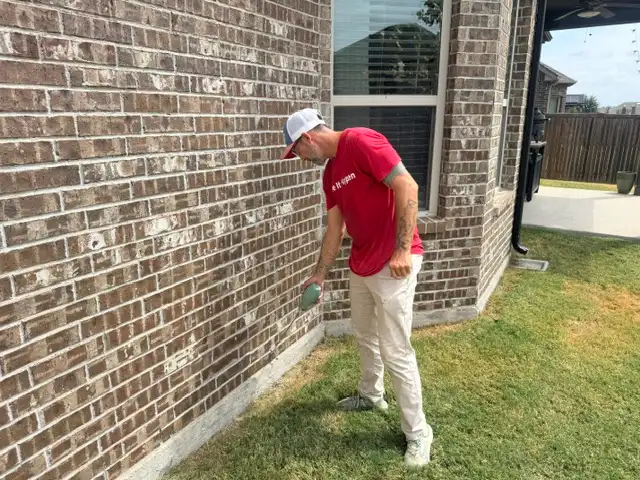
The first thing we establish is what kind of building we are dealing with, because it changes where to look. Older brick gets the bottom course, cracked mortar and worn thresholds; a newer build gets the garage corners, line set and vent penetrations. Weep holes on either are already packed with copper mesh and dusted under both year-round plans.

Where the property stops
We walk the boundary, especially where the mown yard meets open ground, looking for runs through taller grass, burrows at a fence line and droppings along a wall. That tells us which side of the house is under pressure, which is where the traps and locked stations go.
Inside, the attic and the pantry wall
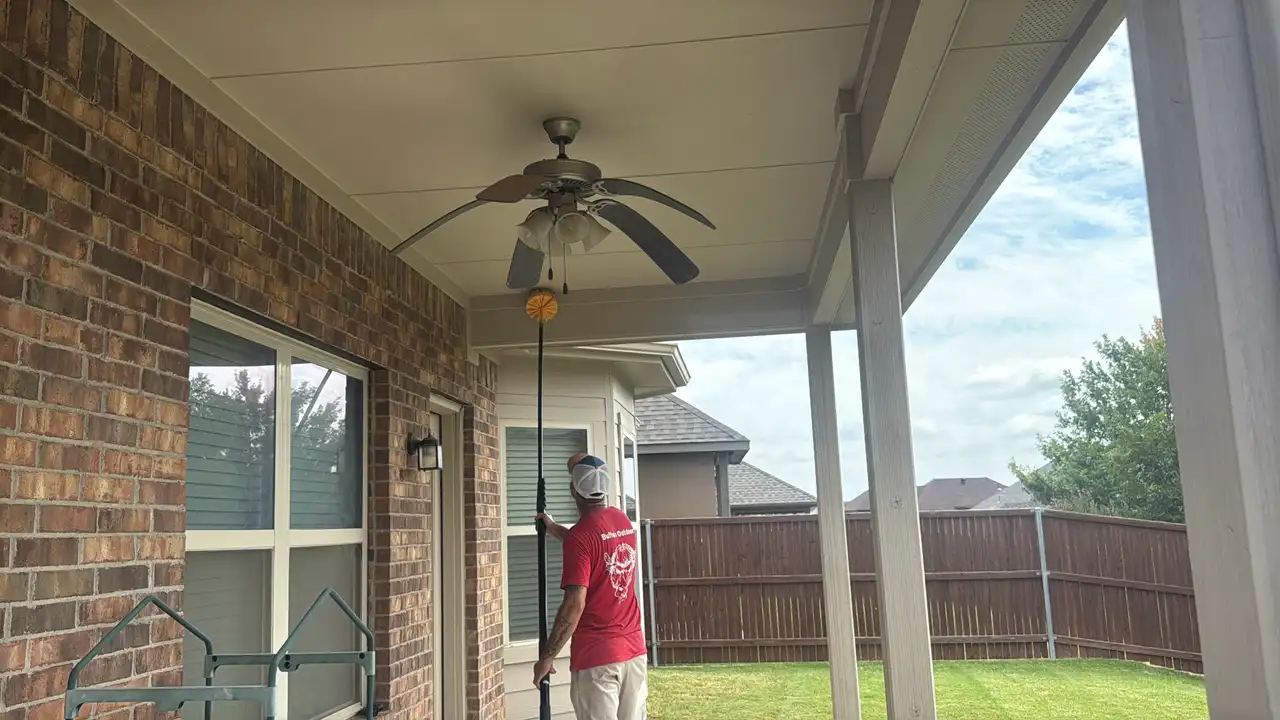
Then the accessible interior: droppings behind appliances, gnawed packaging, runways and rub marks in the attic. We set traps on the routes in use rather than in the corners that look tidy, and we book the return before leaving so the work gets checked.