
SIXTY YEARS OF CANOPY
What makes an older Richland Hills yard hold fleas
Fleas are a soil problem before they are a pet problem. Only the adults ride the animal; the eggs, larvae and pupae that make up the overwhelming bulk of the population sit in the top of the soil wherever it stays cool and damp. A city built out in the 1950s and 60s, under trees that have had all that time to close in, is full of precisely that ground.
Drainage is the other half of the story. Older storm infrastructure and established beds keep low corners of a 76118 yard from ever drying properly, and the larvae concentrate there rather than in the open middle of the lawn, which bakes far too hot for them.
Ticks take the edges instead. They climb whatever grass stands tallest along a fence or an easement and wait for something warm to pass, which is why the strip your mower cannot quite reach matters more than the open turf does.
76118 PRICES, NO GUESSING
How much for a compact city lot?
Richland Hills is compact and mostly built out, and its lots reflect that, so the majority of homes land at $49.95 or $59.95 a visit. Larger corner parcels and the deeper lots reach $69.95. Every figure follows lot square footage, and you can pull yours up at /instant-quote without speaking to anybody.
The age of the house changes nothing, because this program is priced on ground rather than on the structure. What does move a first season is how established the problem already is, since a yard that has been breeding fleas for two summers takes more product early on, and we will tell you that rather than let it surprise you.
7,000 sq ft or less
$49.95 a visit
Standard post-war lots across the city
7,001 to 12,000 sq ft
$59.95 a visit
Wider frontages and corner lots
12,001 to 17,000 sq ft
$69.95 a visit
The deeper lots backing drainage
Interior treatment, if needed
Included once
For fleas that have already moved inside
Every number on this page comes from our published price list. Richland Hills homes get the same table as everyone else; the instant quote reads your square footage and lot size and hands you your own line.
THE UNCOMFORTABLE PART
When the yard program is the wrong purchase
If the bites are happening on the sofa, the lawn is not yet your problem. An indoor flea population lives in carpet fibre, pet bedding and the gap under furniture, feeding on debris, and it will keep cycling behind a perfectly treated yard. Handle that inside first with a hot wash of everything the animal sleeps on, a proper vacuuming emptied outdoors, and a preventive from your veterinarian.
If nothing in the house has fur and nobody has picked a tick off an ankle, hold off. A Richland Hills yard without host traffic does not build much of a flea population on its own, and we have no interest in selling a season of visits against a theoretical risk.
Be realistic about the fence line as well. We treat your side of it. Where the ground beyond stays unmowed, ticks will keep arriving from there, and the practical answer is a treated buffer plus a check of the dog after it has been in tall grass rather than a claim that the boundary is sealed.
PET PRODUCT VERSUS GROUND
The vet is already treating the dog. Is that enough?
Often it is, and it is the cheaper route, so start there. A modern monthly preventive kills the adults that reach the animal, and where a yard trickles out only a few fleas, the pet never becomes a working reservoir and nothing more is needed.
It falls over when supply outpaces it. A shaded older lot in Richland Hills can put dozens of new adults a day onto a dog, each one biting before the product kills it, and the household reads that as the medicine failing. Treating the ground cuts what the preventive has to absorb, so the pair together closes a cycle that either one alone keeps losing.
FIRST VISIT, RICHLAND HILLS
The opening treatment, step by step
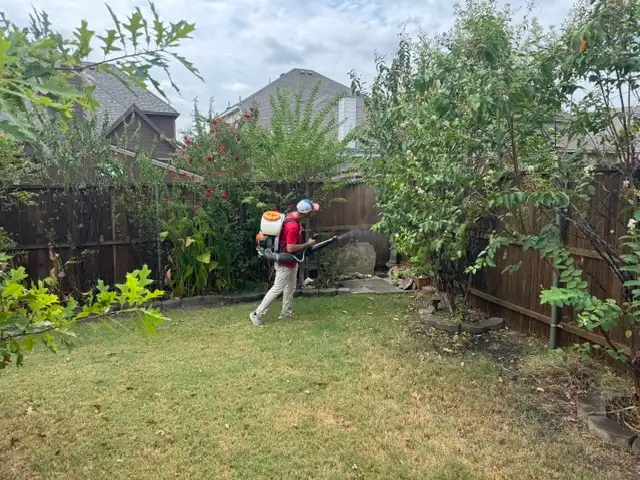
Reading the shade map
We walk the yard before the tank comes off the truck and note where sun never lands: under the canopy, along the north wall, behind shrubs planted tight to the slab, in the leaf litter nobody rakes. On an established lot that is where nearly the whole flea population sits.
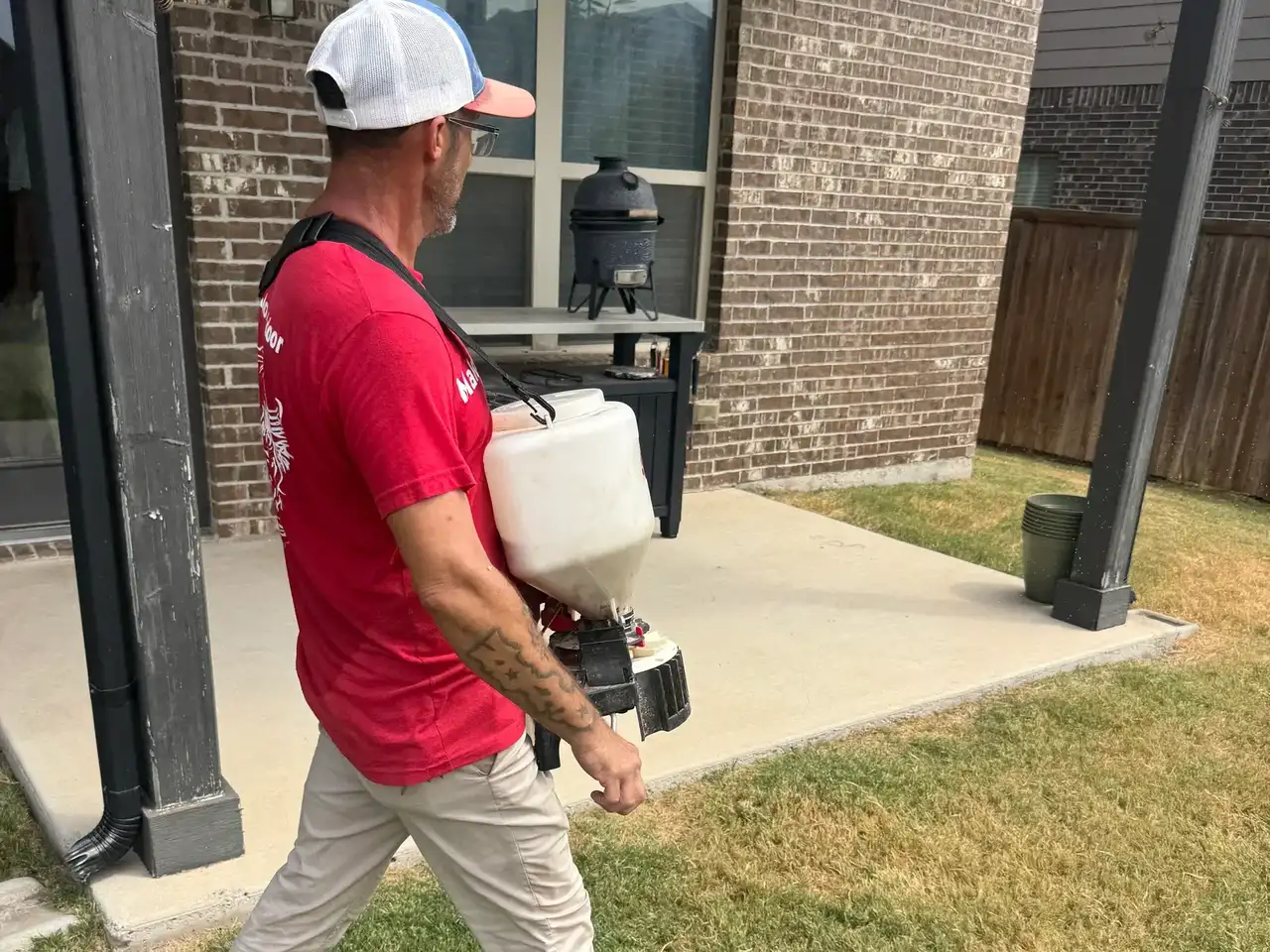
Lawn first, then the structure
The full turf area is treated, followed by a band around the foundation. Beds with deep mulch against the brick get particular attention, because damp mulch works as both flea nursery and tick cover.
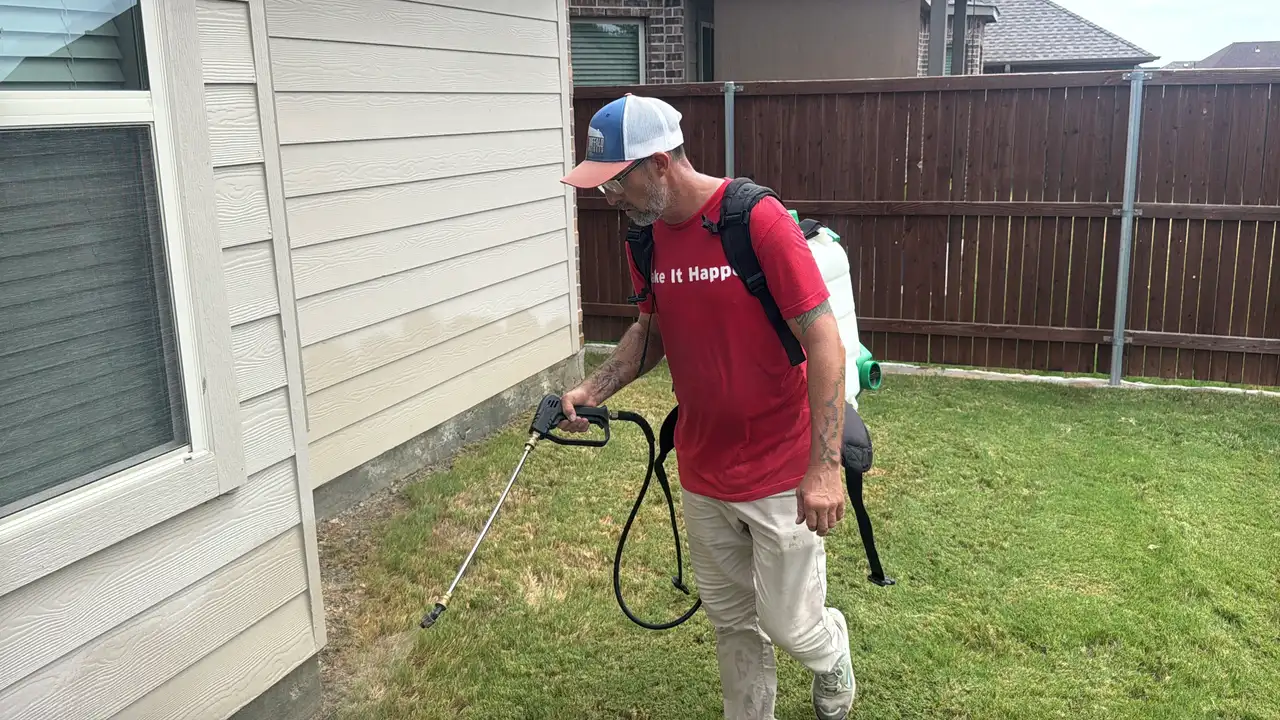
What we ask of you afterward
Stay off the grass until it dries, roughly two hours on a hot afternoon. Then keep the shaded strips cut short and pull leaf litter out of the beds, which is free and lowers how much treatment the yard needs next time.