BUILT OUT AND SETTLED
Why an older house changes what a perimeter plan has to do
An older house has more ways in and less soil disturbance, so the work shifts. Richland Hills was built out through the post-war decades, and the brick from the 1950s and 60s has had long enough for the weep holes, thresholds and utility penetrations to open up. That is where the roaches, crickets, spiders and scorpions get in, and it is why the first thing a technician looks at here is the bottom course of brick rather than the lawn.
The trade is real, though. Settled ground means far fewer fire ant mounds than a subdivision that was scraped flat last year, so the fire ant treatment that comes with the plan is doing less heavy lifting in Richland Hills than it does further out. The Home Defender Plan runs $30 to $54 a month and covers all of it four times a year, across the one ZIP the city uses, 76118.
THE MONTHLY FIGURE
What a compact, established house costs to protect
Home Defender is priced from the square footage of the home, and the housing stock here works in your favour. Post-war construction in this city tends to be modest, so a large share of Richland Hills addresses land in the first two bands, between $30 and $38 a month. Bigger homes exist and cost more, but nobody is paying for a foundation line they do not have.
Four scheduled visits are inside that number, along with one interior treatment if the problem has already made it indoors and unlimited return trips between visits at no charge. There is nothing to pay to begin and nothing to pay to stop. If the figure you were quoted does not match the published range, ask why, because there should be a specific answer.
1,500 sq ft or less
$30 a month
Common on the older Richland Hills streets
1,500 to 3,000 sq ft
$33 to $38 a month
Most of the rest of the city
3,000 to 4,500 sq ft
$38 to $46 a month
The larger and remodelled homes
Copper mesh weep-hole sealing
Quoted separately
An add-on, not part of the monthly price
Every number on this page comes from our published price list. Richland Hills homes get the same table as everyone else; the instant quote reads your square footage and lot size and hands you your own line.
STRAIGHT ANSWERS
What we cannot solve with a barrier treatment
Rats and mice are not a spraying problem, and no amount of product around your foundation will change that. What works on rodents is finding the openings they are genuinely using, closing those, then trapping and following up, and that runs as a $25 a month add-on to a year-round plan. With older drainage and mature trees around Richland Hills, it comes up more than people expect.
Mosquitoes are outside this plan too. The canopy that makes these streets pleasant also keeps the ground damp and the air still, which is where mosquitoes spend the daylight hours, and a barrier on the wall of the house does nothing to them. Mosquito, Flea & Tick is the 21-day program that addresses it, from April through September.
Termites are a different licence and a different trade. If a technician sees evidence of them, you will be told plainly and referred to a termite operator, not quietly sold a plan that was never going to help.
SEAL IT OR TREAT IT
Closing the gaps versus paying somebody to spray
On a sixty-year-old house, sealing has the better return per dollar, and we will say that even though sealing is the part we charge extra for. A door sweep that actually meets the threshold, caulk around the pipe and cable penetrations, and copper mesh packed into the weep holes all stay done. Every opening you close is one the barrier no longer has to defend.
Treatment is what covers the rest, and on a Richland Hills house the rest is considerable: the eave and soffit line where wasps and spiders set up, the door frames, the mulch beds and the turf where crawling insects gather before they ever reach the slab. The plan handles that four times a year, and includes Delta Dust in the weep holes whether or not you ever buy the mesh.
THE FIRST TREATMENT
Where the technician starts on an older house
The bottom course of brick
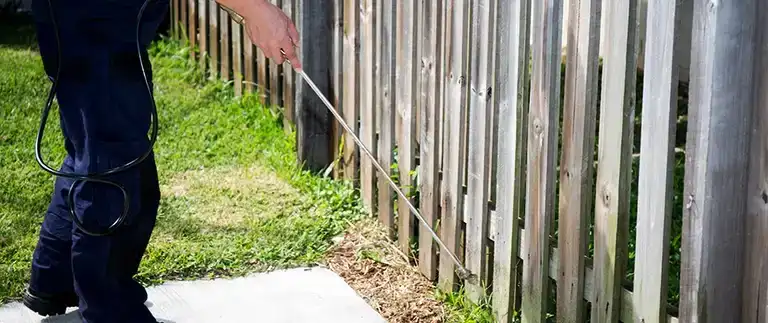
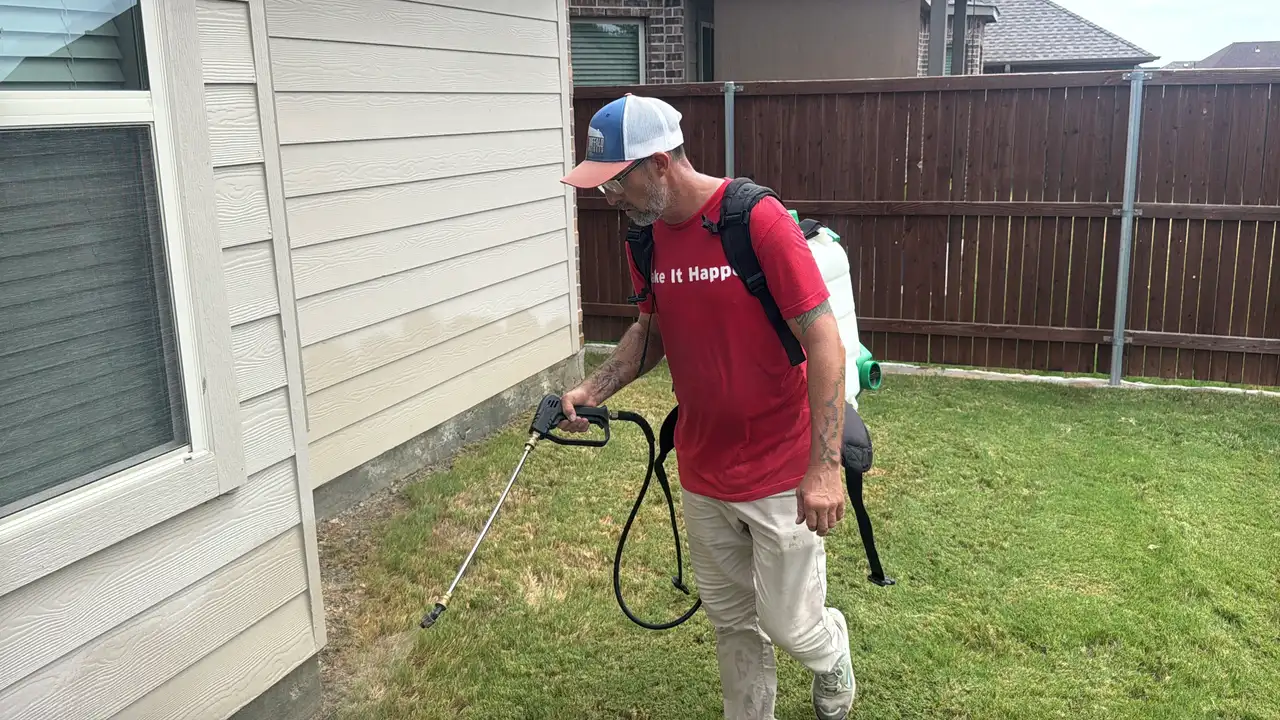
Every weep hole gets Delta Dust, and the technician works along the base of the wall noting what has opened up over the decades: worn thresholds, gaps at utility penetrations, brick that has moved. You get told what is worth closing, and what it would cost to close it.

Foundation band and eave sweep
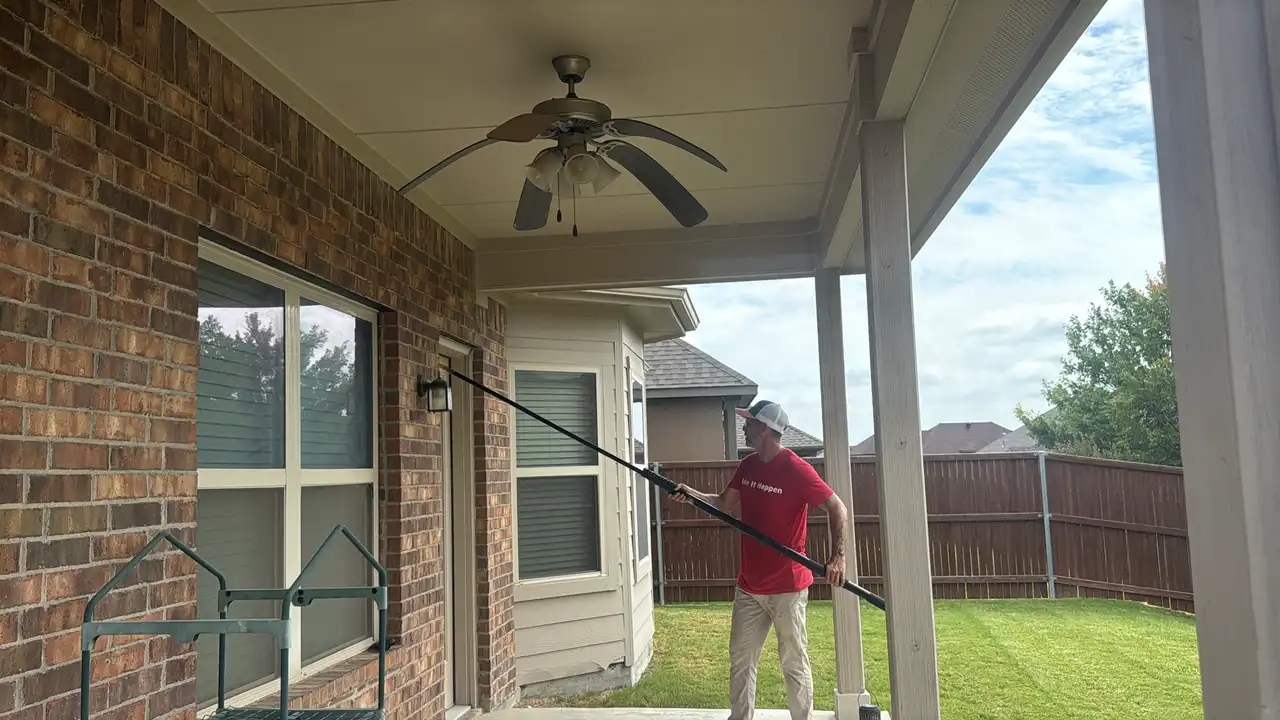
Liquid goes around the whole slab and roughly three feet up the wall, then a web pole clears the eaves, soffits and door frames. Under the mature trees common in Richland Hills, that overhead sweep is what stops the same porch corner filling with web again by next month.
Mulch, litter and the 25-foot ring
Deep mulch against the slab and leaf litter under shrubs are harborage, and you will be told what to pull back rather than left to guess. Granular then goes out about 25 feet into turf and beds, with fire ant bait broadcast in the same visit at no extra cost.