SHADE AND DRAINS
What keeps a compact city this buggy
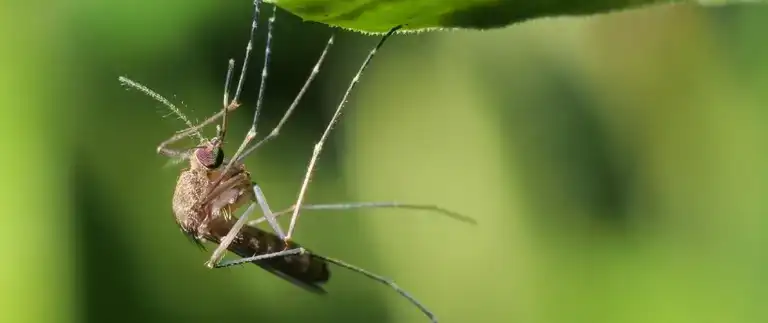
Humidity that never burns off. Richland Hills is small and mostly built out with brick homes from the 1950s and 60s, and the trees planted with them now throw enough shade to keep ground damp from one watering to the next. Adults spend the daylight hours in that cool layer under the foliage and come out for the patio at dusk, which is why the yard can feel fine at noon and unusable at eight.
Older drainage adds the water. Settled ground holds low spots, storm drains stay damp for days after a Texas downpour, and anything that keeps a film of water for a week is producing more mosquitoes. A treatment every 21 days from April through September is aimed at both halves: the foliage where they rest and the water we can reach.
RICHLAND HILLS RATES
What a visit costs on a lot this size
Nearly every property in the city prices at $49.95 or $59.95 per visit, since the post-war blocks here were laid out well before the half-acre suburbs. Lot square footage is the only input. A remodeled house and a tired one on identical lots get identical numbers, and no premium is added because the mosquitoes are already bad.
Nothing is collected for the season in advance. Each visit is charged as it is performed, there is no contract and no cancellation fee, and you are told the figure before committing to anything. If a treatment fails to carry to the next stop we come back and redo it for free. A Richland Hills address typed into /instant-quote returns the band directly.
Lots of 7,000 sq ft or less
$49.95 a visit
Most of the original blocks
Lots from 7,001 to 12,000 sq ft
$59.95 a visit
Wider and corner lots
Lots from 12,001 to 17,000 sq ft
$69.95 a visit
The deeper properties in town
Every number on this page comes from our published price list. Richland Hills homes get the same table as everyone else; the instant quote reads your square footage and lot size and hands you your own line.
WHERE IT DISAPPOINTS
Three things worth knowing before you sign up
Storm drains and easements are not ours to treat. Water sitting in public drainage after a storm keeps producing regardless of what happens inside your fence, so a Richland Hills yard near one will always see some arrivals. What the program removes is the resident population using your shrubs and canopy as a daytime hotel, and that is the part doing most of the biting on your own patio.
A fog is also no help against a yard that keeps making them. One neglected bird bath or a saucer under a potted plant can out-produce every treated shrub on the property, and we would rather hand you a list than sell extra visits to cover for it.
And the product runs out. Three weeks is about what it gives in peak heat, sooner if a storm lands the same night, which is why visits are set at 21 days and why anything showing up early is treated again at no charge. A company quoting you a longer interval is quoting a cheaper schedule, not a better chemical.
START NOW OR WAIT
Begin in April or wait until it gets bad?
Waiting is the common choice and it is the expensive one. Mosquito numbers build from the first nights that stay above 50 degrees, usually late March here, and a population that has had ten weeks of May and June rain to multiply takes more visits to pull back down than one that was never allowed to climb. Starting in July is not wrong, it is just a harder fight with the same tools.
There is a fair case for waiting, though, and it is yours to make: no contract exists, so a Richland Hills homeowner who genuinely only uses the back yard in August can start in August and stop in October, paying for the visits that fall in that window and nothing else. What we will not do is sell a single rescue fog before one weekend, because a lone treatment stops working after about three weeks and the yard refills.
VISIT ONE
How the first treatment is put together
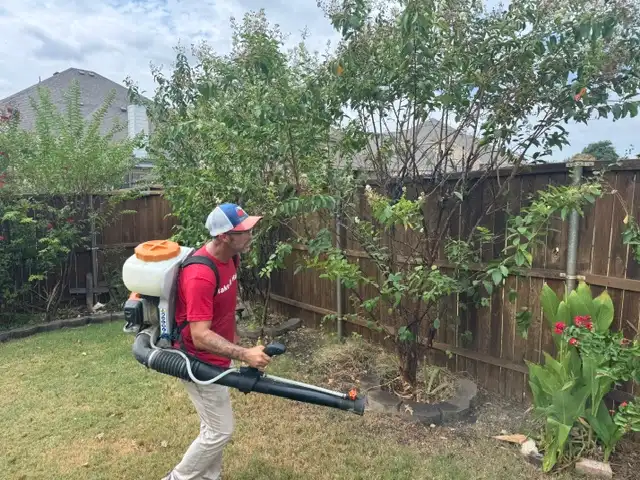
The shade inventory
Treatment begins with a walk, not a trigger pull. The technician notes the north side of the house, the deep foundation shrubs, deck skirting, the fence line under the heaviest canopy and any bed that stays dark all afternoon, because that is where the adults are sitting.
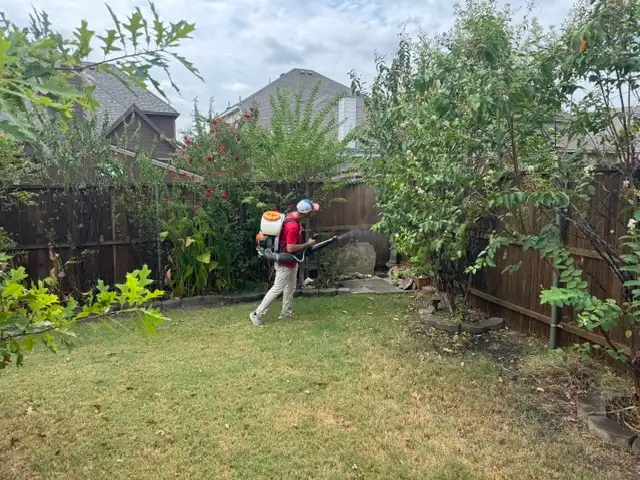
Foliage gets the fog
A backpack fogger works through ornamental trees, hedges and shrub beds and along shaded fencing, and the turf and bed edges get their own pass for fleas and ticks. Open sunlit grass is largely left alone since nothing rests there in the heat.

The water conversation
You get a short honest list before we leave: the gutter holding pecan leaves, the tarp in the side yard, the low corner that stays wet three days after rain. Anything that cannot be tipped out is larvicided instead, and only gate access is needed for us to work.