OLD TREES, TIGHT LOTS
Is a fog worth it on a post-war Blue Mound lot?
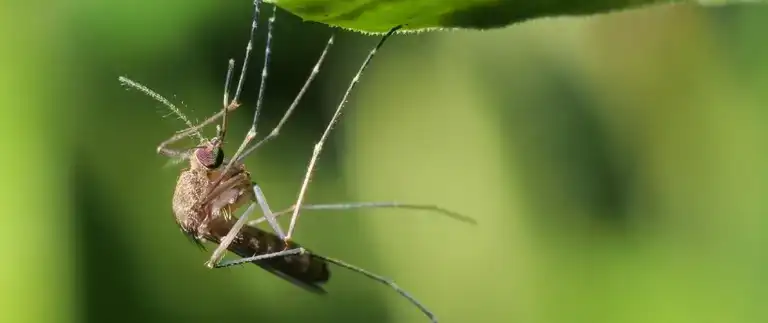
For most households, yes, and for a smaller number, no. Blue Mound is compact and mostly built out, with housing from the post-war decades sitting on soil that settled long ago and under trees that have had sixty years to spread. Canopy that size keeps the ground under it damp and the air still, and still damp shade is precisely the habitat an adult mosquito needs to survive a July afternoon.
The counterweight is the size of the lots. On a narrow lot your treated shrubs and fence line are a short flight from an untreated yard on either side, so the barrier is doing a smaller share of the total work than it does on an acre. That is worth knowing before you buy, and it is why the honest pitch here is fewer bites on your own patio rather than a mosquito-free block.
THE CHEAPEST BANDS
What Blue Mound homeowners actually pay
Almost every yard in town falls in the first two bands, $49.95 or $59.95 per visit, because the lot sizes here were laid out generations before the half-acre suburbs went in. Pricing keys off lot square footage alone, so a well-kept yard and a jungle on the same street pay the same, and nothing is added for the age of the house.
The money goes out visit by visit from April through September, not as a lump at the start, and there is no startup fee, no contract and nothing charged if you quit. Treatments that fail to hold get redone for free between scheduled stops. Running a Blue Mound address through /instant-quote returns the band without anyone having to call you back.
Lots of 7,000 sq ft or less
$49.95 a visit
The great majority of Blue Mound
Lots from 7,001 to 12,000 sq ft
$59.95 a visit
Corner lots and the wider parcels
Between-visit re-treats
No charge
Covered when a treatment does not hold
Every number on this page comes from our published price list. Blue Mound homes get the same table as everyone else; the instant quote reads your square footage and lot size and hands you your own line.
THE UNCOMFORTABLE PART
What this program will not do for a small yard
It will not out-treat your neighbors. On lots this close together, adults produced two doors down will still find your patio, and any company promising otherwise is describing a yard size Blue Mound does not have. The barrier removes the resting and breeding habitat on your side of the fence, which is the piece you control.
It will not fix what is holding water. Older drainage and settled ground mean yards here keep low corners that stay wet for days after a storm, and one of those out-produces an entire fence line of treated shrubs. We larvicide the standing water we cannot drain and tell you what to tip out, but a gutter full of pecan leaves is a homeowner job.
It will not last a month, either. Treatments run about 21 days at the height of summer and less after heavy rain, which is why visits land every three weeks rather than on a tidy monthly schedule, and why anything that comes back early is re-treated at no cost to you.
BEFORE YOU SPEND
Free fixes to try before paying anyone
Two of them are worth doing whether or not you hire us. Mosquitoes are weak fliers, so a box fan pointed across a patio makes it noticeably harder for them to land on anybody sitting there, and it costs nothing after the first purchase. Emptying every container that holds rain, a weekly habit rather than a spring chore, does more than any spray in the hardware store aisle.
Where those stop is the standing cover. A fan protects the eight feet in front of it and nothing else, and dumping water does not touch the adults already living in your hedge line and under the canopy. That is the job the fogger does, and if you have done the free things and are still getting eaten in your own back yard, that is when a Blue Mound homeowner should spend money.
THE FIRST STOP
How an appointment on a Blue Mound lot goes
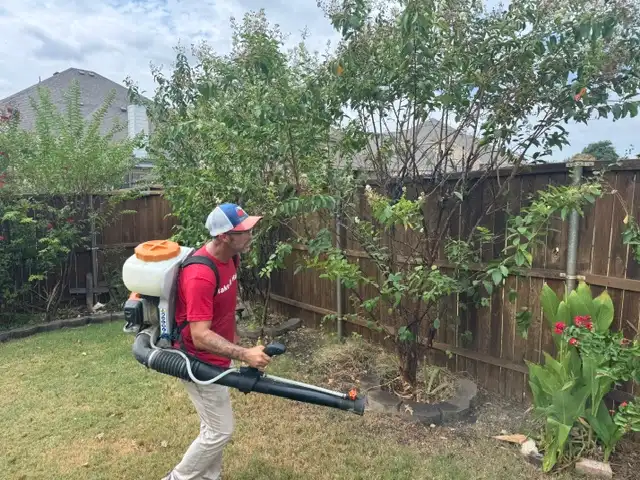
Shade first, lawn last
The technician walks the property looking for daytime harborage: the shaded north side of the house, dense foundation shrubs, the fence run under the biggest tree, deck skirting. On a compact lot that inventory takes only a few minutes and it decides everything else.
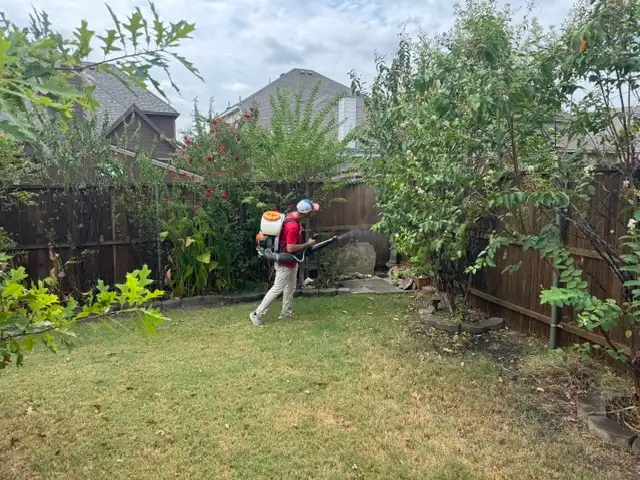
Fogging the resting cover
Product goes up into ornamental trees, through hedges and shrub beds, and along shaded fencing, while turf and bed edges are treated separately for fleas and ticks. Sunny open grass gets very little, because there is nothing sitting in it at noon.

Water, gutters and low corners
Before the truck leaves you get a short list of what is breeding on the property, usually a bird bath, a saucer, a tarp or a gutter packed with leaves. Anything undrainable is larvicided. We only need the gate open, and a text goes out when we are close.