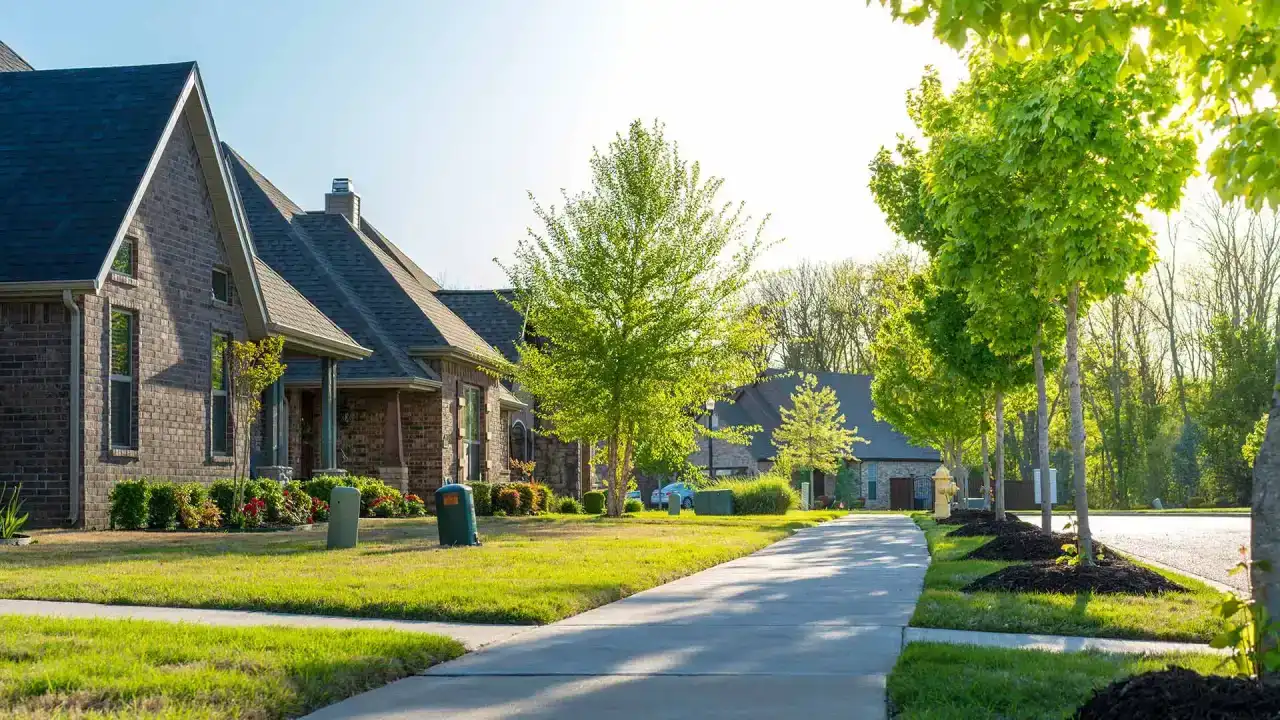
BUILT OUT AND SETTLED
How does a mouse get into a built-out Blue Mound street?
Through gaps that opened up while nobody was looking. Blue Mound was built out in the post-war decades, and brick standing on settled soil that long develops a quarter-inch opening here and there: a mortar joint that cracked, a threshold worn thin, a hole somebody drilled for a cable line and never closed. A mouse does not need a door left open, only one of those.
The town is compact and the lots sit close together, which matters more than people expect. Continuous fence lines and a row of back sheds give a rat cover to work a whole block without ever crossing open ground, and the mature trees that shade these streets hand it a second route, because a limb over the shingles puts an animal at the soffit line.
So the job runs in a fixed order. Find the openings that have sign on them, close those, trap whatever is already inside, then come back and confirm nothing has reopened.
THE MONTHLY MATH
The rodent line is $25; the plan under it follows the house
Rodent control costs $25 a month and rides on top of a year-round plan, either Home Defender or Complete Home & Lawn Defense. We do not sell a standalone version, because the visits that check seals and stations are the same visits that treat the perimeter and the weep holes.
The plan underneath is priced on the square footage of the house rather than the lot. Plenty of the original Blue Mound floor plans come in under 1,500 square feet, where Home Defender is $30, so rodents and perimeter together land at $55 a month. Between 1,500 and 3,000 square feet the base runs $33 to $38, making the combined figure $58 to $63. Pull your own number at /instant-quote; there is no contract, no startup fee and nothing owed if you stop.
The rodent line itself
$25 a month
Flat, whatever the house measures
Home Defender under 1,500 sq ft
$30 a month
The original floor plans
Home Defender, 1,500 to 3,000 sq ft
$33–$38 a month
Additions and remodels
Complete Home & Lawn Defense under 1,500 sq ft
$40 a month
Same rodent line, yard treated too
Every number on this page comes from our published price list. Blue Mound homes get the same table as everyone else; the instant quote reads your square footage and lot size and hands you your own line.
WHAT STAYS YOUR SIDE
Three things sealing a Blue Mound house will not change
Worn-out hardware stays worn out. If daylight shows under the back door of a 1950s house, that strip is a doorway, and a new sweep is a hardware purchase we will point at rather than perform. Same with a garage door whose bottom seal has gone brittle at the corners.
Food on the ground keeps the population fed. Seed spilled under a feeder, a split bag of dog food in the garage, fruit left where it drops — none of that becomes less interesting because the house got tight. Rodents simply hold at the property line and test the walls more often.
And none of it is a spray. A rat walks across treated ground without registering it. Anyone offering to solve mice with a yard application in Blue Mound is selling insect control under a different name.
FOAM OR A SEALED HOUSE
Why a can of expanding foam loses to a rat
Foam is not exclusion, and that is where most of a season gets lost. It is soft enough that a rat opens it overnight, so all you have sealed is your own view of the entry point. Copper mesh packed tight, steel wool behind sealant, mortar and hardware cloth are what actually hold, and they are what we use on the openings a rodent is working.
The other half is knowing which hole matters. Homeowners plug what they can see from the driveway while the animals keep using a penetration tucked behind the air conditioner pad. To be fair to doing it yourself: one mouse, a tight house and a single obvious gap really is a trap-and-patch job, and we would rather tell you that on the phone than put you on a plan you do not need.
THE OPENING INSPECTION
The order we work a Blue Mound house
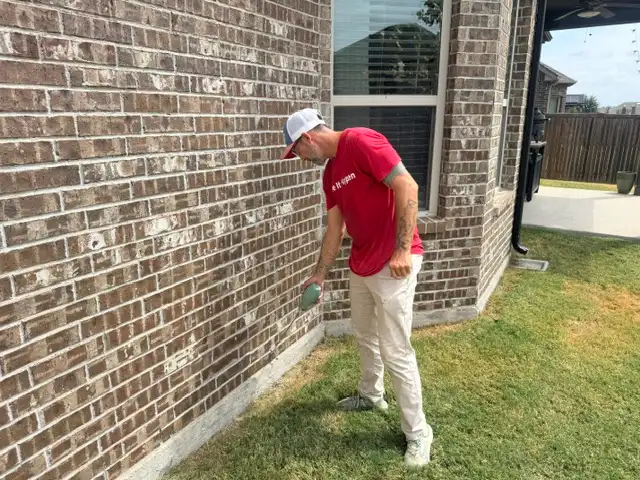
Reading the bottom course
We walk the brick at ground level and look at every weep hole for grease marks, droppings and gnawing. Both year-round plans already pack those weep holes with copper mesh and dust them with Delta Dust as standard, so the inspection is mostly about what else has opened along that course: cracked mortar, a gap where the slab settled, a foundation vent screen that rusted through.

Doors, meters and utility lines
Thresholds, garage-door corners, the gas meter penetration and the hole a cable crew drilled twenty years ago are the usual ground-level entries on a house this age. Each gets measured, and anything a rodent is using gets closed with material they cannot chew through.
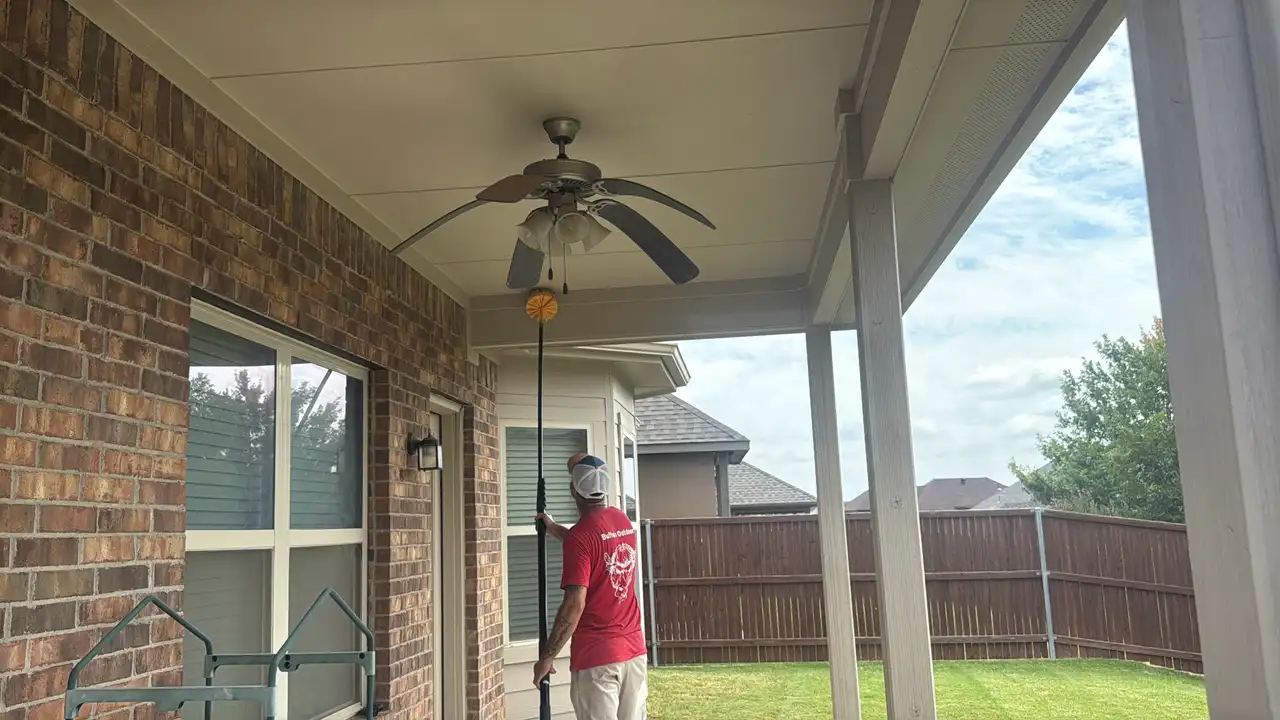
Attic sign and station placement
Inside, we read the attic and any accessible crawl area for runways, droppings and rub marks, because that is what tells us where a trap will catch rather than sit. Locked, tamper-resistant stations go on those runways, out of reach of children and pets, and the return visit is booked before we leave.