
EAGLE MOUNTAIN SHADE
Why a wooded lot bites harder than a subdivision
A Lakeside yard hands mosquitoes two things a tidy subdivision cannot: water down the slope and tree cover across everything above it. Adults spend daylight tucked into cool, still vegetation and only come out toward dusk, and wooded ground running down toward Eagle Mountain Lake suits that habit almost perfectly.
So the season here tends to open early and close late, and the same appointment that targets mosquitoes covers the ticks working their way in from the brush at the lot line. Visits run every 21 days from April through September across both of the town's ZIPs — 76135 on the Lake Worth side and 76108 on the White Settlement side.
WHAT LAKESIDE LOTS COST
Per-visit pricing when the lot is the big number
Because lots here run generous, most Lakeside homes land in the middle of the table rather than the bottom: $69.95 a visit between 12,001 and 17,000 square feet, $79.95 up to 22,000, then onward in 5,000-square-foot steps to $129.95. The house can be a cabin or a custom build; only the lot measurement is used.
Properties past roughly an acre, meaning 47,000 square feet, come off the published table and get quoted for what they are, because fogging four acres of tree line is a different afternoon than fogging a quarter acre. Every band is billed as the visit happens, with nothing prepaid, no contract and no startup fee.
12,001 to 17,000 sq ft
$69.95 a visit
A common measurement on these streets
17,001 to 22,000 sq ft
$79.95 a visit
Wooded lots running toward the water
42,001 to 47,000 sq ft
$129.95 a visit
Top of the published table
Above 47,000 sq ft
Quoted
Roughly an acre and up
Every number on this page comes from our published price list. Lakeside homes get the same table as everyone else; the instant quote reads your square footage and lot size and hands you your own line.
LIMITS OF A BARRIER
Three things a Lakeside homeowner should not expect
First, a treated yard beside Eagle Mountain Lake becomes a quieter yard, not a sealed one. Shoreline and wooded ground that no one treats keeps turning out adults, and adults fly; what the fog takes away is the crowd using your trees and shrubs as a daytime hotel, and that is where most of your biting comes from.
Second, treatment does not reach what it cannot touch. Thicket beyond the property line, a trailer full of rainwater next door, a ditch on the far side of the fence — all of that stays productive, which is exactly why we work the boundary growth on your side of the line so hard.
Third, three weeks is the honest hold: not a month, and nothing close to a whole summer. That is why the cycle sits at 21 days, why a hard rain earns you a free return trip under the warranty, and why we will not take money for a standalone March fog and call the job finished.
MOWING VS SPRAYING
What a mower does that a fogger cannot
On a wooded lot, the cheapest mosquito and tick control is a mower and a rake. Cutting the transition strip where mowed grass meets brush, raking leaf litter off damp low ground and clearing the tarp-covered pile behind the shed removes habitat permanently, and it costs nothing but a Saturday.
What yard work cannot do is kill the adults already resting in a Lakeside tree line, or keep holding through July when the brush grows back faster than anyone cuts it. That is the fog's job on a 21-day rhythm, and the two together beat either alone by a wide margin. Store-bought hose-end sprays belong to neither camp: about five days of life in Texas heat, and no reach under dense cover.
FIRST TRIP OUT
What happens the first time we treat
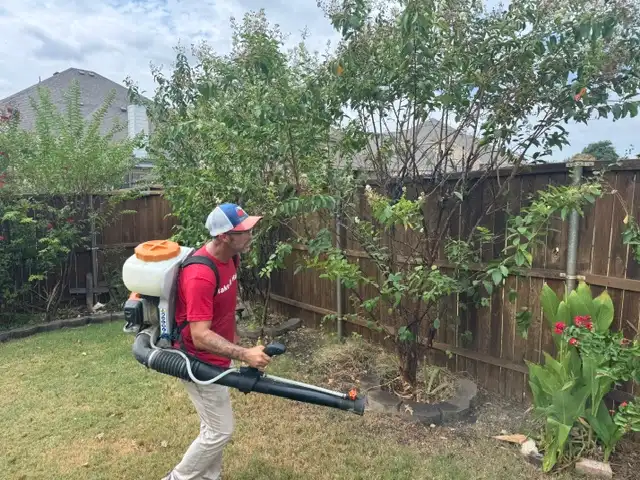
Starting at the lot line
We begin at the boundary, because on a wooded property that is the source: brush, tree cover, the slope toward the water. That strip takes the heaviest attention and it sets the plan for everything nearer the house.
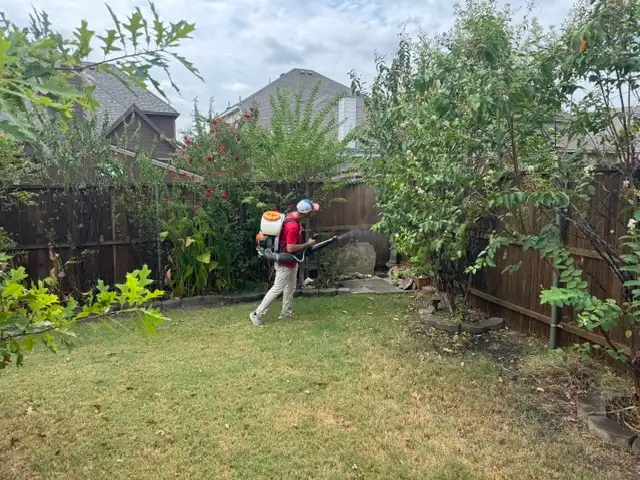
Canopy and shrub lines get the fog
A backpack fogger works through ornamental trees, hedges, fence-line growth and deck skirting, which is where adults wait out the sun, rather than across open turf. Bed and turf edges then get their own pass for fleas and ticks.

Sheds, boats and puddles
Anything holding water for a week is a nursery, so the walk covers boat covers, buckets, wheelbarrows, low spots and clogged gutters. What can be drained we show you; what cannot, such as a French drain, is larvicided.