
BEDS, NOT LAWN
Why big landscaped lots hold the most mosquitoes
Southlake carries the largest average lot and the heaviest ornamental planting we work with, and both of those things work against a homeowner at dusk. Adults never sit in open turf baking in July sun; they tuck into irrigated, shaded, densely planted beds, and one back yard here can hold more planted square footage than an entire lot in an older post-war suburb.
The north end also shifts the calendar. Properties running toward Bob Jones and the Grapevine Lake corridor collect ticks and chiggers off the natural areas on top of the flying pests, and those yards want a treated boundary strip rather than a neat ring around the entertaining area. Every Southlake address sits in 76092, and the cycle is a visit every 21 days from April into September.
SOUTHLAKE PRICE BANDS
What a large lot pays per visit
Lot square footage sets the number, which is why quotes in Southlake sit near the top of our table: most properties fall between $89.95 and $129.95 a visit, and anything past roughly an acre gets measured and quoted for the property instead of dropped into a band. How big the house is has no bearing on this program at all.
There is no contract, no startup fee and no season total to prepay: you are billed each time the truck comes, and walking away after September costs nothing. If a hatch beats the barrier between scheduled visits, the return is covered, and /instant-quote gives you a firm figure for the address up front.
Lots of 22,001 to 27,000 sq ft
$89.95 a visit
Half-acre properties with full bed lines
Lots of 32,001 to 37,000 sq ft
$109.95 a visit
Common on the larger Southlake streets
Lots of 42,001 to 47,000 sq ft
$129.95 a visit
Just under an acre, heavy ornamental planting
Over 47,000 sq ft
Quoted for the property
Acreage toward the lake corridor
Every number on this page comes from our published price list. Southlake homes get the same table as everyone else; the instant quote reads your square footage and lot size and hands you your own line.
WHAT IT CANNOT DO
The honest ceiling near the lake corridor
No barrier makes a property near Grapevine Lake mosquito-free, and anyone promising that in Southlake is selling a feeling rather than a service. Open water and undeveloped ground breed on their own, adults drift in at dusk, and what treatment does is remove the ones living and resting inside your fence, which is the bulk of what bites.
Large lots punish half-measures, too. If the budget only stretches to fogging the entertaining area, the far corner under the trees keeps producing and restocks the patio within days, so on an acre the boundary and the deep bed lines matter more than the part guests see.
And the application fades. Twenty-one days is the working life of a fog in peak heat, hard rain shortens it further, and blooming flowers are skipped on purpose, so a pollinator bed or a hive stays mapped as a no-spray zone from the first visit onward.
MISTING VS FOGGING
You already have a misting system. Do you need us?
Sometimes you genuinely do not, and that is worth hearing from the company that would rather sell you the program. A well-maintained misting system covering the right zones can make a season fog redundant, and we will say so on the walk instead of stacking one service on top of another.
Where installed systems disappoint is money and geometry. They run $2,000 to $4,000 installed plus refills, and nozzles only wet what they were plumbed to reach, so the back third of a big Southlake lot and the boundary toward the natural areas usually sit outside the pattern. A backpack fogger simply goes wherever the resting vegetation is.
THE FIRST SOUTHLAKE CALL
How a big-lot first visit actually runs
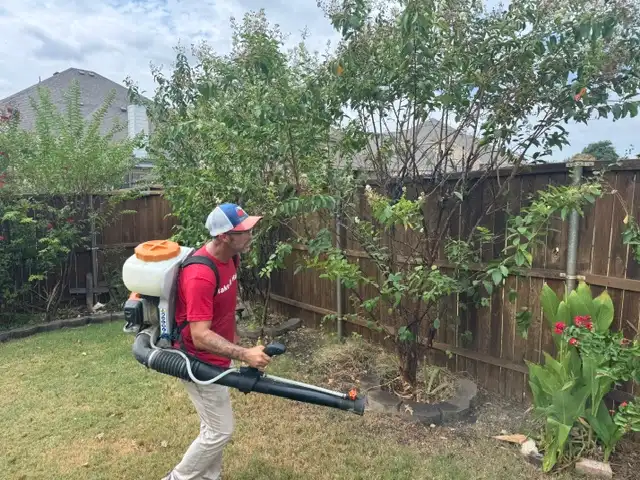
Marking what we skip
Before anything comes out of the tank we walk the beds with you and mark blooming plantings, the vegetable garden and any hive as no-spray. On a heavily landscaped property that conversation takes real time, and it is built into the visit rather than rushed through.
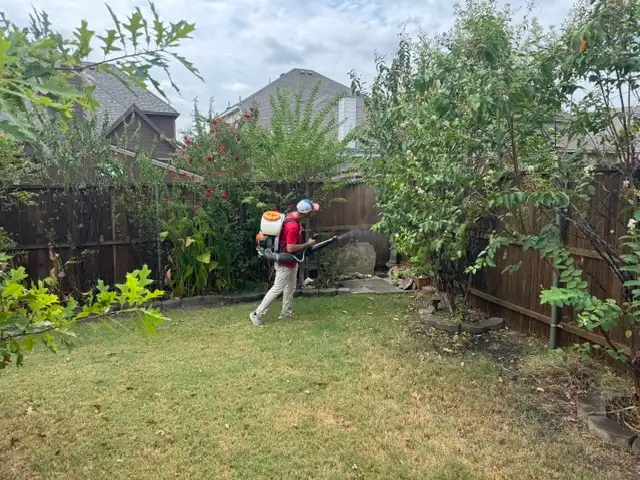
Fogging the planted depth
The fogger then works ornamental beds, hedge lines, tree canopy, deck skirting and the shaded north wall, because that is the small damp fraction of the property adults occupy by day. Turf and bed edges take a flea and tick pass in the same trip.

Walking the boundary
On lots running toward Bob Jones, the last pass is the property line itself, the strip where ticks wait at ankle height and chiggers hold in leaf litter. Water that cannot be drained gets larvicide before the technician leaves.