HISTORIC CORE AND 114
What Home Defender actually covers at this address
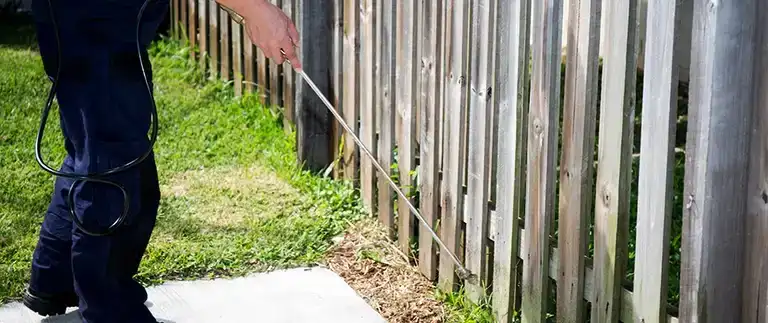
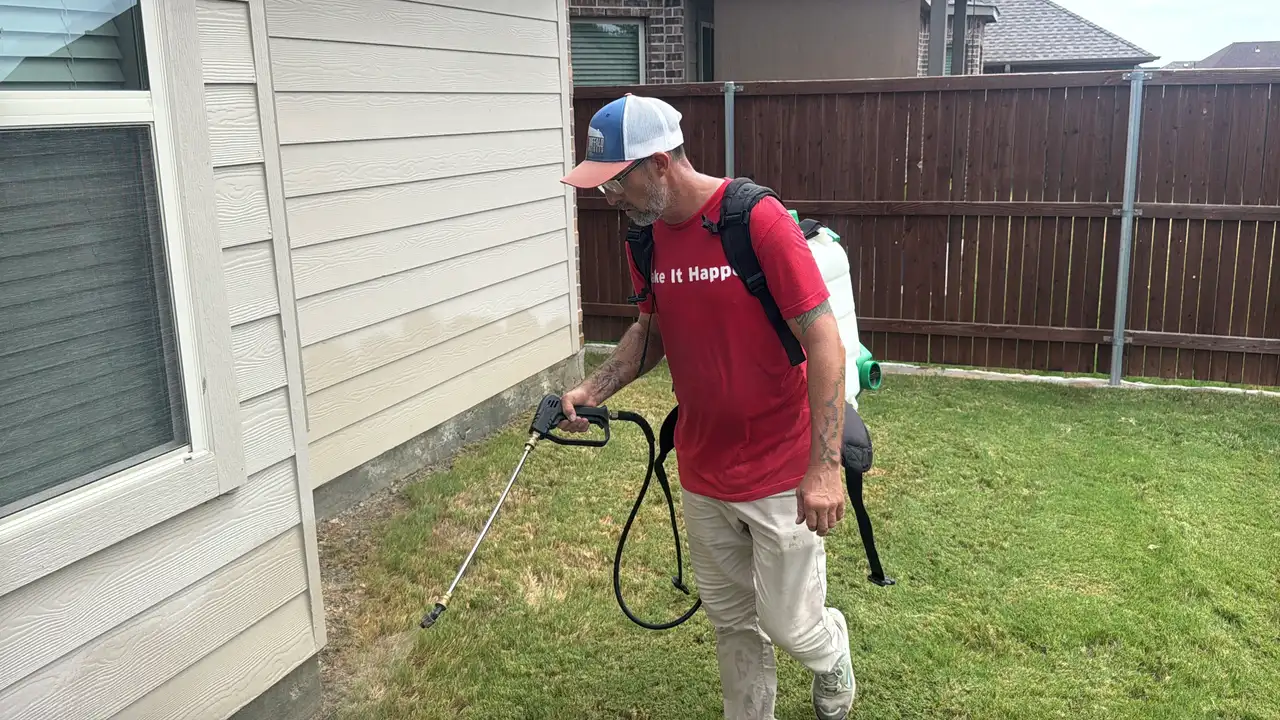
The outside of the house and the ground immediately around it, four times a year. Each visit is a liquid band on the foundation and about three feet up the wall, an eave, soffit and door-frame sweep with a web pole, Delta Dust pushed into every brick weep hole, granular broadcast roughly 25 feet out into turf and beds, and fire ant bait across the yard.
Roanoke hands that plan two different assignments. Around the historic core near Oak Street the soil settled generations ago, so fire ants are less of the story and the gaps in older structures are more of it. In the subdivisions spreading along TX-114 and I-35W the reverse holds: graded ground full of fire ants, young turf, and brick only a few years old that is just as open along the bottom course.
THE 76262 NUMBERS
What a Roanoke house costs to keep on the plan
Between $30 and $54 a month, decided by the square footage of the home. The house sets the length of foundation band and eave line we have to cover, so that is the measurement used. Not the lot, not the age of the structure, not which side of town it stands on.
It is billed monthly across the four visits, and the extras people brace for do not appear. Retreatments between scheduled visits cost nothing, because the service is warrantied in between. One interior treatment is included when something has already made it inside. No contract, no startup fee and no cancellation fee attach to any of it.
1,500-3,000 sq ft
$33-$38 a month
Much of the older core near Oak Street
3,000-4,500 sq ft
$38-$46 a month
The TX-114 and I-35W subdivisions
4,500-6,000 sq ft
$46-$54 a month
The larger newer floor plans
Over 6,000 sq ft
Quoted
Measured and priced individually
Every number on this page comes from our published price list. Roanoke homes get the same table as everyone else; the instant quote reads your square footage and lot size and hands you your own line.
THE HONEST SHORTFALL
Three things this plan leaves on the table
Greenbelt mosquitoes are the first. Roanoke has creek corridors and greenbelts threaded between its neighbourhoods, and they breed mosquitoes that fly straight over a ground barrier without touching it. Nothing in Home Defender is aimed at them. Mosquito, Flea & Tick is, at a visit every 21 days from April through September.
The second is landscaping you may not want to change. Irrigated beds with shrubs planted tight against brick are a damp, covered highway to the wall, and deep mulch banked over the slab is harborage. We treat what stays and tell you what to pull back, but a bed kept exactly as it is will keep sending traffic at the house whether it is treated or not.
The third is speed on fire ants. Broadcast bait is a slow instrument by design, travelling into the colony over days to weeks, so a mound spotted on Monday will not be gone by Wednesday. It is the right instrument for a whole yard, since spot-drenching leaves every mound you never found. It is the wrong one for a deadline.
BOTTLE OR PLAN
Why store concentrate quits before the month is out
It is not that the product in a hardware-store bottle does nothing. It is that it does not last. A consumer concentrate sprayed along a foundation in Texas summer heat is breaking down inside about a week, so matching what one professional application holds for three months would mean walking the whole house again most weekends from May onward.
The parts of the do-it-yourself route that genuinely work are worth doing, and we will tell you which ones. Packing your own weep holes with copper mesh is effective. Pulling mulch back off the slab, replacing a failed door sweep, moving a woodpile away from the wall: all real. The gap between a Roanoke homeowner and a licensed applicator is how long the product on the wall survives, not effort.
HOW VISIT ONE GOES
The sequence at a Roanoke house the first time out
What is touching the brick
Before anything is applied the technician walks the wall looking at what has grown or been planted against it: shrub branches resting on brick, mulch heaped over the slab line, sprinkler heads keeping one elevation permanently damp. Those decide where pressure concentrates, and a few of them are yours to trim rather than ours to treat.

The wall, then the overhead
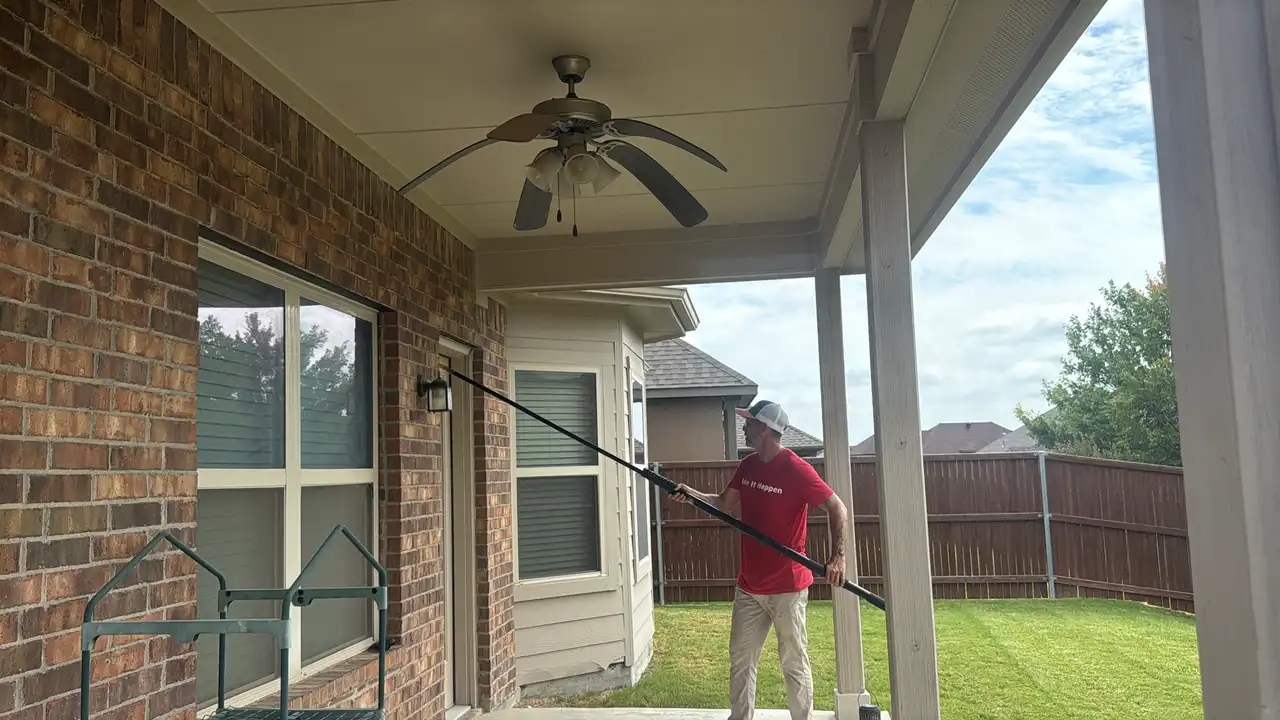
The liquid band goes down along the foundation and three feet up, then the web pole works the eaves, soffits and door frames so spiders and wasps lose the surfaces they rebuild on. Every weep hole along the bottom course takes Delta Dust, which is where most of what ends up indoors came through.
Granular, then bait
A granular barrier goes out into the turf and landscape beds roughly 25 feet from the house, and fire ant bait is broadcast across the yard on the same pass. We only need gate access, so nobody has to take a morning off, and a text goes out when the technician is on the way to the address.