
FENCE LINES AND CHANNELS
Why chiggers in North Richland Hills follow the drainage corridors
Most of North Richland Hills was built in the 1970s and 80s, and the oaks and elms planted then are now big enough to shade the ground and drop a thick layer of leaves every fall. Where that litter piles up against a back fence, especially on a lot that touches the Iron Horse corridor or one of the drainage channels threading through the city, the ground stays damp and chiggers overwinter in it.
You can usually diagnose the problem from the bites alone. Chigger welts sit in tight clusters at the top of the socks, along the waistband and in the fold behind the knee, because the larvae crawl upward until elastic stops them. Random bites on bare forearms are mosquitoes, which is a different program.
THE MONTHLY NUMBER
What treating a North Richland Hills yard for chiggers costs
The typical NRH house, a 1,500-to-3,000-square-foot brick single-story or modest two-story, pays $40 to $51.50 a month for Complete Home & Lawn Defense, the plan whose yard treatment covers chiggers. That price follows the square footage of the home rather than the lot, and it treats the full lawn year-round with a three-foot band at each door. Nothing binds you to a term and there is no setup charge.
Home Defender is the cheaper option at $30 to $54 a month, but it only reaches 25 feet from the foundation. On a North Richland Hills lot where the chiggers are living along a drainage fence 60 feet from the house, that ring misses the problem entirely.
1,500 to 3,000 sq ft
$40 to $51.50 a month
The bulk of the 1970s and 80s housing in NRH
3,000 to 4,500 sq ft
$51.50 to $62 a month
Larger two-stories north along Davis Boulevard
Under 1,500 sq ft
$40 a month
Smaller homes in the Smithfield area
Home Defender, 1,500 to 3,000 sq ft
$33 to $38 a month
25-foot ring; skips a far fence line
Every number on this page comes from our published price list. North Richland Hills homes get the same table as everyone else; the instant quote reads your square footage and lot size and hands you your own line.
WHAT IT WILL NOT FIX
The honest limits of chigger treatment on an NRH lot
A treated lawn does not reach chiggers hiding under six inches of last year's oak leaves. The product lands on the litter and the larvae underneath carry on, so a North Richland Hills yard with a leaf bed along the back fence has to be raked before the visit or the result will disappoint.
The channel behind your fence is city property and stays untreated. Tall grass in a drainage easement produces larvae all summer, and some of them will find their way across, so a lot backing the Iron Horse corridor should expect reduced pressure rather than zero. Most of what bites you lives in your own grass, and that is what the plan controls.
Chiggers are also a seasonal pest, active from about May into August, so a year-round plan buys chigger coverage for roughly a third of the year. The rest of the visits are working on ants, spiders, fire ants and the weep holes on that original 1970s brick.
RING VERSUS WHOLE LAWN
Choosing between the 25-foot ring and full-yard treatment in North Richland Hills
Home Defender's ring is a good buy for an NRH homeowner whose lot is small, sunny and bordered by other mowed lawns, because 25 feet out reaches the patio, the swing set and most of a compact back yard. Fire ants are included either way.
The moment the chigger habitat is a shaded fence line or a strip of leaf litter along a drainage channel, only Complete Home & Lawn Defense gets product to it. The gap between the two plans is $10 to $19.50 a month depending on the house. Before either one, mow the edge tight and rake the litter; that alone cuts the population and it costs nothing.
THE FIRST APPOINTMENT
How the first chigger visit goes on a North Richland Hills property
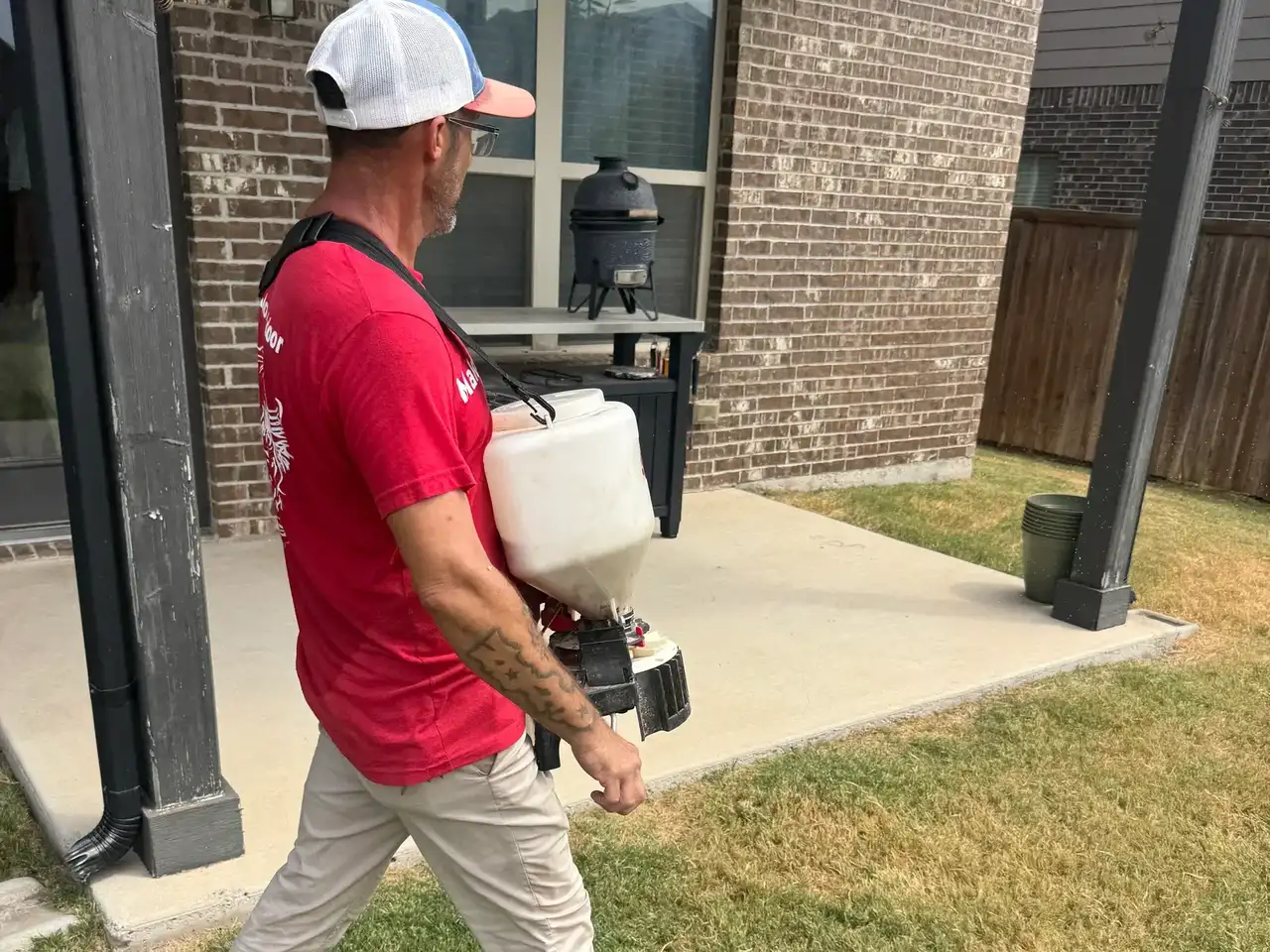
Walking the back line
The technician heads to the fence first, not the front lawn, looking for tall grass the mower skips, leaf beds under the oaks and any damp strip where the lot meets a channel. That is where the product goes heaviest.
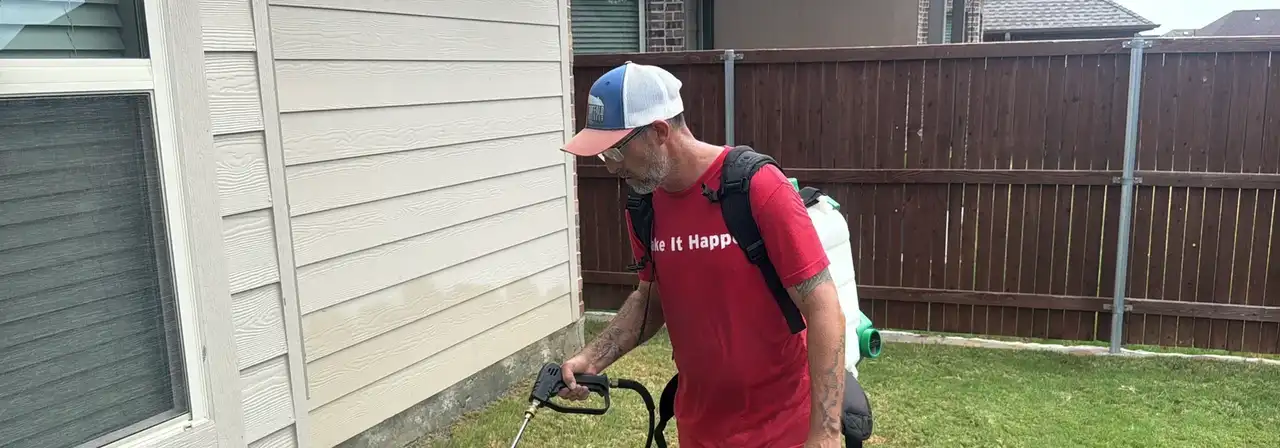
A frank word about the litter
If there is a leaf layer that will block the application, we tell you to rake it and offer to come back once it is clear rather than treat over it. Chiggers spend the winter in that layer, so removing it is also how you stop next year's outbreak.
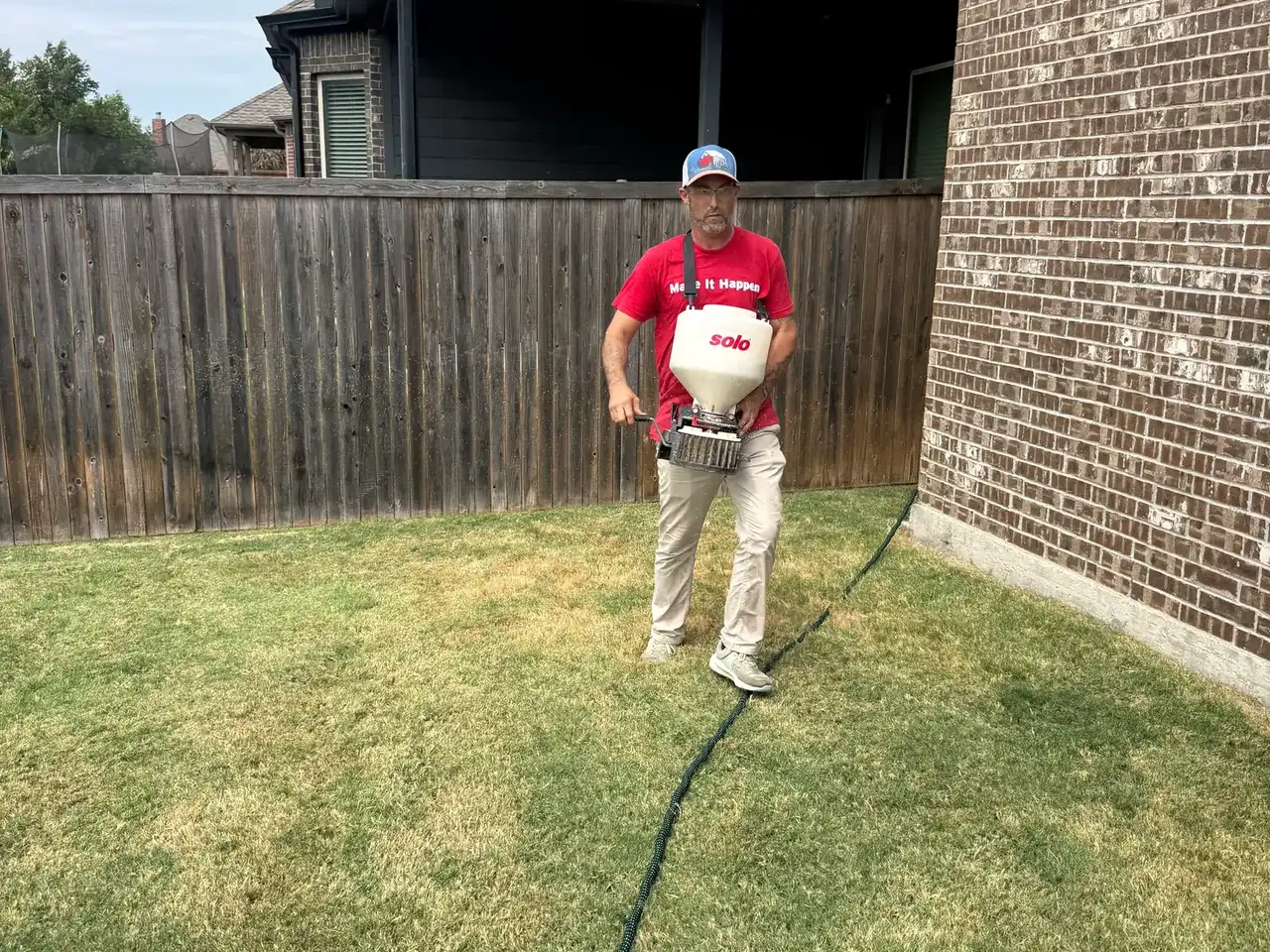
Doors, garage and the 76180 or 76182 question
Each entry point, including the garage door and the patio gate, gets a three-foot treated band so larvae are not tracked inside on socks. South NRH or up toward Davis Boulevard, the visit and the price are the same.