
SHADE, CANOPY AND FLEAS
Why fleas turn up under the old oaks and not out in the open lawn
Fleas spend most of their lives off the animal, in the top inch of shaded soil, and North Richland Hills grew a close to perfect nursery for them. The 1970s and 80s streets around Smithfield and Iron Horse carry forty and fifty-year-old canopy that keeps the ground beneath it cool and damp from May onward, which is the exact moisture range eggs and larvae need to finish developing.
Ticks work a different angle in the same yards. They climb whatever is tall at the edge of where you stop mowing and wait there at ankle height, so the drainage channels running through town and the unmowed ribbon along a back fence produce far more of them than the middle of a tidy lawn ever will.
What you are buying treats all of the lawn and a band around the building, on a 21-day cycle from April through September. The interval is the point: three weeks is roughly how long a new flea generation takes to arrive, so the visits are spaced to meet it rather than to look tidy on a calendar.
WHAT IT COSTS IN 76180
Your lot decides the price, and most NRH lots land in two bands
Most built-out lots here fall between 7,001 and 12,000 square feet, which is $59.95 a visit, or 12,001 to 17,000 square feet at $69.95. The tighter older lots in the south of town come in at or under 7,000 square feet and those are $49.95. Nothing about the square footage of the house enters into it, which surprises people; the lawn is what we are covering.
You hear the number before you commit, there is no contract, and no fee to start or to stop. Anything that shows up between two scheduled visits gets re-treated at no charge, because the work is warrantied between treatments.
Lots 7,000 sq ft or under
$49.95 a visit
The tighter older streets in 76180
7,001 to 12,000 sq ft
$59.95 a visit
Where most NRH lots land
12,001 to 17,000 sq ft
$69.95 a visit
Bigger lots toward 76182
Re-treatment between visits
No charge
Warrantied between treatments
Every number on this page comes from our published price list. North Richland Hills homes get the same table as everyone else; the instant quote reads your square footage and lot size and hands you your own line.
WHAT THIS WILL NOT DO
The indoor half of a flea problem is not ours to fix
Treating the yard does not clear fleas that have already set up inside the house. Once a dog has carried enough of them through the door, eggs roll off into the carpet, under the sofa and into the dog bed, and that indoor generation restarts itself whether or not the lawn outside is spotless. Vacuuming on a schedule, hot-washing the bedding and whatever prevention your veterinarian puts on the animal is the half of this job that belongs to you.
It also does not extend to land we are not contracted for. The drainage corridors and greenbelt strips behind a lot of North Richland Hills back fences belong to the city, so we work your side of the line hard and stop there. A dog that walks that corridor daily is going to keep bringing ticks home regardless of how well the yard is done.
And none of this is sold as a single application. A flea generation takes roughly three to four weeks to come through in summer heat, so one treatment removes what is out now and hands the next batch a clean start. That is why the visits repeat on 21 days and why we do not offer a one-off version of it.
YARD VERSUS THE VET AISLE
Is a monthly preventive from the vet enough on a canopy street?
Sometimes it is, and we would rather say so than sell you something. A dog that lives mostly indoors and steps out into an open, sunny back yard is usually fine on the vet's product alone, because that yard is not manufacturing enough new adults to overwhelm it.
On the shaded 1970s lots it usually is not. A preventive only acts once a flea is on the animal, so if the ground under the oaks is turning out new adults week after week, the dog is reinfested faster than the product can work through them and the owner concludes the medicine quit. It did not quit; the supply outran it. Treating the reservoir while the animal stays covered is what actually ends the scratching.
THE FIRST NRH VISIT
How the first treatment goes at a North Richland Hills house
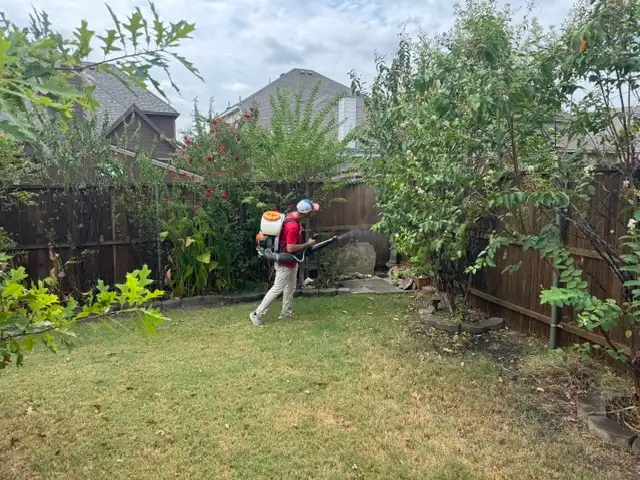
Finding the damp strips
We walk the yard before anything comes off the truck, looking for ground still dark at midday: the north side of the house, under the deck, the fence line where leaf litter has packed down. Those strips get the most attention because that is where the population actually sits.
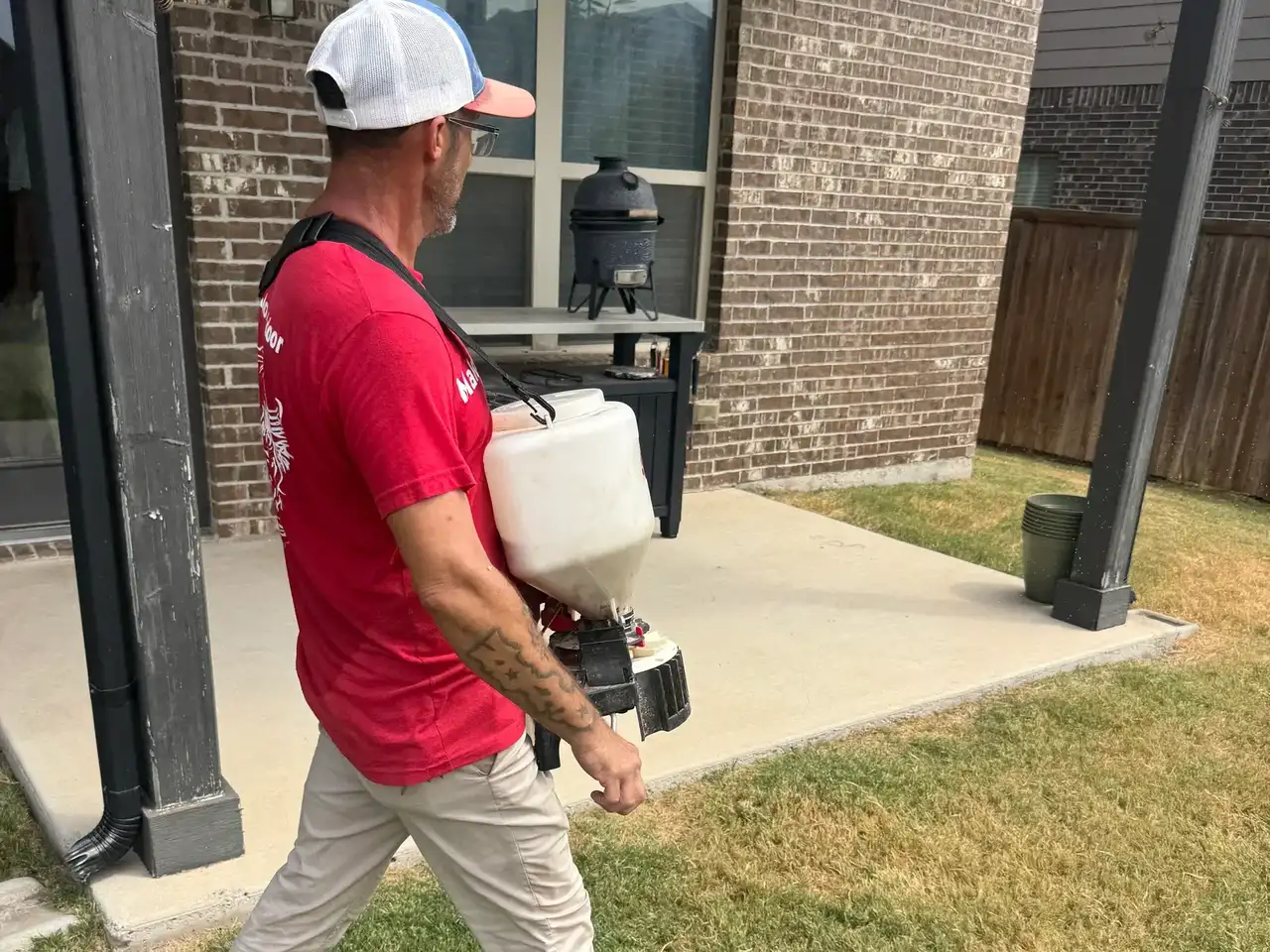
Lawn first, then the building line
The whole lawn gets covered, then a band around the foundation so nothing uses the slab edge as a route to the door. Once it has dried, which in July heat is about two hours, pets and kids are fine to go back out.
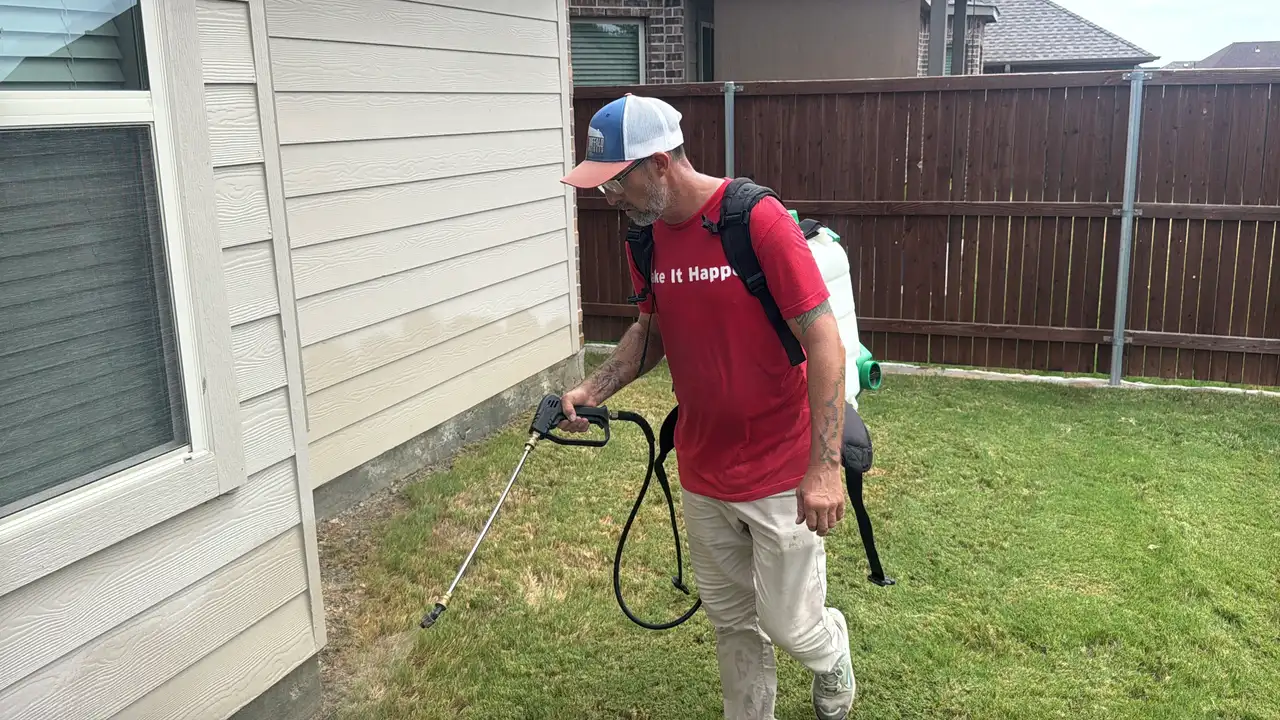
A straight question about the animals
Before we leave we ask what the dog or cat is on and when it was last dosed. If the answer is nothing, we would rather tell you the treatment will underperform than take the money and let you discover it in three weeks.