
A CANOPY PROBLEM
Why the old streets bite and the open ones do not
North Richland Hills is a mosquito town before it is a fire ant town, and the reason is overhead. The neighborhoods built out in the 1970s and 80s now carry forty- and fifty-year-old oaks and elms that hold the ground damp and the air still, and that shaded layer is where adults wait out the daylight before they come looking for the patio.
Pressure is not even across the city either. A yard along the Iron Horse corridor or one of the drainage channels threading through town gets going earlier in spring and runs harder in August than a street two blocks inland, no matter how tidy the lawn is kept. The program treats that resting vegetation every 21 days from April through September, in 76180 and 76182 alike.
NRH LOT PRICING
What a North Richland Hills yard costs per visit
Most homes here land between $59.95 and $79.95 a visit, because lots in the built-out sections are generous by mid-cities standards without being acreage. What gets measured is the ground, not the building: a 1979 ranch and a two-storey remodel on identical lots pay the identical number.
Billing happens per visit, so nothing is prepaid in April and nothing is owed if you stop after the August run. No startup fee, no cancellation fee, no contract, returns between scheduled visits are covered, and /instant-quote hands you the figure before you talk to anyone.
Lots up to 7,000 sq ft
$49.95 a visit
The smaller older lots down toward Smithfield
Lots of 7,001 to 12,000 sq ft
$59.95 a visit
The common size in both NRH ZIPs
Lots of 12,001 to 17,000 sq ft
$69.95 a visit
Deeper yards backing a drainage corridor
Lots of 17,001 to 22,000 sq ft
$79.95 a visit
The largest properties on the north side
Every number on this page comes from our published price list. North Richland Hills homes get the same table as everyone else; the instant quote reads your square footage and lot size and hands you your own line.
THE LIMITS
Three things this will not do for you
It will not empty the drainage corridor behind your fence. Those channels breed on their own schedule and we treat your side of the property line only, so a North Richland Hills yard on that boundary should expect a heavy reduction rather than a silent evening.
It will not outrun water sitting on your own ground. A saucer under a pot, a sagging gutter over the garage or a tarp across the woodpile can hatch a fresh brood while the barrier is still perfectly good, and tipping those out once a week costs nothing and beats anything in our tank.
It does not hold for a month. Three weeks is the realistic life of a barrier in July heat, less when a storm rolls through the night after an application, which is exactly why the cycle is 21 days and why a return trip between visits is free.
DIY OR HIRE IT OUT
Hardware-store bottle against a full season
Give DIY its due: emptying standing water and clearing the gutters are the two highest-return jobs on any property, they cost nothing, and we say so on the phone before quoting anybody. Zappers, citronella candles and the ultrasonic gadgets sold alongside them are a different story and do essentially nothing to a yard-sized population.
Where the store bottle falls down is duration and reach. It breaks apart in roughly five days of Texas heat, and it never gets under a dense holly or into the low canopy on a shaded north wall, which is precisely where the adults are sitting. A summer of weekend refills usually costs more than the visits would have.
VISIT ONE IN NRH
What happens before the fogger comes off the truck
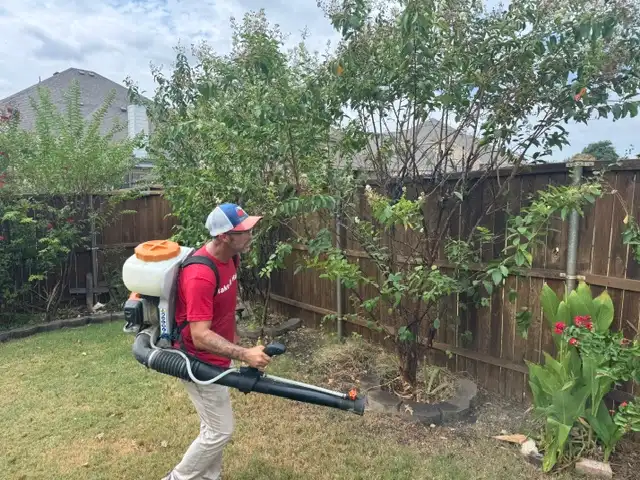
Reading the shade
The first pass is a walk to find daytime harborage: the big oaks, the shrub bank against the north wall, deck skirting, fence lines and anything backing a channel. On an established North Richland Hills lot that list runs long, and it decides where every drop goes.
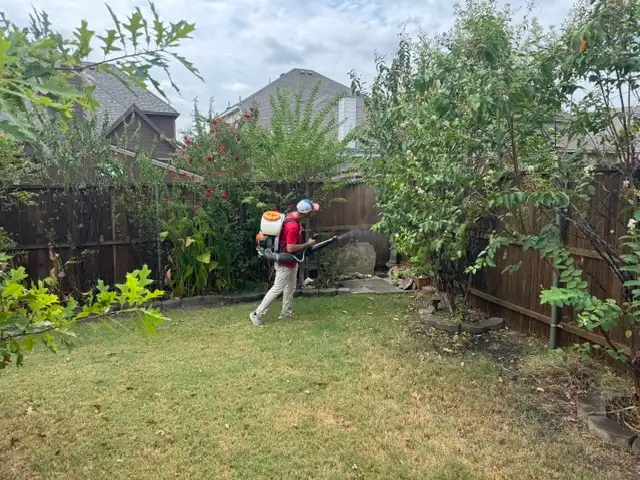
The fog itself
A backpack fogger works the ornamentals, hedge lines and low canopy where adults rest, and deliberately skips open sunlit turf because nothing waits there. Bed and turf edges get their own pass for fleas and ticks, since that is where a dog picks them up.

Your water, our larvicide
Anything holding water that cannot be drained, a French drain or a low spot still wet days after a storm, gets larvicide. Bird baths, toys and saucers get pointed out for you to handle. Gate access is all we need, and a text goes out when the truck is on the way.