OLD BRICK, SHADED YARDS
Why do the same ants come back into a 1980s house every spring?
Because they are walking through the wall, not under the door. North Richland Hills filled in across the 1970s and 80s, and brick from that era carries weep holes along the bottom course that nobody has ever closed. Ants, silverfish, crickets and the spiders that follow them treat those slots as a corridor, and spraying a baseboard indoors does nothing about what is happening on the other side of the brick.
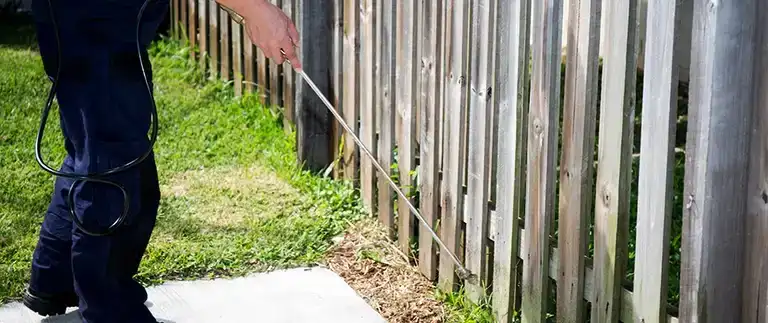
Home Defender works the outside instead. A liquid band goes around the slab and about three feet up the wall, a web pole clears eaves, soffits and door frames, Delta Dust is worked into every weep hole, and a granular barrier is broadcast roughly 25 feet out into turf and beds. Four scheduled visits a year, fire ant bait part of the deal, nothing to sign.
PRICED BY THE HOUSE
What a North Richland Hills home pays each month
Between $30 and $54, set by the square footage of the house, because that is what decides how much foundation run, eave line and brick course there is to cover. A 1,900 square foot ranch on the Rufe Snow side of 76180 lands at $33 to $38. A 3,200 square foot two-story over toward Davis Boulevard in 76182 runs $38 to $46. Past 6,000 square feet the house gets its own quote.
Complete Home & Lawn Defense uses the identical size bands and swaps the 25-foot ring for the whole lot: $40 to $51.50 on that mid-size ranch, $51.50 to $62 on the larger plan. Everything is month to month with no startup fee and no cancellation fee, and you are told the figure before you commit to anything. The instant quote at /instant-quote will hand you your own number.
1,500 sq ft or less
$30 a month
The smallest of the original Smithfield-era homes
1,500 to 3,000 sq ft
$33 to $38 a month
A large share of the 76180 side of town
3,000 to 4,500 sq ft
$38 to $46 a month
Bigger two-stories near Iron Horse and Davis
Whole-yard upgrade
$40 to $73.50 a month
Complete Home & Lawn Defense on the same bands
Every number on this page comes from our published price list. North Richland Hills homes get the same table as everyone else; the instant quote reads your square footage and lot size and hands you your own line.
WHERE THE BARRIER STOPS
Three things this plan will not do for you
It will not quiet your mosquitoes. Forty and fifty-year-old oaks and elms are the reason summer evenings in North Richland Hills are the way they are: canopy holds humidity and shade, adult mosquitoes rest in it all day, and they simply fly over a foundation band. Mosquitoes are a separate program on a 21-day cycle, April through September.
Dusting a weep hole is not the same as closing it. Delta Dust goes into every one of them on every visit and it kills a great deal of what tries to cross, but the opening is still an opening. Packing them with copper mesh is a separate add-on with its own price, and on original brick here it is usually money well spent.
The ring runs about 25 feet, so the far corners of the yard are outside it. If your complaint is chiggers along a drainage fence line, fleas the dog collects, or chinch bugs thinning the old St. Augustine by the driveway, the ring is not reaching them and the whole-yard plan is the honest answer.
RING OR WHOLE LOT
Home Defender or the upgrade, on a typical lot here
On a settled interior street where the house sits near the middle of a modest lot, the 25-foot ring already reaches most of the grass, and Home Defender at $33 to $46 is the sensible buy. Ants indoors, wasps rebuilding at the porch corners, a scorpion in the garage, the odd spider web across the front door: that is exactly the list the base plan is built for.
The extra ten to sixteen dollars a month for Complete Home & Lawn Defense earns itself when the yard itself is the problem. Lots backing the Iron Horse corridor or one of the drainage channels hold leaf litter along the fence, which is where chiggers sit, and the older St. Augustine lawns in this part of Tarrant County are where chinch bugs and grubs show up. We will tell you which one your property is.
DAY ONE IN NRH
What happens on the first visit
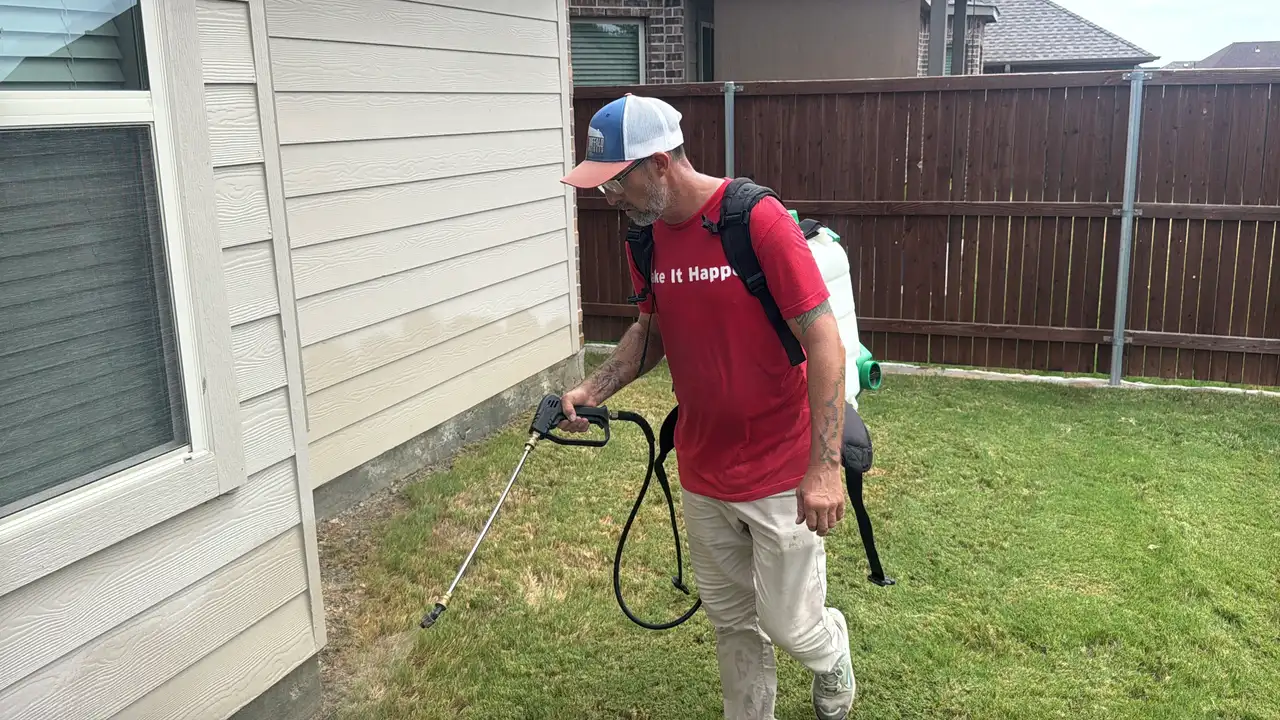
Reading the brick before treating it
The technician walks the bottom course counting weep holes and checking thresholds, mortar gaps and utility penetrations. On a house of this age that walk usually explains years of ant calls, and it is also where we tell you whether copper mesh is worth quoting.

Band, sweep and dust
Liquid goes around the entire foundation and three feet up the wall, the eaves and door frames get worked over with a web pole, and every weep hole takes Delta Dust. Under mature canopy the eave sweep is the part that stops spiders and wasps from setting straight back up.
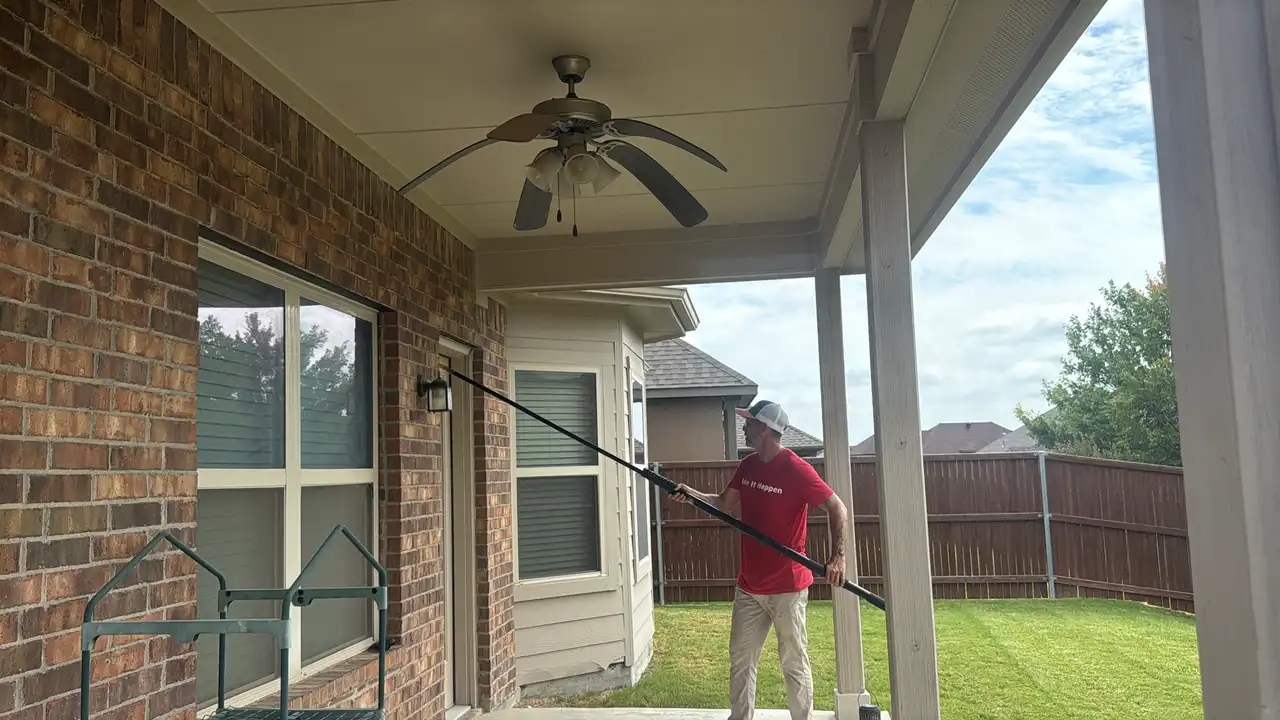
Granular out into the yard
A granular barrier is spread about 25 feet from the wall through turf and landscape beds, and fire ant bait goes down wherever mounds are showing. You do not have to be there; we need the gate open, and a text goes out when the technician is on the way.