
UNDER THE OAKS AND PECANS
Why Westover Hills has more chiggers than its neighbors
Because the whole town is shade. Westover Hills sits under some of the densest mature canopy in the county, and the ground beneath old oaks and pecans stays damp and littered with leaves from one autumn to the next. That is the only habitat a chigger larva needs: cover, moisture and somewhere to wait out the cold before it starts climbing grass stems again in May.
On an estate lot the problem is rarely the open lawn. It is the woodland edge at the back of the property, the layered beds and stone walls where mulch and leaves pile up, and the irrigated plantings that never dry out. Chiggers climb from that ground onto whoever walks through it and feed where clothing presses tight, which is why the welts sit at the sock line and waistband instead of scattering the way mosquito bites do.
LARGER HOMES, UPPER BANDS
What chigger coverage costs on a Westover Hills property
Most Westover Hills homes fall in the upper half of our table, and a good number of them are quoted rather than listed. Complete Home & Lawn Defense, which treats the whole yard and is the plan that actually reaches the chigger edges, runs $51.50 to $62 a month for a house between 3,000 and 4,500 square feet and $62 to $73.50 for one between 4,500 and 6,000. Anything above 6,000 square feet we price after walking it, because the ground to cover varies too much to publish a number.
Home Defender at $38 to $54 a month for those same house sizes treats a 25-foot ring around the structure, which on an estate lot is a small fraction of the grounds and misses the wooded boundary entirely. For chiggers in Westover Hills it is usually the wrong plan. Neither carries a contract or a startup fee, and the figure is settled before the first visit goes on the calendar.
3,000 to 4,500 sq ft
$51.50 to $62 a month
Whole grounds, Complete Home & Lawn Defense
4,500 to 6,000 sq ft
$62 to $73.50 a month
The most common Westover Hills band
Over 6,000 sq ft
Quoted after a walk-through
Priced on the ground there is to treat
Home Defender, same sizes
$38 to $54 a month
25-foot ring; misses the wooded edge
Every number on this page comes from our published price list. Westover Hills homes get the same table as everyone else; the instant quote reads your square footage and lot size and hands you your own line.
WHERE IT FALLS DOWN
Three reasons a Westover Hills chigger treatment disappoints
Leaf litter defeats it. A Westover Hills lot can carry a season's worth of pecan leaves under the canopy and in the beds, and the larvae live in that layer, not on top of it. If the litter stays, the treatment reaches the surface and the chiggers underneath carry on, so raking and clearing the beds before we come is not optional advice.
The lot line is the limit. Where a property runs into a wooded ravine or a neighbor's unmanaged ground, that cover keeps producing chiggers all summer and some will cross into treated grass. We reduce what lives on your side, which is the bulk of what bites you, but we cannot treat land that is not yours.
Big grounds also mean a bigger job for the homeowner between visits. Beds kept deep in mulch and irrigated daily stay chigger-friendly no matter what is applied, and on a heavily landscaped Westover Hills property that can be most of the perimeter. If you are not willing to pull mulch back and let some of that ground dry out, the results will be partial.
SULFUR, RAKES OR THE PLAN
Comparing the old remedies to a treated yard in Westover Hills
The cheapest thing that works is drying the ground out: rake the litter, thin the beds, cut the irrigation back where the lawn meets the trees. Do that on any Westover Hills lot and you remove a real share of the habitat for nothing. Sulfur dust is the traditional follow-up and it does push chiggers back briefly, but on grounds this size you would be dusting a great deal of ground every couple of weeks, and rain undoes it.
A treated yard covers the whole lawn with the heaviest application along the wooded edges, the beds and the walls, and adds a three-foot band at each door so nothing gets tracked into the house. On an estate lot that is the difference between guessing where the larvae are and actually reaching them. With this much shade, the yard work alone is rarely enough in Westover Hills; the two together are what hold.
ON THE GROUNDS
What the first chigger visit covers on a Westover Hills estate

Mapping the shade
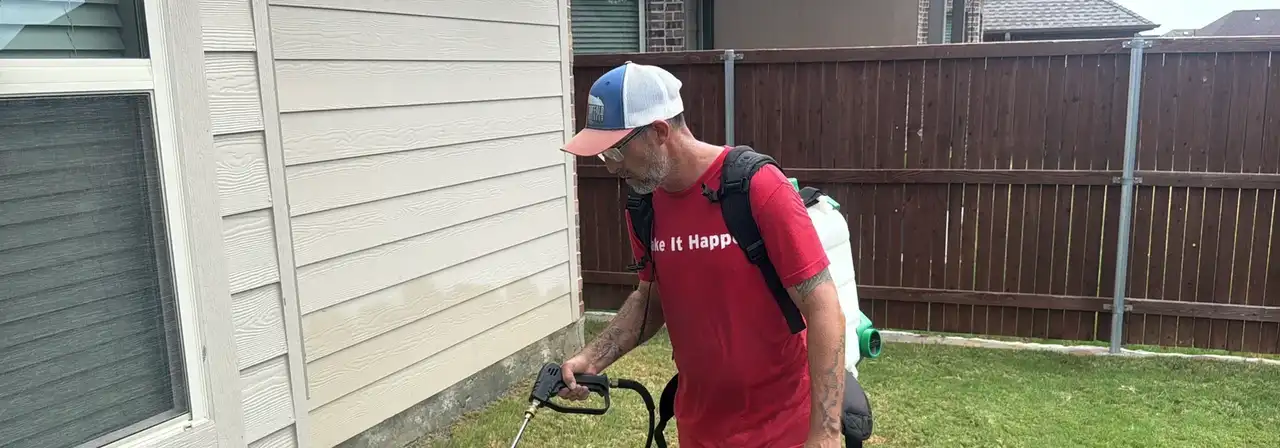
The technician walks the tree line, the beds and the back boundary before treating anything, because on grounds this large the chigger zones are specific and the open lawn is mostly not one of them. That map decides where the product goes heaviest.
The litter conversation
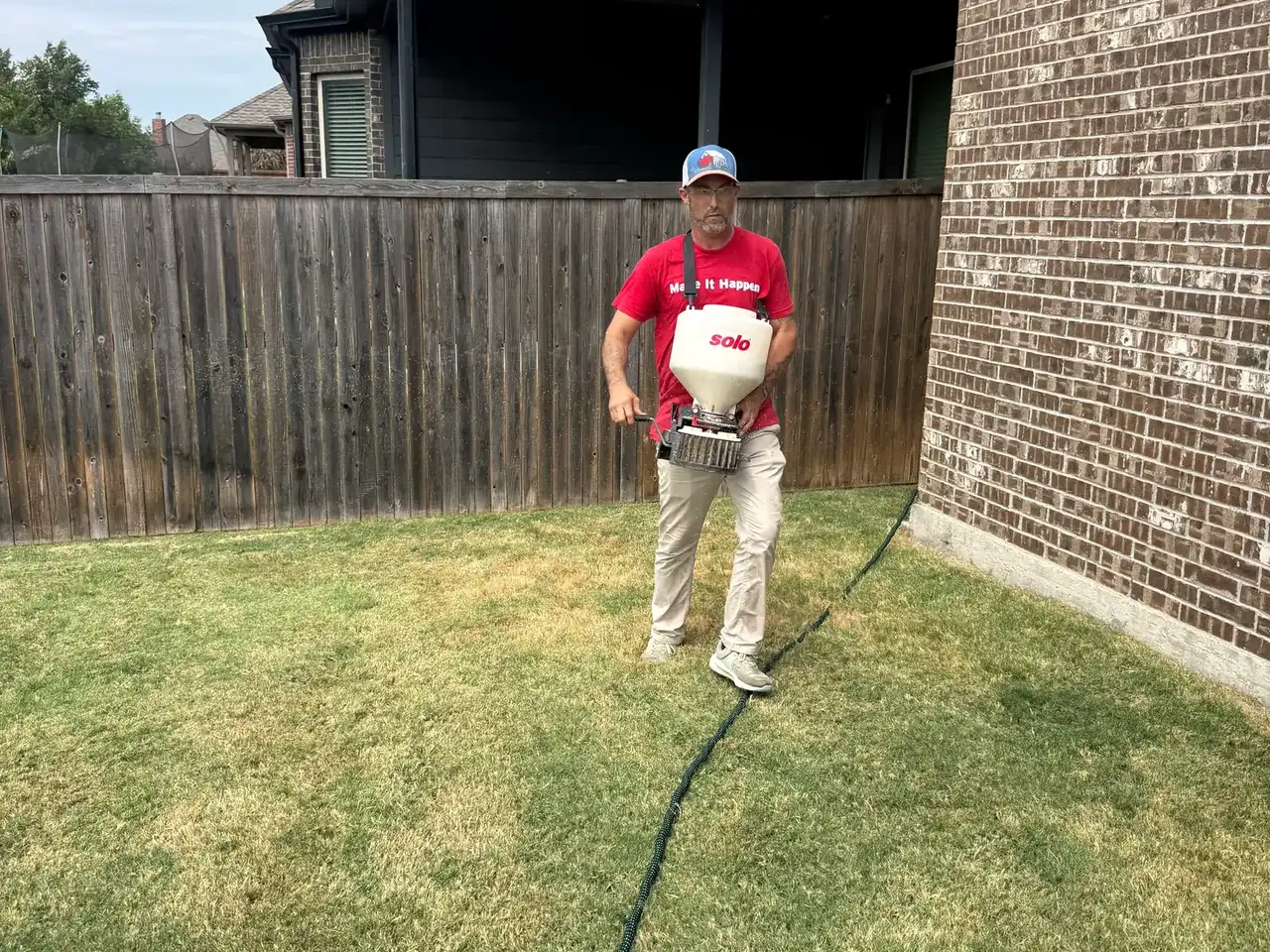
Anywhere leaves have collected under the canopy or in the beds gets pointed out, and we ask you to have it cleared before treatment rather than spraying over it. On a Westover Hills property that is a real job, but it is also most of the fix.
Doors, and the Fort Worth address
Every entry point, including pool-house and garage doors, gets its three-foot band. The whole town mails as Fort Worth 76107, which changes nothing about the visit; we schedule by where the house stands.