
ACREAGE MOSQUITOES
Why a pasture lot bites differently
On an Annetta property the mosquitoes are not made in your lawn. They come off the brush line, the shaded fence rows and whatever holds water out in the pasture, then fly in to the patio at dusk. That changes the shape of the job: on a subdivision lot we fog the yard, and out here we fog the yard plus the edge feeding it.
The Mosquito, Flea & Tick program keeps the same 21-day cycle from April through September that it runs everywhere else, but more land means more resting vegetation to cover and a great deal more boundary to walk. The same visit handles the ticks and chiggers coming off the pasture, which on this kind of ground is usually the louder complaint anyway.
PRICED ON THE LOT
What an Annetta place pays per visit
Nearly every property out here lands in the upper bands or past the table altogether. The steps run from $49.95 a visit on a lot of 7,000 square feet or less up to $129.95 at 42,001 to 47,000, and anything above 47,000 square feet, which is about an acre, gets quoted on the property instead of dropped into a band.
Treatable ground decides that quote, not deed acreage. A five-acre place with a mown acre around the house, a barn and a fence row to fog is not five times the work of a one-acre lot, and we would rather walk it and hand you the real figure than sell a blanket price for land nobody is going to treat. Billing stays per visit, with no contract behind it.
Lots 22,001 to 27,000 sq ft
$89.95 a visit
A half-acre-plus building site
Lots 37,001 to 42,000 sq ft
$119.95 a visit
Close to a full acre of mown yard
Over 47,000 sq ft
Quoted on the property
The normal case in Annetta
Every number on this page comes from our published price list. Annetta homes get the same table as everyone else; the instant quote reads your square footage and lot size and hands you your own line.
WHAT WE WILL NOT CLAIM
The limits of fogging on open ground
Nobody fogs a pasture into being mosquito-free, and a company offering to has sold you the neighbouring field as well. Treatment kills adults resting in the vegetation we can reach and knocks down the population living on your ground; what flies across from the bottomland next door at dusk is not stopped by a barrier at all.
Standing water on acreage is often livestock water, and livestock water is not something we treat. Troughs, tanks and tyre feeders sit inside the no-spray zones mapped around animals, so keeping those turned over rather than stagnant is a chore that stays with you.
Residual is the third limit. Three weeks in peak heat is the honest expectation and less after a Parker County downpour; when something flares before the next scheduled visit, we come back out and re-treat without adding to the bill.
AGAINST A MISTING RIG
System, barrier, or simply nothing
Misting systems get pitched hard on acreage, and around a tight courtyard or a pool deck they do work. Scale is the problem. Between $2,000 and $4,000 installed plus refills buys coverage of the zone the nozzles are mounted on, and where the mosquitoes originate two hundred feet out at the fence row, a ring around the patio is treating the wrong end of the property.
Doing nothing is a legitimate answer for part of the year, and we will tell you when. An Annetta yard used in April and again in October is a completely different purchase from one with a porch in use every night of July. Since nothing is prepaid, running the program hard through the biting months and then stopping is a perfectly normal way to buy it.
FIRST VISIT, ANNETTA
Walking an acreage property
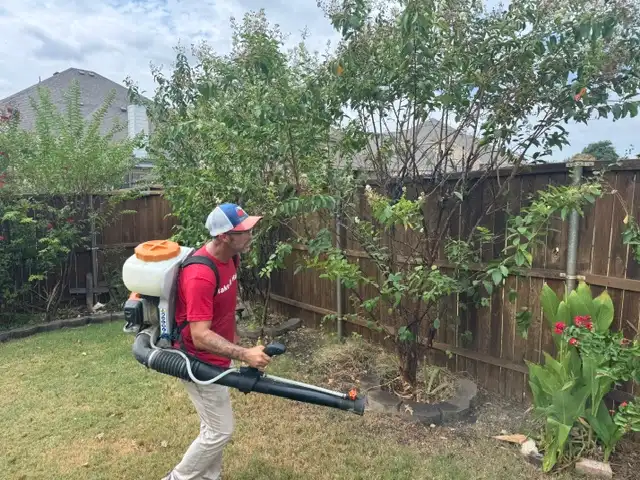
The boundary walk
The mown edge gets walked before anything else, because on a property ringed by pasture that line decides everything: how far the fog needs to reach, where ticks and chiggers are entering, and which stretches of fence row are worth the product.
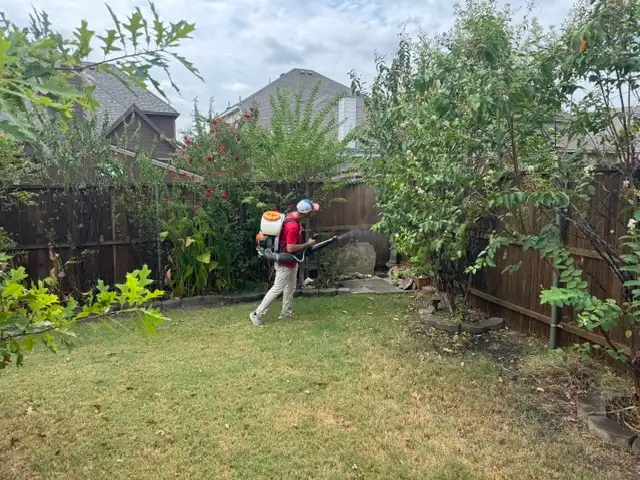
Structures before turf
Barns, shops, the woodpile and the shaded flanks of outbuildings hold damp still air and resting adults through the day, so they are covered on the same pass. Anything obviously breeding around them gets flagged to you: a blocked barn gutter, a bucket, an overflowing tank.

Animals mapped out
Pens, troughs, feed and any hive or pollinator planting are marked as no-spray zones before a fogger is ever started. Tell us where the animals live when you sign up and none of it becomes a surprise on the day.