ACREAGE, 76008
What a perimeter plan covers on an Annetta acreage lot
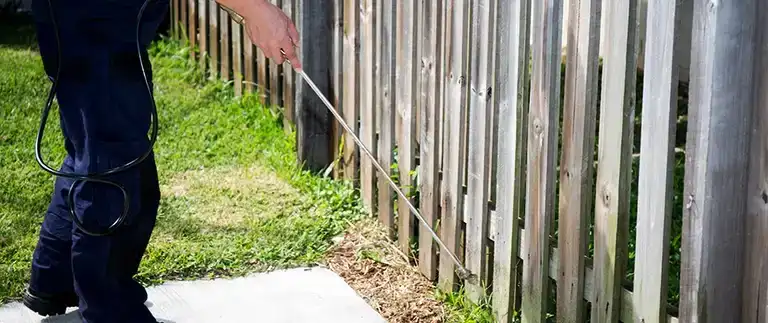
It covers the house and the ground you actually use, not the pasture. Annetta sits south of Aledo where homes are set well back on acreage with hay, brush and pasture on every side, and blanket-treating open ground is both expensive and short-lived, because the next property refills it. Home Defender builds a band at the foundation, a swept eave line, dusted weep holes and a granular ring about 25 feet out.
That ring is the part that earns its keep on a property like this. Chiggers, ticks and fire ants come out of the taller grass at the boundary, and the line worth defending is where your mowing stops rather than where the deed stops. Fire ant bait is broadcast across the treated yard as part of both year-round plans instead of being billed on its own.
THE MONTHLY NUMBER
Why an Annetta acre costs the same as a small lot
Because the plan is priced on the square footage of the home. Acreage does not enter into it: a 3,200 square foot house on five Annetta acres and a 3,200 square foot house on a subdivision lot both sit in the $38 to $46 band, since the perimeter and the eave line are the same length either way.
The full range is $30 to $54 a month for four visits a year, billed monthly, with anything above 6,000 square feet quoted individually. Nothing gets signed, there is no startup fee on the standard plans and no cancellation fee, and you hear the number before committing to anything. If you want the yard treated past the 25-foot ring, that is Complete Home & Lawn Defense at $40 to $73.50 a month.
1,500–3,000 sq ft
$33–$38 a month
Older houses out along the county roads
3,000–4,500 sq ft
$38–$46 a month
Typical of the acreage builds around here
4,500–6,000 sq ft
$46–$54 a month
The larger custom homes set back off the road
Rodent add-on
$25 a month
Only alongside a year-round plan, never by itself
Every number on this page comes from our published price list. Annetta homes get the same table as everyone else; the instant quote reads your square footage and lot size and hands you your own line.
THE HONEST GAPS
What Annetta owners should not expect from it
Your barn is not in the price. Outbuildings, shops and tack rooms are structures of their own, and a plan quoted on the square footage of the house does not silently include them. We look at them on the first visit and say which ones are feeding the problem, but treating them is a conversation rather than an assumption.
It is not a mosquito, flea or tick program either. Those run on their own calendar, a visit every 21 days from April through September priced on the lot, and on a property with that much edge it is the program that touches the biting insects. Home Defender aims at the crawlers: ants, spiders, scorpions, roaches, crickets, earwigs and their relatives.
Rodents need work you cannot spray your way out of. Wood stacked against a wall and a gap under a barn door are shelter and doorway in one, and the order of operations is exclusion first, trapping second. Rodent control is $25 a month added to a year-round plan and is never sold on its own, because the perimeter work underneath it is doing half the job.
SEAL IT OR SPRAY IT
Copper mesh versus another round of product
If you only do one thing to an Annetta house this year, close the weep holes. The gaps along the bottom course of brick let the wall drain, and they are also the most-used doorway into a North Texas home for insects, scorpions and mice. Delta Dust goes into every one of them on every visit as part of the plan; copper mesh packs the opening shut for good without trapping moisture or rusting the way steel wool does.
That sealing is an add-on, quoted separately, and it is genuinely a job a capable homeowner can do on a Saturday. The rest does not transfer to the driveway: a hardware-store concentrate breaks down in roughly a week of Texas heat, so matching one professional foundation band means circling the whole house again each weekend all summer. Sealing is where doing it yourself wins, and longevity is where it loses.
FIRST STOP IN ANNETTA
Three things we check before we treat
Where the mowing stops
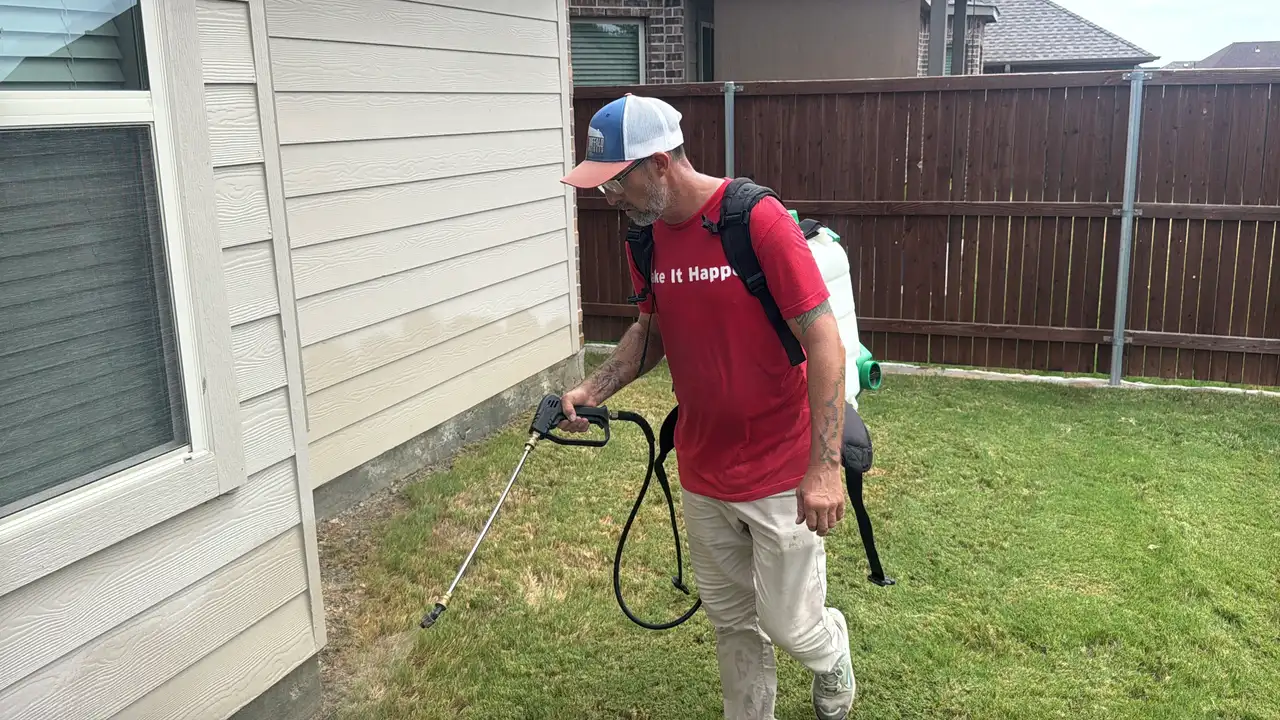
The line between cut lawn and pasture is the front line on a property this size, so it gets walked before anything is applied. Chiggers and ticks hold in the taller grass there and move in from it, and that walk decides where the treated buffer sits.

Barns, shops and stacked wood
Outbuildings and woodpiles shelter rodents, spiders and scorpions long before anything reaches the house. They get looked at on the first visit, and you get told which ones are actually contributing and which are fine as they are.
The brick and its openings
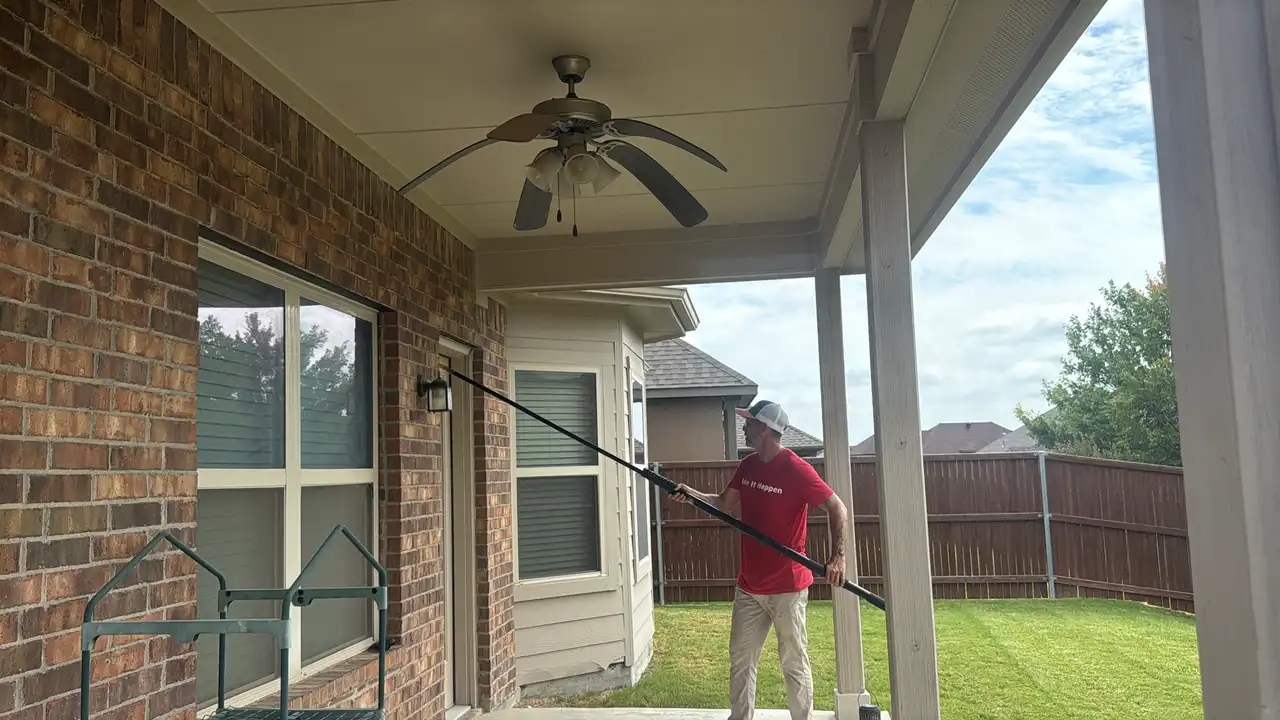
Weep holes get counted and dusted, door sweeps and utility penetrations get checked, and the liquid band goes around the slab and three feet up the wall. Eaves, soffits and door frames are cleared with a web pole so wasps and spiders have to start from nothing.