
CREEK BOTTOM AND CANOPY
Why Argyle mosquito pressure runs late into September
Argyle holds mosquitoes longer than most of Denton County because it has more of what they need. Bigger lots carry more tree cover, fence lines back onto pasture and creek bottom, and horse property comes with troughs and low spots that hold water. Shaded, damp ground stays humid through August when a subdivision lawn has baked dry, so the population here does not thin out the way it does closer in.
The Harvest side is the exception. Master-planned streets with young trees and graded soil have less resting cover, and the pressure there is lighter until the landscaping matures. On either side of Argyle the program is a fog of the resting vegetation every 21 days from April through September, plus the turf edges for fleas and ticks, priced per visit on the lot.
ARGYLE LOT PRICING
What each visit costs on an Argyle lot
Most Argyle addresses sit in the upper bands or past them. An acre-plus property off Country Club Road or Crawford Road is quoted individually because the published prices stop at 47,000 square feet, while a Harvest lot of 7,001 to 12,000 square feet pays $59.95 a visit. The house size is irrelevant; a big house on a small lot pays the small-lot rate.
Payment is per visit as the visits occur, with no contract holding you into September and no startup or cancellation fee. A quote covers the residential envelope: the yard you use, the trees and beds, and a buffer at the boundary, not open pasture. Re-treats between scheduled stops are warrantied, and /instant-quote pulls the lot and returns the band.
Lots from 7,001 to 12,000 sq ft
$59.95 a visit
Typical on the Harvest side
Lots from 32,001 to 37,000 sq ft
$109.95 a visit
Around three quarters of an acre
Lots from 42,001 to 47,000 sq ft
$129.95 a visit
The last band before a quote
Over 47,000 sq ft
Quoted for the property
Most of the acreage and horse property
Every number on this page comes from our published price list. Argyle homes get the same table as everyone else; the instant quote reads your square footage and lot size and hands you your own line.
SAID PLAINLY
What treating an Argyle acre will not achieve
We do not spray pasture, and you should not pay anyone who offers to. Product across acres of open grass costs a fortune and holds for days, while the adults that matter are resting in the treeline and the brush along the creek. Beyond the treated buffer at your boundary, the pasture keeps doing what pasture does.
Horse property has a water problem a fog cannot touch. Troughs, buckets, a low corner of the paddock after rain and the tarp over the hay all breed mosquitoes faster than any barrier kills them. We larvicide what cannot be emptied, but on an Argyle place the homeowner's weekly water check is half the program.
And the creek bottom behind you is a permanent source. Adults drift in from untreated ground every evening, so a treated Argyle yard beside a creek still sees some activity at dusk. Honest expectations are fewer bites rather than none.
SEASON PROGRAM OR YEAR-ROUND
Mosquito, Flea & Tick against Home Defender for an Argyle home
Argyle homeowners often ask whether the year-round Home Defender plan covers mosquitoes, and it does not. Home Defender is a perimeter program priced on the house: the foundation, eaves, weep holes and a granular ring 25 feet out, four visits a year, with fire ants included. It stops what walks into the house. It does not fog the trees.
Mosquito, Flea & Tick is the opposite shape: priced on the lot, run every 21 days only through the warm months, and aimed at resting vegetation and turf edges rather than the wall. If your Argyle problem is scorpions in the barn and ants in the kitchen, buy the year-round plan first; if it is being driven indoors at dusk from May on, the season program is the one that addresses it.
THE FIRST ARGYLE APPOINTMENT
How the first treatment goes on acreage and horse property
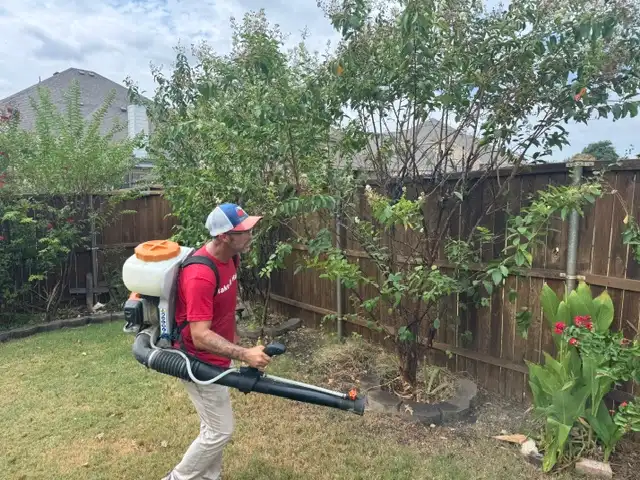
Mapping animals and water
Before anything is applied, the technician asks where horses, dogs, hives and gardens are and marks those areas as no-spray zones. Then the water gets counted: troughs, buckets, gutters, wheelbarrows and any low ground still wet from the last rain.
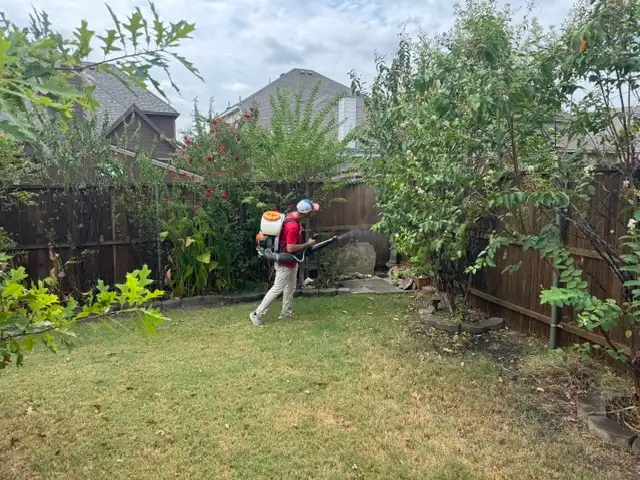
Deciding where the buffer sits
On an Argyle acre we walk the fence to see where the mowing stops, where the brush and creek shade begin, and how far a treated strip should run. That line is set with you, not guessed, and it decides what the quote covers.

Fogging cover and treating the edges
Trees, hedge lines, shrub beds and the shaded sides of barns and shops get the backpack fogger; turf and bed edges are treated for fleas and ticks. A large crew means the first appointment usually lands within a week.