
ACREAGE AND HORSE PROPERTY
Why a house on open ground needs the barrier more than most
Because there is so much more edge touching it. Argyle is the acreage end of Denton County, with tree cover, pasture and creek bottom backing the properties along Country Club Road and Crawford Road, plus a block of master-planned houses on the Harvest side that were pasture themselves not long ago. Both halves of town send steady traffic at the foundation, just different traffic.
The Home Defender Plan answers with four scheduled visits a year and an identical set of jobs each time: liquid along the slab and three feet up the wall, an eave and soffit sweep with a web pole, Delta Dust pushed into every brick weep hole, granular broadcast about 25 feet out, and fire ant bait across the yard. The completeness of that list is what makes it hold. A single spray around the slab is the cheaper version that does not.
76226 NUMBERS
What Argyle homeowners pay, and what does not change it
The plan runs $30 to $54 a month, set entirely by the square footage of the house. Land area is nowhere in that calculation, which is worth stating plainly in a town where lots get described in acres. A five-acre Argyle property with a 3,800 square foot home pays what a 3,800 square foot home on a quarter acre pays.
Most Argyle floor plans land in the $38 to $46 stretch, with the larger custom houses sitting above it. Payment is monthly against four visits, and you hear the figure before committing to anything at all. There is no startup fee, no cancellation fee and no contract, and a return trip between scheduled visits is not billed.
3,000-4,500 sq ft
$38-$46 a month
The common range for houses in this town
4,500-6,000 sq ft
$46-$54 a month
Larger custom builds on the acreage side
Over 6,000 sq ft
Quoted
Somebody measures rather than guesses
Rodent control
$25 a month
Added to a year-round plan, never sold on its own
Every number on this page comes from our published price list. Argyle homes get the same table as everyone else; the instant quote reads your square footage and lot size and hands you your own line.
WHAT AN ACRE WILL NOT GET
Three things we will tell you this plan cannot reach
It does not treat pasture, and we would rather say so before you buy than after. The treated area is the house, the yard your family uses and a buffer at the boundary. Blanket-spraying acres of grazing land costs a fortune and washes out of usefulness long before the next visit, so if that is the request our answer is no rather than an underquote.
Rodents sit outside this program too. Barns, shops and tack rooms have gaps a finished house does not, mice use them as a staging area before they ever work toward the home, and nothing sprayed on the ground alters that. Rodent work is exclusion first and trapping second, at $25 a month added to either year-round plan.
Mosquitoes are separate as well. The Argyle properties with real tree canopy and standing water behind them hold pressure deep into the season, and none of it is touched by a barrier meant for insects that walk. That work runs every 21 days from April through September, priced on lot size.
BUFFER OR BLANKET
Treating a boundary strip versus treating everything
The real choice on acreage is not which plan carries more product, it is where the product goes. Home Defender lays a granular ring roughly 25 feet out from the walls, which covers the patio, the play area and the beds, meaning the part of an Argyle property people are genuinely standing in. Complete Home & Lawn Defense widens that to the whole yard for $40 to $73.50 a month.
Neither is a pasture treatment, and the upgrade earns its money when the usable yard is bigger than the ring, not because the deed says five acres. Where chiggers and ticks are the complaint, the cheaper half of the fix never appears on our invoice anyway. Keeping the grass short where the lawn runs into brush removes the habitat the treatment would otherwise be chasing.
THE ARGYLE WALKAROUND
The order the first appointment happens in
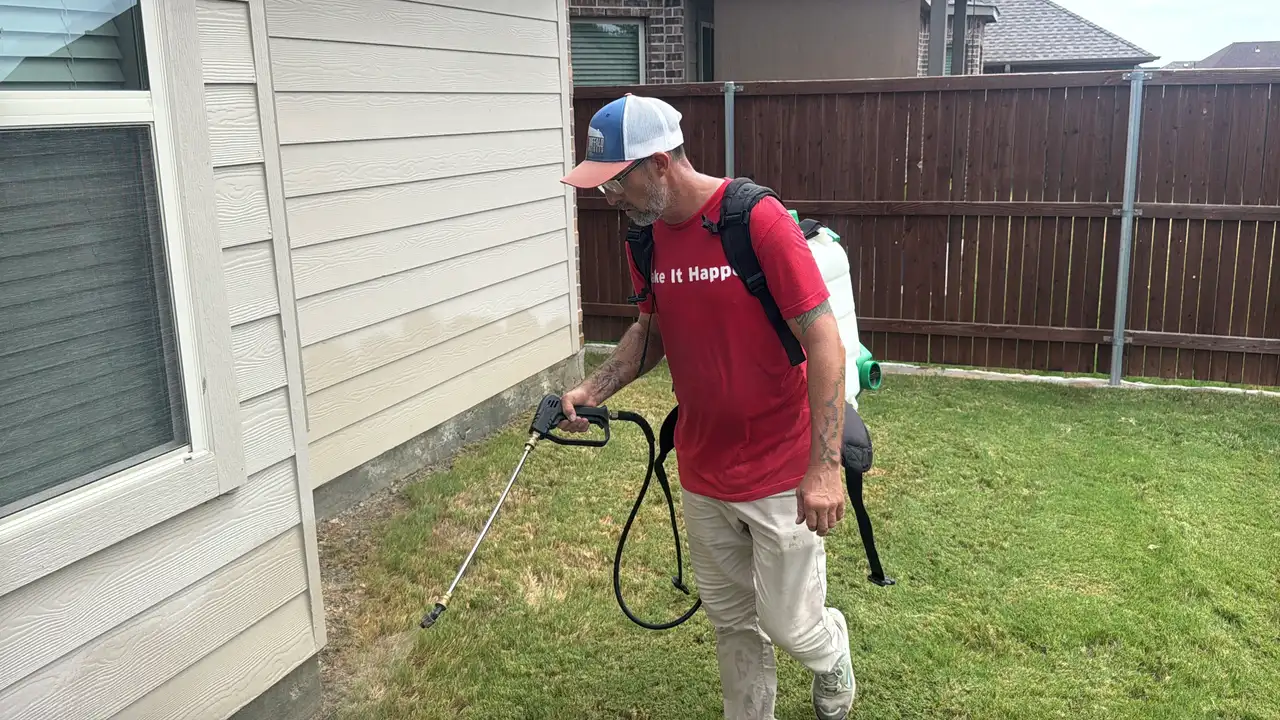
The fence line first
Before anything comes off the truck the technician walks the boundary, because on an acre that is where the chiggers, the ticks and a fair share of the ant pressure begin. Where the brush starts decides how wide the granular goes and whether the ring is enough on its own. If it is not, you get told so rather than sold up quietly.

Outbuildings and livestock areas
Barns, shops, tack rooms and detached garages get inspected the way the house does, since those are the structures nobody sealed. Point out where the horses and the dogs are kept before we start and those areas go on the map as no-spray, which is a conversation worth having in advance instead of afterwards.
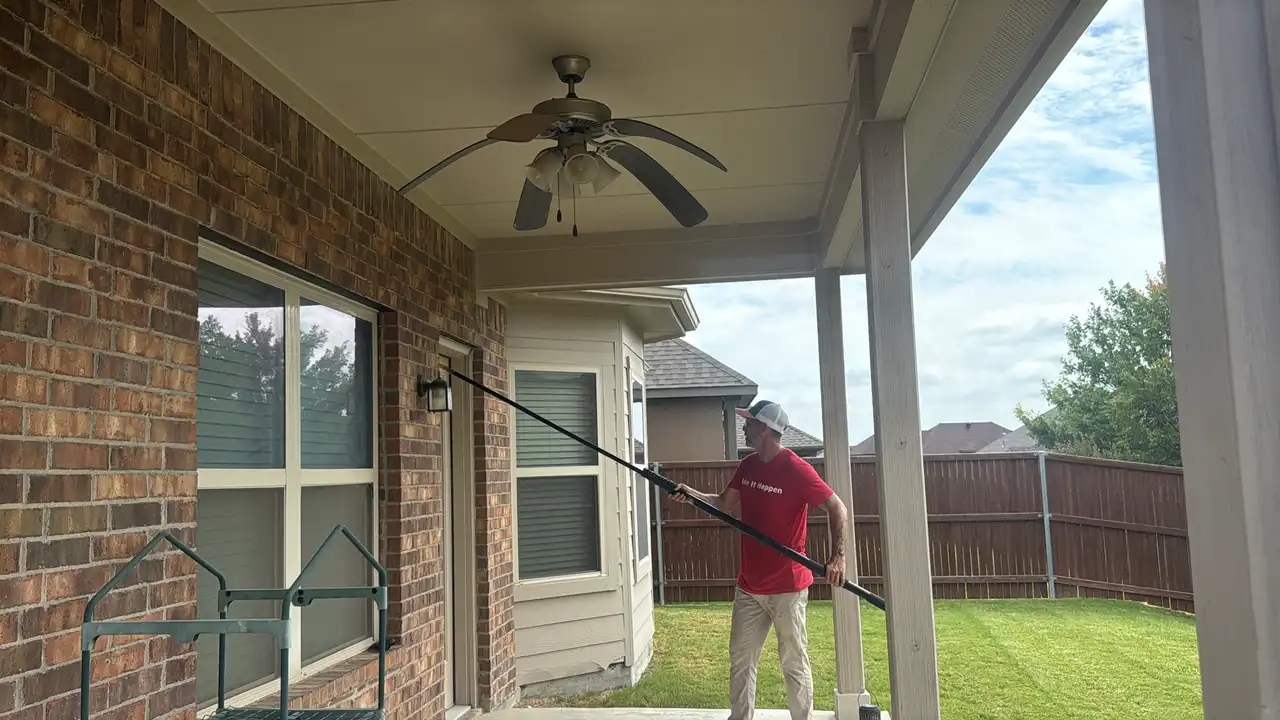
Then the house itself
Liquid goes down along the foundation and up the wall, the web pole strips webs and wasp starts out of eaves, soffits and door frames, every weep hole takes Delta Dust, and the granular and the fire ant bait go out on the same pass. Gate access is the only requirement, and a text lands when the technician is on the way.