ACREAGE AND OUTBUILDINGS
Why acreage in Argyle turns into a rodent problem
Because acreage comes with buildings that were never meant to be sealed. An Argyle place typically has a barn, a shop, a tack room or a detached garage, each with doors that do not meet the slab and walls that stop short of the roofline. Put hay, feed and stored equipment inside and you have housing, food and cover in one building.
The ground around them supplies a steady stream. Pasture edges, creek bottom and the brush behind a fence line hold rodents whether or not anyone is feeding them, and every structure on the property looks like an upgrade from a field. That is the traffic; it is not, by itself, the problem.
The problem starts when they reach the house, and that step is usually the shortest one on the property. Which is why on an Argyle inspection the house is not where we begin.
COST ON AN ARGYLE PLACE
One flat rodent price, whatever is standing on the property
Rodent control is $25 a month, added to Home Defender or Complete Home & Lawn Defense, and it is not available without one of the two. That figure does not change because you have three outbuildings instead of none, and it does not change because the first inspection takes an hour longer than it would in town.
The plan underneath is priced on the square footage of the house alone. Argyle homes at 3,000 to 4,500 square feet carry Home Defender at $38 to $46, so the monthly total is $63 to $71; at 4,500 to 6,000 it is $46 to $54, making $71 to $79. Anything above 6,000 square feet gets walked and quoted rather than guessed. Nothing here involves a contract, a startup fee or a charge to cancel.
Rodent add-on
$25 a month
Same price with or without outbuildings
Home Defender, 3,000 to 4,500 sq ft
$38–$46 a month
Many Harvest-side houses
Home Defender, 4,500 to 6,000 sq ft
$46–$54 a month
The larger acreage homes
Homes above 6,000 sq ft
Quoted after a walk-through
Call or text (817) 984-8611
Every number on this page comes from our published price list. Argyle homes get the same table as everyone else; the instant quote reads your square footage and lot size and hands you your own line.
SAYING IT PLAINLY
What rodent work on Argyle acreage cannot achieve
Nobody is making a hay barn rodent-proof. Hay is bedding and cover, the doors are open half the day, and the building has gaps by design. On that structure the work is trapping, station placement and sensible storage, and any company promising exclusion on it is selling you a sentence rather than a service.
We also cannot fix a property whose feed is loose. Grain, sweet feed and bagged supplements are the whole reason a tack room has mice, and metal bins with tight lids do more than anything we bring in the van. We will point at it every visit until it changes, politely.
And the pasture is not treatable. Rodents live in open ground across this part of Denton County and always have. What the add-on delivers is a house that is closed to them and outbuildings that are actively worked, not an empty property.
METAL BARN OR BRICK WALL
Why the shop and the house need different tactics
A brick house can be genuinely closed. There is sound material to fasten to, the openings are countable, and copper mesh, steel and hardware cloth will hold at every one of them. Do that properly and the building stops being available, which is a result you can verify on the follow-up.
A metal shop or a pole barn is a different proposition. Ribbed panels leave voids, roll-up doors have corners, and the slab has usually moved somewhere along its length. We close what has something to close against and then work that building with traps and locked stations instead, checked on the plan visits. Treating both the same way is how people end up disappointed with the barn and surprised by the house.
WALKING THE PLACE
The route a first Argyle visit takes
Fence line and pasture edge
We walk the boundary before touching a building, because it shows the direction of travel. Runs through taller grass, burrows at a fence post and droppings along a rail tell us which structures are under pressure and from which side, and that decides where the trapping goes.

Tack room, feed and the shop
Every outbuilding is opened and inspected: nests in stored blankets, droppings on shelving, gnawed sacks, chewed wiring in equipment. On most Argyle properties this is where the population lives, so it gets traps and stations on the first visit rather than on a later one.
The house, low and high
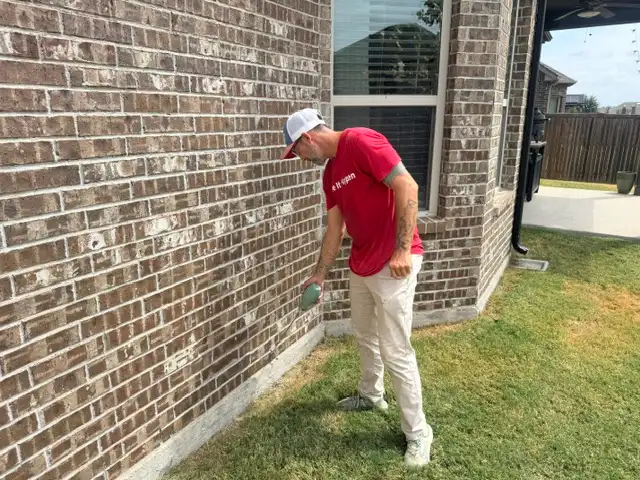
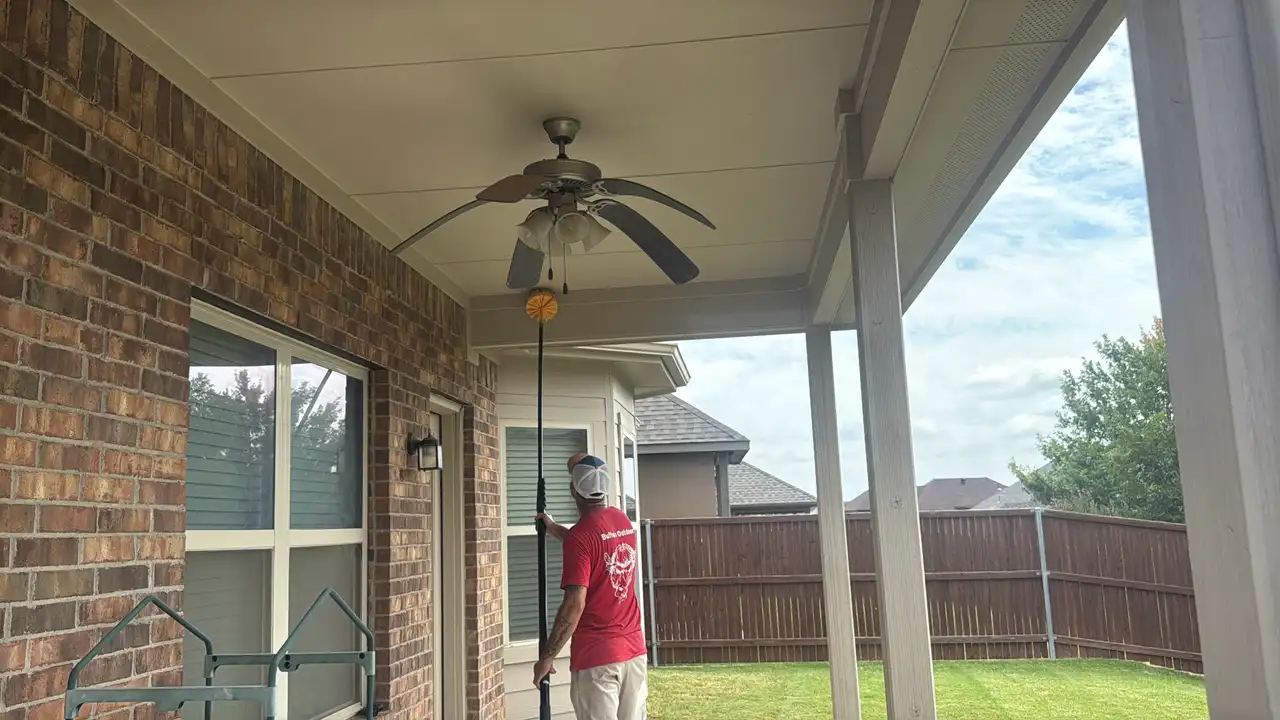
Then the house, working the bottom course, thresholds, garage corners and utility penetrations, and up at the roof line where trees reach the eaves. The weep holes are already sealed with copper mesh and dusted under both year-round plans, so the inspection covers everything else, and the attic tells us where the traps belong.