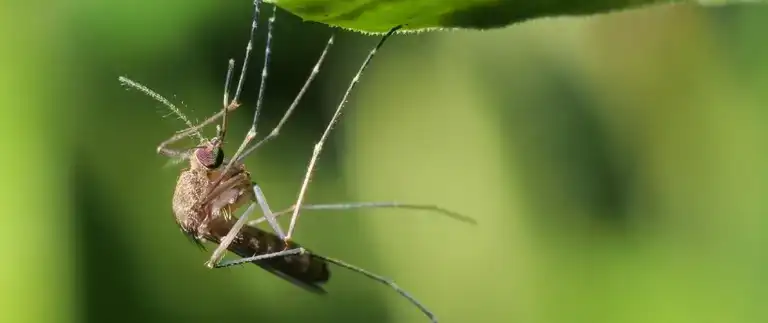
HOME TURF
Mosquito pressure changes by Fort Worth neighborhood
Fort Worth is big enough that the mosquito problem depends on which part of it you live in. North of Loop 820, along the Alliance corridor and in Park Glen, Summerfields and Fossil Creek, construction is mostly from the last twenty years, so the canopy is thin and pressure is moderate; inside the loop, Arlington Heights, Ridglea and the streets around TCU sit under 60- and 70-year-old trees that hold mosquitoes in the shade all summer.
Buffalo Outdoor's shop is at 13181 Harmon Road in 76177, so north Fort Worth is home and the rest of the city is a normal drive. The program is identical in both halves of town: a visit every 21 days from April through September aimed at shrub lines, canopy and turf edges, in 76177, 76131 and 76137 and the older neighborhoods south and west.
FORT WORTH PRICING
How much mosquito control costs in Fort Worth
A Fort Worth lot of 7,000 square feet or less pays $49.95 a visit, and the common suburban lot between 7,001 and 12,000 square feet pays $59.95. Older inside-the-loop lots usually land in those two bands; bigger Alliance-area yards step up to $69.95 or $79.95, and lot size is the only thing that sets it.
No contract, no startup fee, no cancellation fee, and never a season total up front; you are billed each time we come. Retreatments between visits are included under the warranty, so a washout after a Fort Worth thunderstorm costs nothing extra.
Up to 7,000 sq ft
$49.95 a visit
Many of the older lots inside Loop 820
Between 7,001 and 12,000 sq ft
$59.95 a visit
The most common Fort Worth band, north and south
Between 12,001 and 17,000 sq ft
$69.95 a visit
Larger newer lots along the Alliance corridor
Every number on this page comes from our published price list. Fort Worth homes get the same table as everyone else; the instant quote reads your square footage and lot size and hands you your own line.
THE HONEST PART
Where mosquito treatment disappoints Fort Worth homeowners
If your house backs the Trinity greenbelt or a creek corridor, expect fewer mosquitoes, not zero. Those corridors breed constantly and adults drift in from land nobody treats; the program cuts the population living on your lot, which is most of what bites you on the patio, but it is a reduction, not a wall.
In the newer north Fort Worth subdivisions with thin canopy and open Bermuda, pressure is often light enough that a full program is not worth buying, and we would rather say so than sign you up. The money on those lots is better spent on fire ants and chinch bugs, which the year-round plans cover.
Twenty-one days is the realistic hold in peak season and rain shortens it, so anyone selling monthly visits is leaving a week or more uncovered. We also skip blooming flowers, and a pollinator bed or hive becomes a no-spray zone from the first visit.
DIY VS A PROGRAM
Should a Fort Worth homeowner just do this themselves?
Some of it, yes, and we say this to every caller: dump the standing water weekly and fix the gutter that holds a puddle. Those two steps are free and remove breeding sites no spray touches; citronella, zappers and ultrasonic gadgets do essentially nothing for a yard-sized problem.
Where the store-bought route fails is duration and reach. A hose-end spray lasts around five days in Fort Worth heat and never reaches the underside of a dense holly or the shaded north wall, and a summer of bottles usually costs more than $49.95 to $59.95 every three weeks.
VISIT ONE
What a first mosquito visit in Fort Worth covers
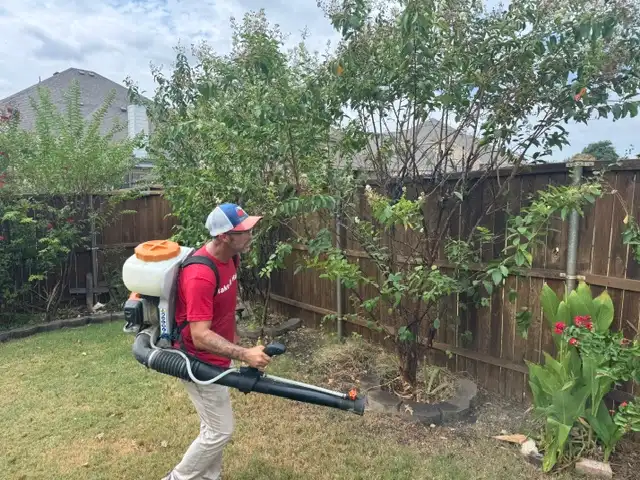
The shade survey
We walk the property for daytime resting spots: dense shrubs against the brick, the north side of the house, deck skirting, low canopy and the fence line. In older Fort Worth neighborhoods that list is long; in a new Alliance build it may be three shrubs and a fence.
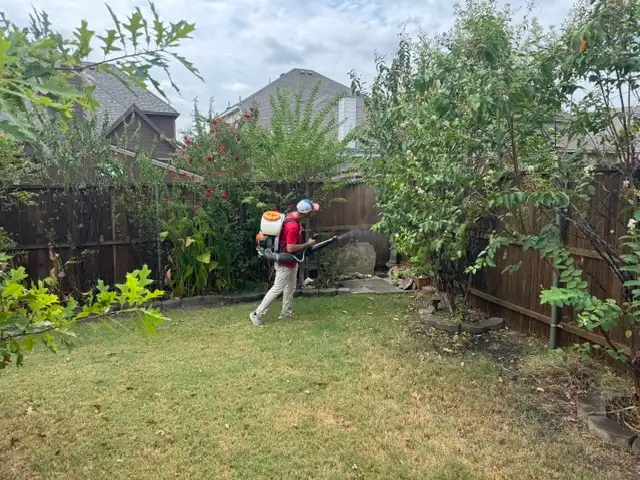
Fog, then the turf edges
The backpack fogger goes through ornamentals, hedges and canopy where adults rest, and turf and bed edges get a separate pass for fleas and ticks. Open lawn in full sun is skipped on purpose, because nothing rests there.

Standing water and larvicide
French drains, low spots and anything else that holds water and cannot be drained gets larvicide. We also point out the saucers, tarps and bird baths you can empty yourself, because that is your half of the job.