FOSSIL CREEK SHADE
Why an older suburb bites harder than a new one
Two reasons, and both are things Haltom City homeowners usually like about the place. The first is the trees: housing here mostly went up between the 1950s and the 1970s, and the canopy that came with it holds damp, still air over the ground through the hottest hours, which is exactly the daytime shelter adult mosquitoes are looking for.
The second is Big Fossil Creek and the tributaries feeding it. Running water and the wet margins beside it keep producing after the last rain has dried out of everyone else's yard, so the streets nearest those corridors are usually the ones swatting first in spring and last in September. Our visits work that cover on a 21-day cycle from April through September.
WHAT IT COSTS HERE
Per-visit pricing on a Haltom City lot
Most of the city sits in the lower half of the table, between $49.95 and $69.95 a visit, because post-war platting produced modest lots. The number is read off lot square footage, which catches people out: a small 1950s house on a deep lot can price above a bigger house on a narrow one, since it is the ground being treated, not the building.
Payment follows the work rather than the season. Each visit is billed when it happens, no contract is signed, no startup fee is charged, and stopping in the middle of August costs nothing. If something comes back before the next scheduled treatment, the return trip is included. Put a Haltom City address into /instant-quote to see your own band.
Lots of 7,000 sq ft or less
$49.95 a visit
The tighter post-war blocks
Lots from 7,001 to 12,000 sq ft
$59.95 a visit
Most of the city
Lots from 12,001 to 17,000 sq ft
$69.95 a visit
Deeper lots, several near the creek
Every number on this page comes from our published price list. Haltom City homes get the same table as everyone else; the instant quote reads your square footage and lot size and hands you your own line.
STRAIGHT ANSWERS
Three honest limits on a creek-corridor yard
A treated yard beside Big Fossil Creek is a quieter yard, not an empty one. The corridor is public ground and it breeds whether anyone treats or not, and mosquitoes cover ground easily, so the barrier is there to stop your own shrubs, fence line and canopy from adding to the supply. That is most of what bites you within arm's reach of the house.
Yard treatment also does nothing about mosquitoes already indoors. Houses of this age often have doors and screens that no longer seal, and if they are getting in through a torn screen, the fogging outside will not be the thing that fixes it.
And the barrier is temporary by design. Roughly 21 days is what the product gives at peak, storms cut it shorter, and that is the reason for the interval and for the between-visit re-treats being free rather than billed. We would rather set the number honestly than have you wondering in week four why the yard changed.
SCREENS OR SPRAY
Fixing the house against treating the yard
If your complaint is mosquitoes in the living room, start at the house. On Haltom City's older housing stock, the usual culprits are a window screen with a split corner, a door that has lost its sweep, or a garage left open at dusk, and repairing those is cheap and permanent. No amount of outdoor fogging compensates for an opening they can walk through.
If the complaint is that the back yard is unusable at dusk, the house is not the problem and the shade is. Sealing a screen does nothing to the population resting in your hedges at 3pm, and that is what the 21-day program takes out. Most homeowners here need one of the two, not both, and it is worth working out which before spending anything.
FIRST TIME OUT
What the first Haltom City treatment involves
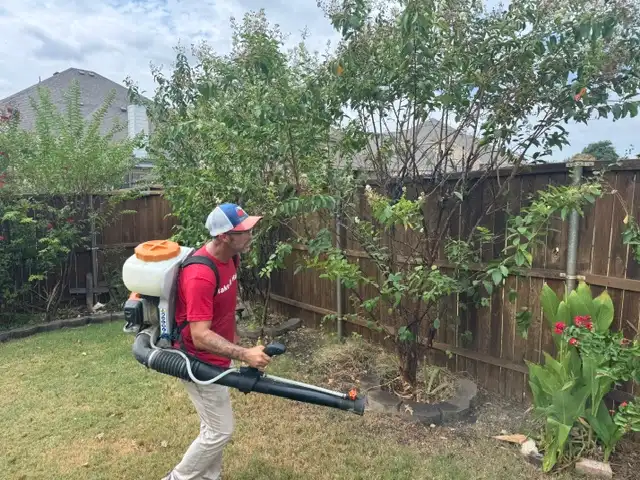
A slow lap of the property
The technician walks before treating, looking for where the shade and damp sit: the north wall, mature shrub beds against the brick, deck skirting, and the back fence where the yard meets a creek corridor or an easement. That is the map for everything that follows.
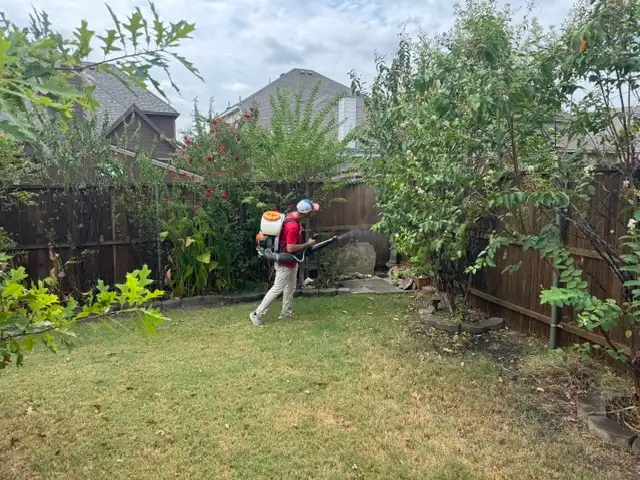
Foliage, fence lines and edges
The fog is directed up into the canopy and through hedges and ornamental beds, along with the shaded structures, while the turf and bed edges are treated for fleas and ticks. Sunlit lawn takes almost nothing, on purpose.

Finding what holds water
Bird baths, plant saucers, a wheelbarrow, old tires, a tarp over a woodpile and gutters full of leaves from seventy-year-old trees all get pointed out. Whatever cannot be emptied gets larvicide. Nobody has to be home, provided the gate is unlocked, and a text arrives when the truck is close.