NEW BUILDS, LIGHT SHADE
Mosquitoes in a town that is almost all new construction
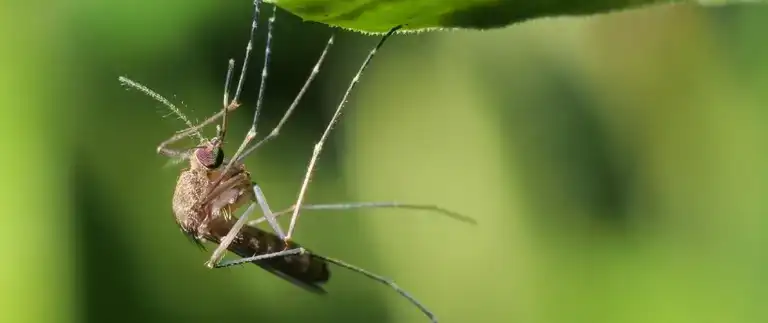
Haslet is nearly all new construction, which means fewer mosquitoes than Keller or the older Fort Worth neighborhoods, because young trees do not yet cast the shade adults need to rest in by day. What Haslet has instead is fire ants in freshly graded soil and chinch bugs in builder-laid St. Augustine, so it is worth asking which pest is actually bothering you.
Plenty of Haslet yards still need it: lots backing undeveloped land, homes with a drainage swale or retention area behind the fence, and anyone whose builder left a low spot that holds water. For those, the program runs a visit every 21 days from April through September in 76052, including the newer additions that mail as Fort Worth.
HASLET LOT PRICING
What Haslet homeowners pay per visit
New-build lots in Haslet tend to be a little larger than the older suburbs, so most fall between $59.95 and $79.95 a visit, stepping up in 5,000-square-foot lot bands. House size and neighborhood age have nothing to do with it; acreage over 47,000 square feet on the edges of town is quoted individually.
Everything is billed per visit with no contract and no startup fee, and there is no season total to hand over in April. If a hatch gets ahead of the barrier between visits, we return under the warranty at no charge, and your address returns a firm number at /instant-quote.
Lot size 7,001–12,000 sq ft
$59.95 a visit
Most Haslet subdivision lots
Lot size 12,001–17,000 sq ft
$69.95 a visit
Larger lots in the newer additions
Lot size 17,001–22,000 sq ft
$79.95 a visit
Corner lots and homes backing open ground
Lot size above 47,000 sq ft
Quoted
Acreage on the edges of Haslet
Every number on this page comes from our published price list. Haslet homes get the same table as everyone else; the instant quote reads your square footage and lot size and hands you your own line.
WHEN NOT TO BUY
Why we sometimes talk Haslet homeowners out of this
If your Haslet lot is open Bermuda with three young trees and no shade, a mosquito program may not be worth $59.95 a visit to you, and we would rather say so than take the money. The barrier works by treating resting vegetation, and with little vegetation there is little for it to do.
Where a Haslet yard does need it, the limits still apply: mosquitoes fly in from the undeveloped land behind the fence, the retention pond down the block and the neighbor who has not touched his gutters since move-in, so a treated yard sees fewer, not none. Standing water in your own yard undoes the work faster than anything.
The fog is not a monthly product and not a single-visit product either. It holds roughly 21 days at peak, so that is the cycle, with in-between retreats covered; a mosquito program in January is not something we sell.
MOSQUITOES OR FIRE ANTS
Which Haslet problem deserves the money first?
In a new Haslet subdivision, the fire ant mounds after every rain are usually the bigger threat to a family using the yard, and broadcast bait for them is included in Home Defender ($30 to $54 a month by house size) and Complete Home & Lawn Defense ($40 to $73.50). Neither plan treats mosquitoes; they handle what crawls, while Mosquito, Flea & Tick handles what flies and what the dog picks up in the grass.
The honest sequence for most Haslet homes is a year-round plan first, then mosquito control if the lot backs open ground or has real shade. A homeowner on a thin-canopy interior lot who buys the mosquito program first is often disappointed for the wrong reason: mosquitoes were never the main problem.
THE FIRST HASLET STOP
What we do on a new-build lot the first time
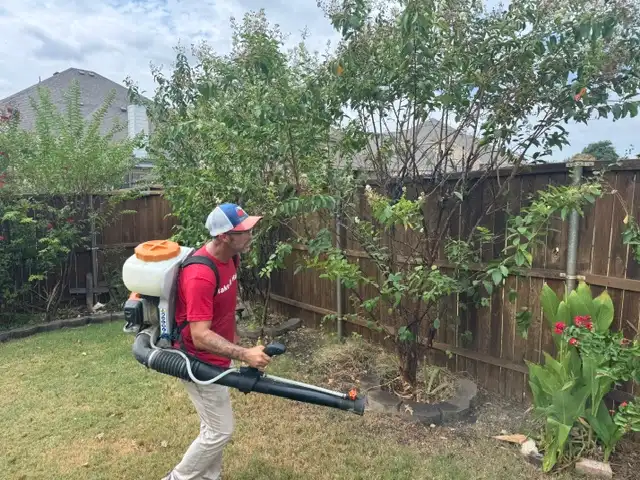
An honest look at the shade
We check how much daytime resting habitat the lot actually has: young trees, shrub beds, the shaded side of the house, fence lines and whatever sits on the far side of the property line. On some Haslet lots this ends with us suggesting a different plan.
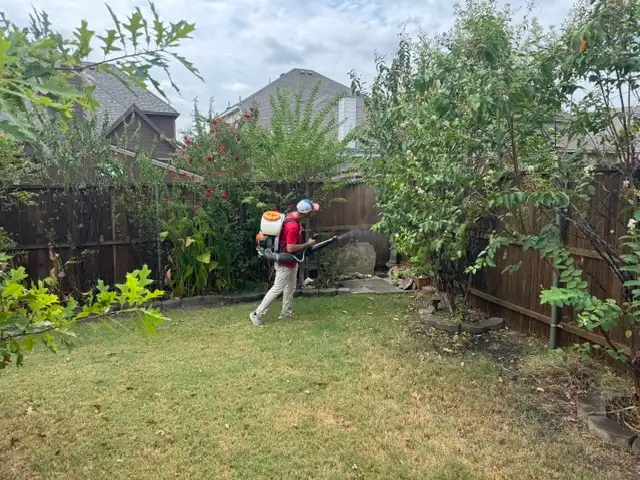
Treating the edges that matter
Where there is habitat, the backpack fogger goes through it: shrubs, hedge lines, deck skirting and the boundary with undeveloped ground. Turf and bed edges get a flea and tick pass, since new lawns full of kids and dogs are where those show up.

Builder low spots and drainage
New grading leaves low spots that hold water for days after a Haslet storm, and French drains that never fully empty. We larvicide what cannot be drained and show you what can; being home is optional.