OLD TREES, OLD LOTS
Why the mosquitoes here spend the day under the canopy
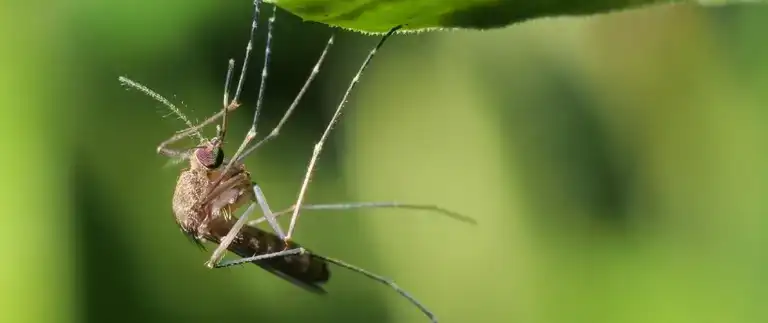
Mosquitoes in White Settlement are a shade problem before they are a water problem. These post-war streets were planted seventy years ago, and the pecans, elms and live oaks that grew up over them hold the ground damp and the air still, which is exactly the daytime resting spot an adult mosquito needs between feeds. A settled block bites harder at dusk than a bare new-build lot two towns over for that reason alone.
The Mosquito, Flea & Tick program answers it with a fog every 21 days, April through September, aimed at the underside of that canopy, the hedge lines, the fence shade and the north wall of the house. Lots on the open west side of town, out toward the undeveloped ground and Lake Worth, get the same cycle with harder attention on the boundary, since that edge feeds mosquitoes, ticks and chiggers into the yard all summer.
WHAT A 76108 LOT COSTS
The per-visit number on a White Settlement lot
Most homes here land in the bottom two bands, $49.95 or $59.95 a visit, because the older platted lots on this side of town are small. That number comes off lot square footage and nothing else: not the age of the brick, not how many trees you have, not how bad last August got.
Billing happens per visit, so nothing is prepaid and nothing holds you in. No contract, no startup fee, no charge for stopping. If mosquitoes flare up before the next scheduled fog, the return trip is part of what you already bought, and the figure for your address comes back from /instant-quote the same day.
Lots 7,000 sq ft or less
$49.95 a visit
The tight post-war blocks
Lots 7,001 to 12,000 sq ft
$59.95 a visit
Most of the wider streets
Lots 12,001 to 17,000 sq ft
$69.95 a visit
Bigger parcels toward the west edge
Over 47,000 sq ft
Quoted for the property
About an acre and up
Every number on this page comes from our published price list. White Settlement homes get the same table as everyone else; the instant quote reads your square footage and lot size and hands you your own line.
THE HONEST LIMITS
What fogging a yard here will not solve
It does not build a wall. Mosquitoes cross fences, so a treated White Settlement yard beside an untreated one still catches strays at dusk. What the barrier removes is the population resting and breeding on your own ground, and that is where the large majority of the biting comes from.
It also cannot outrun water you are still holding. A gutter with a low spot, an old wading pool, a tarp over the woodpile or a saucer under a pot will produce new adults faster than any fog kills them, and tipping those out once a week beats anything on our truck.
The residual is finite, too. Expect roughly three weeks of knockdown in peak heat and less after a hard rain, which is why the cycle runs on 21 days rather than a calendar month. If what you want is a single visit before one cookout, this is the wrong product, and we would rather time a party date inside the season than pretend otherwise.
PROGRAM VS BOTTLE VS BOX
Weighing the hardware-store route honestly
Some of the do-it-yourself advice is genuinely better than anything you can buy from us. Draining containers weekly, clearing gutters on a house with mature trees dropping into them, and cutting back the deep shrub shade against the foundation all cost nothing and all work. We say so on the phone before we quote a number.
Where a store bottle gives out is duration and reach. Hose-end product breaks down in about five days of Texas heat and never gets under the dense shrubs where the adults actually sit, while zappers and citronella do close to nothing at yard scale. Misting systems are a different animal at $2,000 to $4,000 installed plus refills, which is a great deal of money to spend on a small older lot.
THE FIRST FOG
How a first White Settlement visit runs
The shade inventory
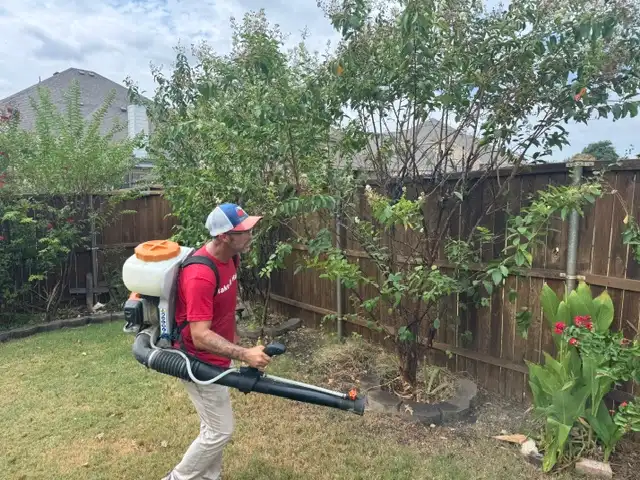
The technician walks the property before the fogger comes off his back, marking the cool damp pockets: under the old canopy, along the fence line, behind the garage, down the north wall. On these lots that shade is often a third of the property and nearly all of the mosquito habitat.
Fog first, then turf
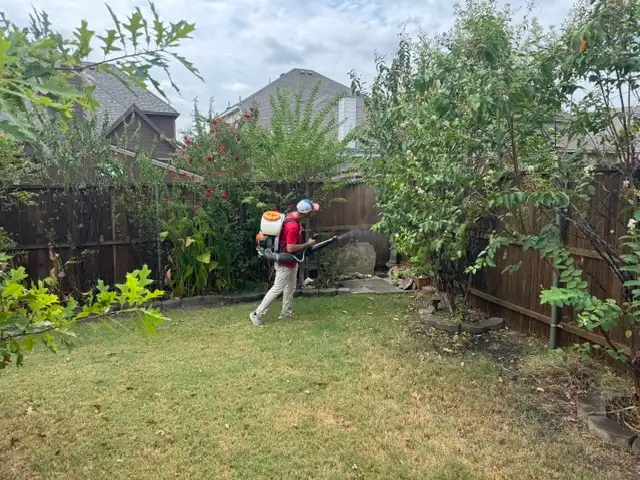
The backpack fogger goes through ornamentals, hedge lines and deck skirting rather than the open lawn, because open sun is the one place adults are not. Turf and bed edges then get the flea and tick pass, which is the ground a dog collects both from.

The water conversation
Whatever holds water and cannot be drained gets larvicide; whatever you can empty gets pointed out instead, from bird baths and kid toys to plant saucers and a sagging tarp. Yards under seventy-year-old trees almost always have the gutters on that list.